

Resources to Help You Grow
The Daily Walk 2026
The Daily Walk includes devotion and Bible readings for each day of the year and informative charts and insights that will help you understand more as you read from Genesis to Revelation in 2026.


Luke
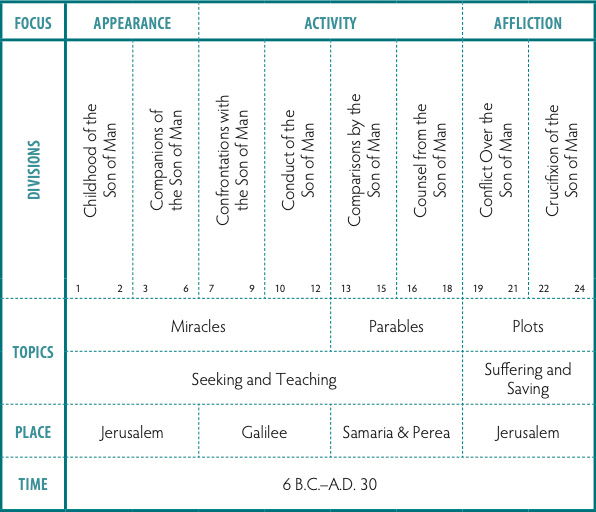
October 16
Luke 1:26-56; 2:1-20

Overview
In the first four verses of his gospel, Luke describes the process by which his inspired account was composed. Not being an eyewitness himself, he diligently researched the facts to produce an accurate account of the life and ministry of Jesus. Known to Paul as "our dear friend Luke, the doctor" (Colossians 4:14), Luke provides a more precise and complete narrative than the other three gospel writers. Even in his opening chapters, you will discern the heart of a family doctor as he recounts Mary's life, the birth of Jesus, and the boy's early years.
Your Daily Walk
Try to think of at least seven ways you are growing mentally, physically, emotionally, and spiritually. (Perhaps some unneeded desserts and long overdue exercise have caused you to grow in ways you would just as soon forget!)
Now read again in 2:40, 52 how Jesus grew. The perfect Son of God, who became a man, needed to grow just as you do.
Jesus grew physically. If you're past 18, then you probably aren't growing in stature. But are you keeping your body in good physical condition-that body which is God's very temple?
Jesus grew in wisdom. If you're using this devotional guide every day, that shows you're concerned about growing in your knowledge of God. But are you putting that knowledge to work in your service for Him?
Jesus grew in favor with God and man. Is your love for God growing? Is your circle of friends and witnessing contacts continuing to widen?
Set a goal for the week in each of those growth areas. It's never too late to increase "in wisdom and stature, and in favor with God and men" (2:52). With God's help, it's never too late to grow.
Insight - Getting Right to the Source
Matthew and Luke trace their histories back to Jesus' birth, but Luke gives a more detailed account, suggesting that much of his information may have come from Mary.
____________________
October 17/18
Luke 3:1-22; 4:1-12

Overview
From the very beginning of His ministry, Jesus demonstrates His authority over every area of creation: demons, disease, nature, human laws, and institutions. Later, this will lead to confrontations with life-and-death stakes. For now, the main effect is to attract the multitudes, arouse curiosity, and establish a basis for individuals to believe His claims. Visible miracles and physical healings let the Son of Man demonstrate His authority to forgive sins and heal lives spiritually. In anticipation of the day when others would carry on the work He began, Jesus makes a prayerful and careful selection of 12 men (called apostles) to be His close inner circle of friends.
Your Daily Walk
Tucked away in chapter 4 is an indispensable key to facing temptation successfully. Do you know what it is? "Jesus, full of the Holy Spirit, returned from the Jordan and was led by the Spirit in the desert.... Jesus returned to Galilee in the power of the Spirit" (4:1, 14).
Jesus handled temptation successfully because He never faced it alone. Every step He took was under the guidance of the Holy Spirit. He met every battle in the power of the Holy Spirit. And the result of such a Spirit-directed, Spirit-empowered lifestyle was victory over the attacks of Satan-the same kind of victory you can experience in your walk with God.
Remember that the Holy Spirit is with you wherever you go to light your path and empower you to glorify God.
Insight - Fleeting Fame with the Fickle Public
In the space of today's four chapters, you will find a remarkable change in public opinion regarding Jesus. At first: "News about him spread through the whole countryside" (4:14). But only two chapters later: "They were furious and began to discuss with one another what they might do to Jesus" (6:11). Can you account for this sudden shift in the thinking and attitudes of the masses?
____________________
October 19
Luke 7:36-50; 8:41-56

Overview
Preaching. Healing. Discipling. That in capsule form summarizes Jesus' daily activities during much of His ministry. Luke records the healings with meticulous attention to detail, as befitting a doctor. When John the Baptist sends messengers to Jesus to ask whether He is the long-awaited Messiah, Jesus points to His miracles as proof of His claims. And as He preaches and heals, Jesus patiently prepares His followers to carry on the same kind of ministry. The stakes are high; the cost of discipleship is steep, demanding nothing less than self-denial and wholehearted commitment. But the goal of saving lives makes all the pain and effort worthwhile.
Your Daily Walk
Few forces in the world today match the power of personal testimony, and yet surprisingly few Christians have learned to use its awesome power. Have you?
In chapter 8, Jesus casts the demons out of a man from the region of the Gerasenes-a man who, under demonic control, could be neither clothed nor chained. Once delivered, however, the man sits clothed and in his right mind, listening hungrily to the words of Jesus. In sheer gratitude, the man asks permission to accompany Jesus, but his request is denied. "Return home," said Jesus, "and tell how much God has done for you" (8:39). Don't preach a sermon, Jesus said. Just give personal testimony of God at work in your life. And the result? "So the man went away and told all over town how much Jesus had done for him" (v. 39).
Has God made a difference in your life? Then share that testimony with one person today. Firsthand experience with God is too precious to keep to yourself!
Insight - Would the Real Thaddaeus Please Stand Up?
Luke's list of the 12 apostles (6:14-16) agrees with the lists found in Matthew 10:2-4 and Mark 3:16-19, with one exception. Luke speaks of "Judas son of James," who is identified in the other lists as Thaddaeus.
____________________
October 20
Luke 10

Overview
As Jesus moves south into Judea, He focuses on training and commissioning His disciples. In addition to the Twelve, He now equips and sends 70 others to minister in His name. When they return, Jesus initiates a "postgraduate" program of discipleship covering such topics as prayer, hypocrisy, covetousness, anxiety, watchfulness, and His own approaching death. Along with the training of those sympathetic to the Savior, Luke also records the growing hatred of Jesus' enemies. When the Pharisees disapprove of Jesus' apparent disregard for their traditions, He responds with a series of woes against their hypocrisy.
Your Daily Walk
Read 10:38-42 and then ask yourself these questions: "Would an outside observer say my life more closely resembles that of Mary or that of Martha? Why?"
It is natural to admire the person who does so much for God. After all, anyone who can teach a children's class, sing in the choir, bake a pie for the church potluck, visit shut-ins, and still maintain one's sanity must be doing something right. Right?
A casual reading of the story of Mary and Martha may give the impression that Mary was lazy and unconcerned, while Martha was industrious and faithful. But it was Mary, not Martha, whom Jesus praised. Being with Jesus was more important than being "worried and upset about many things" (10:41).
Are you letting some good things crowd out more important things? Do you let a TV program crowd out a better book, or even the Scripture? Do you allow a clean house to keep you from pursuing a clean heart before God? Decide to do an important task today, even if you have to postpone some good ones. Take it from Mary; you won't miss a thing.
Insight - Pinpointing a Popular Parable
The much-loved parable of the Good Samaritan, written as only a doctor could describe it, is found in Luke-and nowhere else in the Gospels.
____________________
October 21
Luke 14:25-35; 15

Overview
Teaching that is plain and to the point is bound to produce some enemies, and Jesus' teaching is no exception. His sermons are seldom veiled, and His purpose is never simply to make truth comfortable or palatable. Consider these pointed statements:
"Unless you repent, you too will all perish" (13:3, 5).
"Everyone who exalts himself will be humbled" (14:11).
"Any of you who does not give up everything he has cannot be my disciple" (14:33).
But there is a tender side to His teaching as well. The Savior's love for lost sinners permeates His words. Three times in chapter 15, He illustrates the truth that there is joy in heaven over one sinner who repents.
Your Daily Walk
Passersby admiring the latest in boating equipment are confronted by an enormous, shiny new yacht with these words stenciled on the bow: "If you have to ask how much it costs, you can't afford it!" They are being admonished to count the cost.
Two army generals confront one another, with their respective troops standing toe-to-toe on the battlefield. The generals study each other's strengths and weaknesses, consult their advisors, and then meet to resolve their conflict without firing a shot. Again, they count the cost rather than engaging in a hopeless battle.
Discipleship is costly. It means rearranged priorities, inconvenience, expense, and personal sacrifice. Read 14:25-35 carefully. Then count the cost in your own personal walk with the Lord. What are you willing to give up in order to put Jesus first?
Insight - Three Parables, One Point (Chapter 15)
"The Son of Man came to seek and to save what was lost" (19:10).
____________________
October 22
Luke 16:1-17; 17:7-19

Overview
Although Luke the physician frequently mentions ministries of healing, the focus of his narrative shifts to Jesus' teaching and preaching in the final days of His life. The curriculum is varied in its scope and practical in its purpose, covering such subjects as wealth and its proper use; meekness, faithfulness, thankfulness, and watchfulness in the life of a disciple; proper priorities as illustrated in the rich young ruler (who did not have them) and in blind Bartimaeus (who did).
Your Daily Walk
Few parental tasks are as challenging as that of teaching your children to say, "Thank you." Despite your best intentions, you will soon discover that ingratitude and thanklessness come naturally. It is the rare child indeed who regularly and spontaneously says, "Thank you!" after enjoying an act of kindness.
Parents, take heart! The problem is at least as old as the Book of Luke. In 17:11-19, Jesus heals 10 lepers. But upon finding themselves cleansed, only one returns to offer thanks and worship. The brief episode ends with this haunting question: "Were not all ten cleansed? Where are the other nine?" (17:17). It's a question worth asking yourself today.
When was the last time you told your spouse, your children, your pastor, or your God "thank you" for a blessing that has recently come into your life? Make today an unscheduled "thanksgiving day" at your house. You don't need turkey and dressing to thank the ones you love.
Insight - Plenty of Priests in the Family of God
Next month you will read in Acts 6:7 that "a large number of priests became obedient to the faith." Such a "priestly revival" is doubly amazing in view of the high priest's role in masterminding Jesus' death. Why were the priests so responsive? Perhaps in part because of the numerous lepers whom Jesus healed and sent their way (Luke 17:14). In the same way, God can use your testimony of a changed life to bring others to Himself, if you'll allow Him.
___________________
October 23
Luke 19:1-27; 20:9-18

Overview
In today's section, Jesus visits Jericho-the previously destroyed and accursed city and His acceptance there is a pivotal incident in the Gospel of Luke. It provides the context for 19:10, the theme of Luke's Gospel, and an illustration in miniature of the whole course of His earthly life. As He goes on to Jerusalem, Jesus is met by the Passover crowds who hail His arrival. But even as He enters the city in triumph, Jesus' opponents are plotting His speedy and permanent exit.
Your Daily Walk
Jot down the first three names that come to mind in response to the following question: From whom would you definitely not want to receive a dinner invitation? Now examine your answers. Why did you pick those three? What made them particularly undesirable as dining partners?
Luke 19 records the story of Jesus dining at the home of an "undesirable," a man who was despised and spurned by his fellow Jews. Zacchaeus was a publican, a man who had purchased from the Romans the right to tax his own countrymen. Publicans were viewed as thieves and traitors, and with good reason. They were free to stop people at will, set up roadside "taxation booths" on a moment's notice, and assess taxes as they saw fit. Little wonder the public was dismayed when Jesus accepted Zacchaeus's dinner invitation.
Throughout His earthly ministry, Jesus associated with questionable individuals: adulterers, tax collectors, the sick and the poor. Why? That He might "seek and save what was lost" (19:10). Have you developed that habit too? Invite someone over for dinner this week-someone to whom you might not normally be attracted, but who needs a listening ear and a loving friend.
Insight - Tears for Tomorrow
The Jews rejected Jesus and chose to place their hope for deliverance in military might rather than in God. Their hopes were dashed when Rome destroyed the city in A.D. 70, an event which Jesus foretold and mourned in Luke 19:41-44.
____________________
October 24/25
Luke 24

Overview
With his typical attention to detail, Luke now provides a full account of the arrest, trial, and crucifixion of the Son of Man. In graphic word pictures, Luke describes the diabolical plot of Judas, the warm fellowship of the Last Supper, the mental anguish at Gethsemane, the tragic denial by Peter, the miscarriage of justice at the trials, and the brutal agony of the Roman execution. But the dark days in Jerusalem give way to the brilliant dawning of the resurrection morning when angels ask the perplexed followers of Jesus: "Why do you look for the living among the dead?" (24:5). Luke concludes his account with Jesus' post-resurrection appearances and His ascension back into heaven.
Your Daily Walk
Today, instead of focusing on a particular need in your life and how a principle from God's Word can help you meet that need, simply meditate upon your wonderful Savior.
Rehearse in your mind the events of that last dramatic day in Jesus' life, the day in which He prayed and was betrayed; was tried and denied; was crucified and buried. Ponder the pain He suffered for you. Relive the death He died. And rejoice with those early disciples at the glorious news: "He is not here; he has risen!" (24:6). Then close your time of worship by reading prayerfully the words of the following hymn titled "Hallelujah! What a Savior!"
Man of Sorrows! What a name for the Son of God who came, ruined sinners to reclaim.
Hallelujah! What a Savior!
Guilty, vile, and helpless we; spotless Lamb of God was He; full atonement can it be?
Hallelujah! What a Savior!
Insight - Daily Dividends from a Risen Savior (24:52-53)
Having trouble worshiping, enjoying, or praising God? The disciples didn't once they saw their risen Savior.
__________________
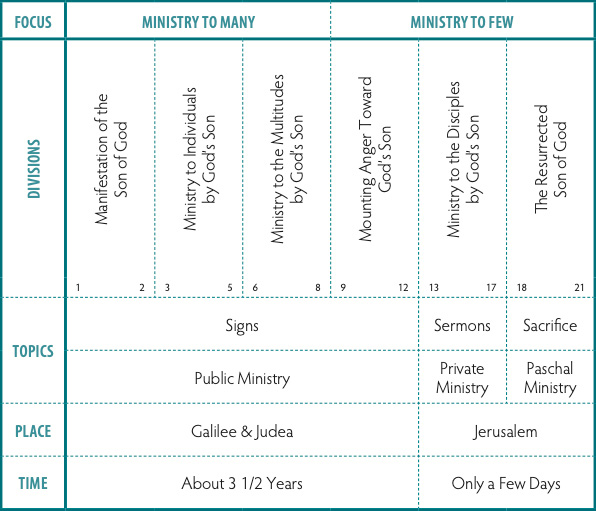
October 26
John 1:1-18; 2:13-25

Overview
The opening of John's Gospel makes clear that he offers a different perspective on the life and ministry of Jesus Christ than the other three Gospel writers. John begins with the pre-existence and deity of the Word, the One who became flesh to show God to humanity and to fulfill God's promises of a Messiah to Israel. John the Baptist proclaims Jesus' identity as the Word, directing his disciples to become Jesus' first followers. At a wedding in Cana, Jesus demonstrates His miraculous power for the first time. Later in Jerusalem, His zeal for His Father's house causes Him to overturn the status quo, an act that forces an early confrontation over His claims.
Your Daily Walk
Turn to Acts 1:13. There you will find the names of 11 of the 12 disciples of Jesus. Glance down the list and see if you can recall one significant fact about each man. (For example, Peter walked on the water, etc.) Which disciples come up "anonymous" in your mind?
Although he was one of the 12 apostles, Andrew lived his life in the shadow of his brother Peter. Outside of John's Gospel, he is mentioned only in the lists of the apostles. And yet, Andrew was distinctive in at least one way: He was constantly bringing people to Jesus. First, his brother (1:40-42), and later a little boy (6:8-9) came to the Savior because of Andrew's invitation.
"Witnessing for Christ" may sound like a scary assignment. But could you "invite" another person to meet a friend who has changed your life? This week, invite a neighbor to go to church with you on Sunday. You'll be glad you did.
Insight - A Handy Outline in a Handy Place
1:1-4 Revelation of the Son of God (Expanded in 1:19-6:71)
1:5-11 Rejection of the Son of God (Expanded in 7:1-12:50)
1:12-18 Acceptance of the Son of God (Expanded in 13:1-21:25)
____________________
October 27
John 3:1-21; 4:1-39

Overview
Today's section centers on Jesus' encounters with three individuals: Nicodemus, the Samaritan woman at the well, and the paralyzed man at the pool of Bethesda. In each instance, Jesus' dealings with the individual have a far-reaching impact on others as well. His contact with the Samaritan woman (ch. 4) leads to the evangelization of the town of Sychar. The healing of the lame man (ch. 5) produces an angry confrontation with Jews intent on killing Jesus. Jesus' night visit from Nicodemus (ch. 3) provides the context for one of the most beloved verses in all of Scripture: John 3:16, "For God so loved the world that he gave his one and only Son..."
Your Daily Walk
Have you ever used an interstate on-ramp? (If you've tried getting on the interstate at rush hour, you've probably felt like you lived on an on-ramp!) Though the on-ramp is not technically part of the interstate itself, without it the interstate would be virtually useless. On-ramps get you onto the interstate. They provide access to the highway itself.
Now think of the gospel of Jesus Christ as an interstate highway. How are you at finding "on-ramps" to share that good news with others? In each of the three chapters you will read today, Jesus uses an on-ramp to open a door of opportunity for His listener to hear and receive the gospel. Can you discover the on-ramps Jesus used? And can you suggest one you might use with a friend or co-worker today?
Insight - Tracing the Roots of the Samaritans
The Samaritans were a mixed people group, resulting from intermarriage between Jews and pagan colonists whom the Assyrians used to repopulate the northern kingdom after its dispersal in 722 B.C. Racial hatred ensued, causing the Samaritans to form their own national and religious identity, complete with their own holy mountain and sacred writings. Though Samaria was considered off-limits to devout Jews, Jesus and His disciples passed through it in order to keep a divine appointment (4:4).
____________________
October 28
John 6:1-7:8

Overview
John relates his record of Jesus' life and ministry to the major feasts of the Jews. The feeding of the 5,000 and Jesus' discourse on the true bread of life take place during the Passover (6:4). The discourses of chapters 7 and 8 are given during Jesus' visit to Jerusalem for the Festival of Tabernacles (7:2, 10). Though in both cases it is a time for feasting, clearly the temperament of the Jewish leaders is closer to murder than to merriment as they take up rocks to stone Jesus (8:59).
Your Daily Walk
Do you stand alone in your family circle as a Christian? And do you find your home environment hard on your spiritual life and growth? Then take heart. The Lord Jesus faced the same discouraging problem in His earthly family (7:5). But none of His brothers believed He was the Messiah until after His resurrection. Not only were they unbelieving, but they also made fun of His claims and ministry.
The way Jesus dealt with unbelief and sarcasm in His family will work for you too. First, do not respond to scoffing either in anger or in rebuttal. It only feeds the fires of antagonism. Second, Jesus quietly and consistently continued His ministry. Do not be intimidated by unbelieving family members. Ask God to enable you to be faithful to Him and to live a consistent, vibrant Christian life before them as a witness. Remember, you may be the only "Bible" your unsaved family will ever read. Third, Jesus drew strength and encouragement from other believers (Matthew 12:46-50). Schedule a time of prayer with one of your brothers or sisters in Christ. You need it, and so do they.
Insight - "I AM" in the Old, "I AM" in the New
In Exodus 3:14, God reveals His name to Moses as "I AM," the self-existent, all-sufficient God. The claims of Jesus in today's section (6:35, 48; 8:12) make it clear that He is identifying Himself as the same Person-a claim that the Jewish leaders understand perfectly and react to vehemently.
___________________
October 29
John 10:1-11; 11:1-12:11

Overview
Continuing His ministry in Jerusalem after the Festival of Tabernacles, Jesus first gives a blind man physical sight, then opens his spiritual eyes as well. This leads to a discussion with the Jews about "the blind leading the blind," and the importance of a Shepherd who both guides and guards His sheep. Jesus' seventh climactic miracle takes place in Bethany, where He raises Lazarus from the dead. Though Bethany is astir with wonder and belief, from this point on, Jesus is a marked man (11:53), His every step leading closer to the cross.
Your Daily Walk
Mary of Bethany is a woman every Christian should emulate. She is mentioned three separate times in the Gospels, and each time she is described as being at the feet of Jesus (Luke 10:39; John 11:32, 12:3). In this position she worshiped Him, received instruction from Him, and experienced His comfort in the midst of sorrow. In attitude, you can take the position of Mary: that of submission and dependence.
Mary also was willing to sacrifice her most costly possession in devotion to Jesus. The alabaster jar of spikenard was worth hundreds of dollars by today's standards. It may well have been her dowry in anticipation of a wedding proposal. Yet she poured it over Jesus' feet in an offering of love.
Perhaps you are wondering, "What do I have that I can give to Jesus as an act of worship?" The most precious thing you possess is yourself. If you have never done so before, assume the posture of Mary as you read Romans 12:1 and give yourself as an offering. It's an act of worship that God never grows tired of receiving.
Insight - The Doorless Door of the Sheep (10:7)
In ancient times, the sheepfold was a circular stone corral with a single narrow opening. After the sheep were inside, the shepherd would lie down across the opening, using his body to form the "door" of the sheepfold. Nothing could enter or leave without the shepherd knowing about it.
____________________
October 30
John 14, 17

Overview
Today's section, traditionally called the Upper Room Discourse, actually takes place partly in an upper room (chs. 13-14) and partly in an unspecified location (chs. 15-17; see 14:31). These verses constitute Jesus' final instructions to His disciples before His death. In them you will read of the importance of a servant's heart, the necessity of Jesus' return to heaven, and the provision of the Holy Spirit in Jesus' absence. The disciples have yet to grasp many spiritual insights, and that realization drives Jesus to His knees as He prays for His followers both present and future.
Your Daily Walk
A sermon needn't be long to be powerful. Reflect upon this thought-provoking sermon-in-a-sentence by Robert Murray McCheyne: "If I could hear Christ praying for me in the next room, I would not fear a million enemies. Yet distance makes no difference. He is praying for me."
In John 17, Jesus prayed fervently and specifically for His disciples-those He would leave behind to continue the work He began. And that means He was praying for you. Read the chapter that way. Insert your name where it belongs, beginning with verse 6: "I have revealed you to _______________ [whom] you gave me out of the world. _______________ [is] yours; you gave _______________ to me.... I am not praying for the world, but for _______________ whom you have given me, for _______________ [is] yours.... I will remain in the world no longer, but _______________ [is] still in the world.... My prayer is not that you take _______________ out of the world but that you protect _______________ from the evil one."
Insight - Mission Accomplished... Cross Yet to Come
In His prayer to God the Father, Jesus reported: "I have brought you glory on earth by completing the work you gave me to do" (17:4). Though Jesus' death was still a day away, victory was certain, since He bathed each step to the cross in prayer. You can face today with confidence too.
___________________
October 31
John 20-21

Overview
After reading the closing events of Christ's life in each of the other three Gospels, you may be tempted to skim John's account. But don't! Put yourself in the sandals of the key individuals in the narrative and feel the emotions as the crucifixion unfolds: Judas's disillusionment; Peter's denial; Pilate's concession; the crowd's frenzied screams; the rugged cross; the nail-pierced hands; the bleeding side; the hurried burial. Experience with the women the shock of finding the tomb empty. Follow Thomas's transformation from a doubting disciple to a devoted believer. Listen as Peter receives his marching orders to feed God's flock until the Shepherd returns.
Your Daily Walk
Read John 20:30-31 carefully to refresh your memory regarding John's purpose in writing. He is not merely trying to satisfy your curiosity about the historical person of Jesus or teach you all the events from Bethlehem to Calvary in chronological order. Rather, John is seeking to move you to a point of commitment. Unless Jesus Christ has invaded your life, you are lost in your sins-without God, without life, without hope of heaven.
Becoming a Christian is not simply joining a church, or signing a card, or walking an aisle, though these can certainly be valid expressions of your desire to become a Christian. Rather, true faith comes as the result of believing on Jesus Christ, God's Son, to solve your sin problem. It is trusting Him to do something for you that you cannot do yourself. Have you done that? If not, there is no better way to close your reading of the Gospels than by opening your heart to the Savior of whom those Gospels speak: Jesus Christ.
Insight - Evidence Enough for John
John records that he saw the graveclothes and headcloth lying undisturbed in Jesus' tomb with a space between them. For him this was clear and convincing evidence that Jesus' body had passed through them and that Jesus was alive. John saw and believed!
____________________
Matthew
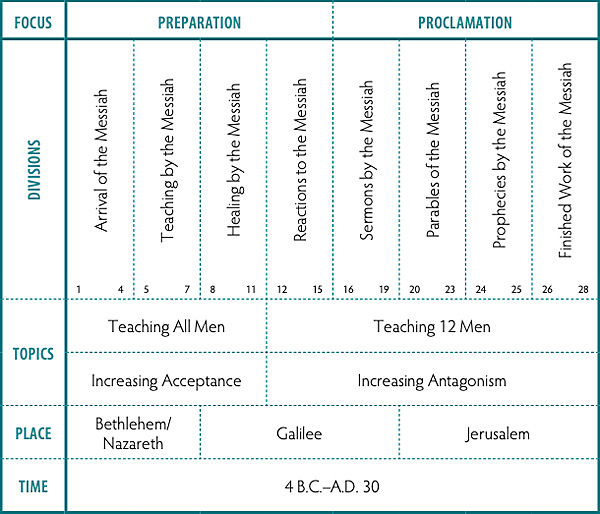
October 1
Matthew 1:18-25; 3:13-4:11

Overview
Matthew begins his Gospel with a record of Jesus Christ's genealogy. But this beginning is more than just a tabulation of names, for the word genealogy can also mean "genesis." The Old Testament Book of Genesis traces the creation of the universe and man; now Matthew shows that the advent of Jesus inaugurates a "new creation." From the call of Abraham, God has been moving to accomplish His great redemptive plan. Jesus, the prophesied Messiah, fulfills the Old Testament promises in every facet of His life: annunciation, birth, boyhood, baptism, and upbringing.
Your Daily Walk
How well do you obey divine directives? On an obedience scale of 1 to 10 (with 1 being "consistently disobedient," 10 being "consistently obedient"), how would you rate yourself?
Today's reading is full of examples of the importance of obedience. The genealogy of chapter 1 sparkles with the names of those who obeyed God in times of spiritual decadence: Abraham, Ruth, David, Hezekiah, Josiah, Joseph. Chapter 3 describes the ministry of John the Baptist as he preached a message of repentance and fruit-bearing- a message demanding uncompromising obedience. In chapter 4, Jesus was obedient to God's will and Word, rather than open to Satan's subtle temptations.
In what area of your life is God speaking to you about obedience? It is one thing to know what God wants you to do; it is something else to make obedience a commitment in your daily schedule. In the margin, write the acts of obedience performed by three different people in the genealogy (for example, Abraham obeyed God by leaving Ur). Now add your name to the list, together with an act of obedience you will undertake by faith today.
Insight - The Worldwide Impact of Messiah's Appearing
Jesus' coming held significance not just for the Jews, but for the Gentiles too. Note the four women in chapter 1, the Magi from the East, and His Gentile following in 4:25.
Jesus Christ
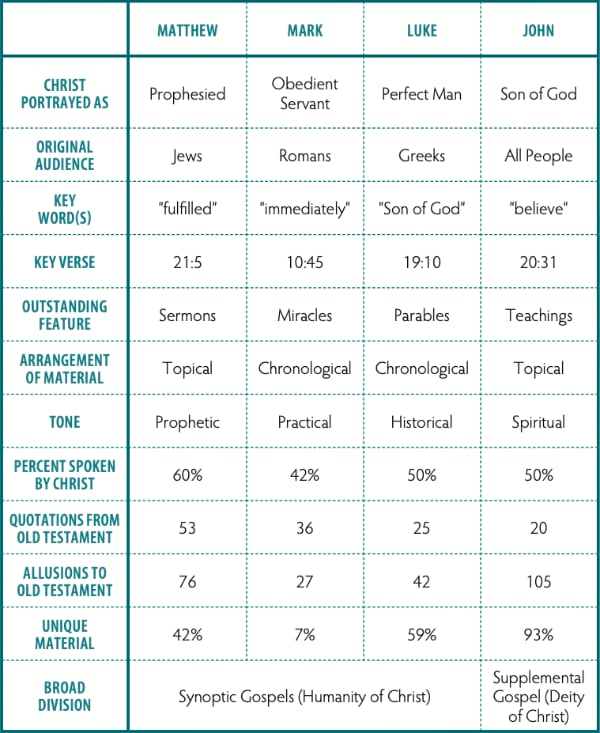
October 2
Matthew 5:1-20; 7:1-20

Overview
All candidates for public office must present a platform for their campaign. Jesus claimed to be the Messiah, the King of the Jews. Today's Scripture reading, traditionally called the Sermon on the Mount, presents His "platform"-His statement of heaven (5:3, 10). Christ's message focuses on relationship to God (not simply adherence to ritual) and inward attitude (not merely outward action). Only by building upon the sure foundation that God has provided (7:24-27) can we live a lifestyle of righteousness that exceeds that of the scribes and Pharisees (5:20).
Your Daily Walk
"Do not judge, or you too will be judged" (7:1). "By their fruit you will recognize them" (7:20). How can you put these seemingly contradictory statements together? What is the point Jesus is trying to make?
Judging (7:1) involves the attaching of motives to another person's actions. You may conclude your neighbors are thrifty or cheap, friendly or nosy, depending on the motives you ascribe to them. Snap judgments and misunderstood motives only lead to the same kind of treatment in return.
By contrast, you have a Christian responsibility to be a "fruit inspector," to evaluate your actions (and the actions of others) by the objective standards of God's inspired Word (7:20), and to adjust your behavior accordingly. Find a piece of fruit to nibble on as you read Matthew 7:1-5, 15-20. And as you do, if you find evidence of fruit that doesn't belong in your life, ask God to do some overdue pruning of your attitudes and actions.
Insight - The "Eyes" Have It
In the Bible, the eye often symbolizes moral qualities. It not only has sight, but it is also arrogant (Isaiah 5:15); full of adultery (2 Peter 2:14); and capable of pity (Deuteronomy 7:16). The good eye of Matthew 6:22 is fixed on God, while the person with bad eyes tries to view God and the world at the same time, yet sees neither with clarity.
____________________
October 3/4
Matthew 8, 10

Overview
Matthew concentrates on 10 miracles in chapters 8 and 9 that demonstrate Jesus' power over disease, the forces of nature, and the spirit world. Jesus then bestows that same power and authority on His chosen apostles and sends them out as ambassadors of the kingdom. He first instructs them how to act, then warns them of the dangers they will face, as He calls them to committed discipleship. When news of John's imprisonment reaches Jesus, He publicly honors John as God's messenger and prophet. The One to whom John pointed now invites all who are burdened with cares to find rest and refreshment in Him.
Your Daily Walk
Think back to your childhood days and recall one personality from the world of sports or entertainment that you wanted to be like. Write that name in the margin. Then below it, list some of the things you did to pattern your life after that "childhood idol" in matters of dress, actions, and speech.
Without even knowing it, you had become a "disciple" of that personality, a follower and learner of everything he or she did and said. Every TV appearance, every word, every mannerism became an object of intense interest to you because of your commitment to be like that person.
Does that help to clarify what it means to be a disciple of Jesus Christ? Look up the following verses to see what else Matthew has to say about the commitment Jesus demands of all who would follow Him and learn from Him today: 8:19-22; 10:35-38. Then complete this job description of your responsibilities as a disciple: "My role as Jesus' disciple is ________________."
Insight - The "Move" Every Christian Should Make
Matthew mentions repeatedly that Jesus had compassion for the people (see 9:36; 14:14; 15:32; 20:34). Biblical compassion is seeing someone's need and then doing something about it. It is realizing that, though you cannot do everything, you can do something-and with God's help, you will do what you can.
____________________
October 5
Matthew 12, 14

Overview
A turning point in Matthew's Gospel occurs in chapter 12. Mounting antagonism by the Jewish religious leaders erupts into open denunciation of Jesus. Attributing His miracles to the power of Satan, they demand yet another sign to substantiate Jesus' messianic claims. Because of their hardhearted rejection, Jesus begins to speak to them in parables-stories from everyday life whose deeper spiritual significance is explained only to the disciples. After a rude reception in His hometown of Nazareth, Jesus withdraws across the Sea of Galilee to the regions of Tyre and Sidon in order to escape growing opposition.
Your Daily Walk
In today's reading, Matthew 14 tells the tragic ending of the life of John the Baptist, who was beheaded because of a king's immoral conduct in the palace. John, the uncompromising declarer of God's righteousness, stood fearlessly before Herod Antipas, pointed an accusing finger at the adulterous tetrarch who had married his brother's wife, and declared, "It is not lawful [under Roman or divine law] for you to have her" (14:4). Herod was afraid of the people (14:5); his wife was infuriated; and for John's unflinching stance, the prophet of God was arrested and eventually beheaded.
All that is necessary for evil to prosper is for good men to do nothing. In our society, moral issues command front-page attention: abortion, pornography, homosexuality, and the breakdown of traditional marriage and the family. The Bible is not silent about these issues; are you?
First, do your homework in the pages of God's Word. (A concordance will help.) Then let your voice be heard for good and for God.
Insight - Matthew-A Lot of Old in the New
Many times in Matthew you will find the phrase, "to fulfill what was spoken through the prophet" or its equivalent. Can you find such statements in today's section?
___________________
October 6
Matthew 16

Overview
Matthew records many crucial incidents from Jesus' life in these four chapters. Though Jesus takes time to heal an epileptic boy, pay His temple tax, and confront the increasingly hostile Pharisees, it is clear that His primary concern is for His disciples-those He would soon leave behind to continue the work He had begun. Healings and discourses, miracles and parables-all focus on Jesus' faithful followers to prepare them for the difficult days just ahead.
Your Daily Walk
Imagine for a moment that you are Jesus of Nazareth. In one year's time your earthly life and ministry will be over. Your followers-an assortment of fishermen, politicians, and professional people-will be all you leave behind to continue the work you have begun. People like Peter (who usually needed three reminders before he learned his lesson); James and John (the hot-tempered "sons of thunder"); Thomas (the skeptic of the group).
How optimistic would you be that the task of taking the gospel to a waiting world would ever be accomplished? Yet, today you will read some of the most significant words ever uttered by our Lord: "I will build my church, and the gates of Hades will not overcome it" (16:18). Down through the centuries, in spite of persecution and dispersion, satanic attack, and human failure, the church of Jesus Christ has continued. Why? Because it is God's vehicle to take the message of life to a dying world.
Now, how optimistic are you that God will complete what He has started? God has all the resources you need to do the task He created you for. He lacks only one thing: your availability. And only you can provide that.
Insight - The Way of the Cross-Groan and Glory
Following Peter's insightful confession that Jesus is the Messiah (16:16), notice how Jesus carefully blends the two strands of suffering and glory in the sections to follow. True of His own life, they would be true of the lives of His followers as well.
____________________
October 7
Matthew 20:17-28; 21:1-17

Overview
Peter's dramatic confession of Jesus as "the Christ, the Son of the living God" (16:16) is followed by a statement with ominous overtones: "From that time on Jesus began to explain to his disciples that he must go to Jerusalem and suffer many things at the hands of the elders, chief priests and teachers of the law, and that he must be killed and on the third day be raised to life" (16:21). After preparing His disciples for the unexpected events that would soon take place, Jesus begins His final journey to Jerusalem. Arriving to a hero's welcome, He is hailed as king while making His humble entrance into the city. It is now the final week of His earthly life-a week the world will never forget.
Your Daily Walk
As you read through today's section, you'll notice the three different reactions to Jesus' words.
The disciples were inattentive. Three times He described for them what would befall Him when they arrived in Jerusalem (16:21; 17:22-23; 20:17-19). But they failed to heed His words.
The Pharisees were irritated. Being the focus of someone's sermon is never very comfortable (21:45-46), especially when the preacher calls you "blind guides," "hypocrites," and "whitewashed tombs." Rather than change their ways, they tried to silence the preacher.
The blind men were instantly obedient. They listened to Jesus, acknowledged His authority, admitted their need, and responded to His call (see 20:29-34). As a result, they received their sight.
Select a verse from today's section that you have ignored, or that you find irritatingly convicting. How would the two blind men have responded? How will you? When will you?
Insight - Truly Quotable Quotes
Today's section contains at least nine quotations from the Old Testament. All totaled, the Book of Matthew contains nearly 130 allusions and quotations from Old Testament passages-more than any other New Testament book.
____________________
October 8
Matthew 24:36-51; 25:14-30

Overview
Herod's magnificent temple captured the attention of all who passed by. Commenting on its beauty and splendor, the disciples set the stage for Jesus' Olivet Discourse, a prophetic look at future events. His followers are urged to live with watchful expectation and faithful service because, despite the signs of His coming, Jesus' return will be unannounced. His coming will bring vengeance on His enemies, judgment on the nations, and rewards for His watchful followers.
Your Daily Walk
Have you ever watched a young child at an airport, waiting for the arrival of grandparents or the return of his father from a business trip? How did that child express his eager expectation? Perhaps he stood on tiptoes... craned his neck for a better look... jostled for position among the other bystanders. Every fiber of his being shouted the message, "Someone very special is coming, and I want to be ready when he gets here!"
As Jesus-followers, we should walk on tiptoes, anticipating His return (2 Timothy 4:8). In Ephesians 5:16, we're told to make "the most of every opportunity, because the days are evil." Anticipating His return is no excuse for neglecting the physical or spiritual needs of the world around you. Your task is to be the "salt of the earth" and the "light of the world" (Matthew 5:13-14)-making others thirsty for God (salt) and then guiding them to Him (light). Think of one person in whose life you can be salt and light, to God's glory, today. Remember, a little salt goes a long way.
Insight - The Stones That Stood Alone
Jesus' prediction that "not one stone here will be left on another" of Herod's breathtaking temple (24:2) was fulfilled to the letter. In 70 A.D., Roman soldiers, in their eagerness to recover the gold that had melted between the stones of the temple during its burning, literally tore the temple apart stone by stone and threw them into the valley below, exactly as Jesus had foretold.
____________________
October 9
Matthew 27:15-28:20

Overview
The events during the final two days of Jesus' earthly life carry the shadow of the cross. Everything He says and does foreshadows that symbol of shame, sacrifice, and salvation: the anointing in Bethany, the Passover observance and Lord's Supper, the prayer in Gethsemane. Jesus is arrested and tried, first by the Jews, then by the Romans. He is condemned, executed, and placed in a tomb. But the story does not end there. In glorious triumph, Jesus comes out of the grave in resurrection power. Indeed, the King of the Jews lives again, a message of good news that His followers are commissioned to share.
Your Daily Walk
The cross of Jesus Christ has been called "the fulcrum of cosmic history." The eternal destiny of every human being hinges on a person's relationship to Jesus and His work on the cross.
As you read today's section, think deeply about Jesus' crucifixion and its significance. Can you say with Paul, "May I never boast except in the cross of our Lord Jesus Christ, through which the world has been crucified to me, and I to the world" (Galatians 6:14)?
Think of what the cross means to your neighbors, friends, family members, and co-workers. Has each one of them come to the cross in faith and received salvation, which only Jesus can provide? How can you help to lead one person to Calvary today?
It may involve a phone call, an email, an invitation to lunch, an evening get-together. Ask God for a prepared heart, an open door, and boldness as you share the life-changing message of the gospel. That's your privilege.
Insight - The Fragrance of Gratitude
In Bible lands, oil to anoint and soothe the skin was common for all levels of society. Wealthy people had expensive perfumes and ointments. The woman of Matthew 26:7 anointed Jesus with a precious perfumed oil worth almost a year's wages-a lavish gesture of love.
____________________
Mark
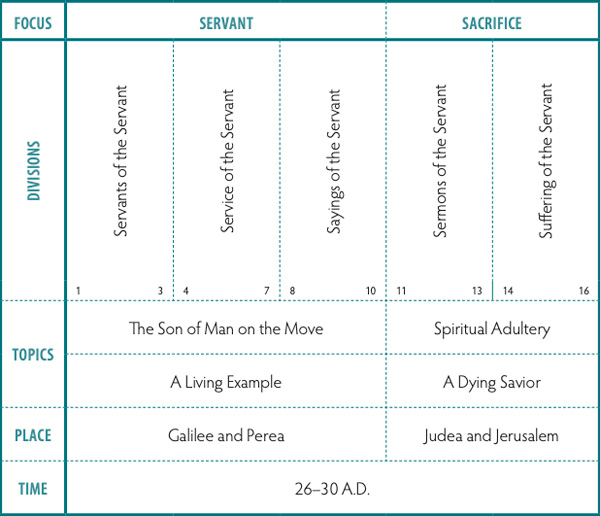
October 10/11
Mark 1:1-2:17

Overview
Mark's writing style mirrors his purpose. The narrative is crisp, vigorous, and "on-the-spot," with the economy and efficiency of a servant at work. Jesus Christ is portrayed as a Man of action, a Servant busy about His Father's business. Mark includes only brief glimpses of the events preceding Jesus' active public ministry (such as His baptism by John and temptation by Satan) before plunging into the topic that will consume nine chapters of his Gospel: Jesus' ministry in Galilee. Servants are constantly at work in people's lives, and Jesus is no different. The fever-ridden and demon-possessed, palsied and leprous all feel His healing touch. And early in His ministry, He begins to select others who will be His close companions to carry on the work of preaching, teaching, and healing after He is gone.
Your Daily Walk
If all the books ever written on the subject of discipleship were collected in one place, they would probably fill a library. And yet, it is difficult to find a satisfactory definition of just what discipleship involves.
Mark 3:13-15 provides the first installment of an answer. In chapters 1 and 2, Jesus is a living object lesson of a Servant at work: healing, comforting, teaching. Now it is time to select 12 disciples for two distinct purposes: to be with Him and to be sent out by Him (v. 14). The Master equipped them through example and instruction so they could minister like the Master.
How can you profit from Jesus' example in your own personal discipleship ministries as a parent, teacher, or friend? Take someone with you the next time you teach, preach, or counsel, so they might learn from your example.
Insight - Follow the Straight Way... Without Delay!
Mark portrays Jesus as being instantly obedient to the Father's will. Over 30 times in the book, you'll find words like "at once," "immediately," "as soon as" (all translated from the same Greek word). Isn't that what you'd expect from the Perfect Servant?
____________________
October 12
Mark 4:1-5:20

Overview
It is one thing to make a claim of greatness; it is something else to back up that claim with credentials. Through both His words (parables) and works (miracles), Jesus proclaims His true identity to His disciples and to the multitudes, confirming who He is by what He does. At first even His disciples are perplexed by His power and authority. "Who is this? Even the wind and the waves obey him!" (4:41). But Jesus patiently works with them in anticipation of the day when their faith will be sparked to believe His claims.
Your Daily Walk
What do a lead foot, creative math, and a box of paper clips have in common? They can each be the undoing of a parent's best efforts to teach a child right from wrong. Consider the following:
Scene I: It is Sunday morning. Blake has just disobeyed his mother. But since the family is late leaving for church, she saves her tirade until everyone is in the car, traveling at 70 miles per hour.
Scene II: It is income-tax time. Two sons tangle in a game of Monopoly, and one accuses the other of cheating. The father leaves his paperwork long enough to deliver his finest homily on "You shall not cheat," then returns to the absorbing task of figuring a way to make golf clubs a medical deduction.
Scene III: While at work, a father receives a phone call from the police. His daughter has been picked up for shoplifting. Would he please come immediately? Dad hangs up the phone, pausing only long enough to grab a box of paper clips that are needed at home.
Where are your actions drowning out your words? (Ask your spouse or a trusted Christian friend for help on this one.) Remember, your talk will only be as believable as your walk.
Insight - A Peek at Jesus' Family Life (6:3)
As was the custom of the day, Jesus learned the trade of His earthly father: carpentry. The Greek word for carpenter can mean a craftsman in stone or metal as well as wood.
____________________
October 13
Mark 8:22-38; 10:17-52

Overview
As opposition to Jesus' ministry increases, it is no longer safe for Him to move about openly in Galilee. In today's chapters Jesus traverses the regions of Decapolis (7:31-8:9), Caesarea Philippi (8:10-9:29), and Judea (10:1-52), thereby avoiding the crowds and the deadly plots of the religious leaders. In the concluding days of His earthly ministry, Jesus begins to prepare His disciples for the return to Jerusalem-an event that will mark the end of His life and the beginning of the disciples' roles as servants who continue the work of the Perfect Servant.
Your Daily Walk
Three-year-old Zack watched with fascination as his father filled the family car with gas. A few days later, Zack decided to do the same. Removing the gas cap, he placed the end of the garden hose in the tank and was ready to turn on the water when his horrified father grabbed the hose and scuttled the plan.
Zack's problem was a misconception about what his father was doing. Misconceptions can be humorous; often they can be harmful; occasionally they can be fatal. Jesus constantly had to deal with misconceptions people had about Him and His mission in the world. Even His closest followers seemed to miss the point with frustrating regularity. After Peter's ringing testimony, "You are the Christ" (8:29), the very next verses record his satanic misconception about Jesus' suffering and death (8:31-33). In chapter 10, after Jesus' extensive teaching about servanthood, James and John come to ask for the positions of honor in the coming kingdom (10:37).
Write down some questions you have about Jesus. Then invite your pastor or Sunday school teacher over for a meal and a time of probing God's Word together to find the answers you seek. There's no better way to avoid misconceptions.
Insight - A Quick Quiz with a Catch
Did Jesus feed 4,000 or 5,000 at one time with a handful of fish and loaves? (To find out, check Mark 6:35-44; 8:1-9.)
____________________
October 14
Mark 11

Overview
It is rare for a servant to receive the accolades of the crowd. Mark includes the Servant of God's fleeting triumph as the Passover crowds acclaim Him upon entering Jerusalem for the final week of His life. But after driving the bankers and merchants from the temple, Jesus faces growing opposition from the Jewish leaders. With murderous intent, they seek to silence the Servant once and for all. As Jesus and His disciples leave the city one evening, they rest on the Mount of Olives, where He reveals to them events related to His return in final glory.
Your Daily Walk
There is nothing quite as pathetic as a fruitless tree, unless, of course, it is a fruitless Christian, a fruitless family, a fruitless church, a fruitless nation. Fruit on a fruit tree is a sign of life, vitality, and reproduction. But take away the fruit, and you are left with a tree that is good for firewood and very little else. Why? Because it is not producing the very thing for which it was planted.
The barren fig tree that Jesus cursed has been said to represent the nation of Israel, which had all the outward trappings of religion but none of the fruit of true spirituality. Do you know a church like that? More importantly, are you like that? Is a "leafy" exterior or religious façade concealing a deep, inner lack of fruitfulness in your walk with God? If so, turn to John 15:1-8 for a divine clinic on fruit-bearing: remain, abide, obey, love. Don't allow barrenness to be the norm in your Christian life. For trees, and for believers, it's just not normal.
Insight - Figuring Out a Fig Tree
Jesus' cursing of the fig tree seems senseless until you understand the timetable for picking figs. By Passover time (late March, early April), a crop of "nob" figs appears, followed by the leaves. Thus, the presence of leaves should have indicated that fruit was already on the tree. By being leafy but fruitless, the tree became the object of Jesus' curse-and an object lesson to the disciples.
____________________
October 15
Mark 14:53-72; 15:24-39; 16:1-8

Overview
Mark does not slacken the tempo of his action-packed gospel as the sacrifice of the Servant of God approaches. In a climactic crescendo, God's plan blends with the plot of Jesus' enemies. Even the peaceful evening in Bethany and the fellowship of the Passover meal are saddened by the overtones of impending death. Betrayal, arrest, trial, denial, physical abuse, crucifixion, death-the mission of the Servant is at last accomplished. Redemption has been achieved, a fact confirmed by Christ's resurrection and ascension.
Your Daily Walk
Have you ever faced a situation where you felt you stood completely alone? Perhaps you took a stand for something you were convinced was right, but at the crucial moment when the opposition was at its strongest, you found yourself forsaken and alone. It's a terrifying feeling-perhaps a feeling you've experienced in the past or are wrestling with today.
Take courage. Your Lord and Savior went through a similar experience during His arrest, trial, and execution. It seemed His cause was lost and His enemies had won. In fact, just before He died, even His Heavenly Father turned away from Him. And yet, His victory (and ours) over sin and Satan, death and hell, was confirmed by Jesus' triumphant resurrection on Easter morning.
If you have never done so before, begin today to collect a stockpile of verses for those times when you feel alone. Verses such as Hebrews 13:5: "Never will I leave you; never will I forsake you." Or Matthew 28:20: "Surely I am with you always." Or Hebrews 4:15-16; 12:3. Begin your collection today. Keep it handy. Use it often.
Insight - The Boy Who Got Away
Who was the young man who was following Jesus at the time of His arrest? Many people believe it was Mark (read 14:51-52).
September 16
Micah 3, 5

Overview
As you read today's section, watch Micah's focus narrow from the nation (chapter 3) to the remnant (chapter 4) to the King (chapter 5). The nation's leadership is morally and spiritually bankrupt. But against such a dark backdrop, God's promises of peace shine all the more brightly. Judgment will not utterly sweep away God's people. A remnant will be spared to enjoy the blessings of peace and safety yet again. Out of an obscure town called Bethlehem would emerge a Judge and Shepherd of God's people. In that day, vengeance would fall on the disobedient nations, while a purified remnant would enjoy unparalleled privileges and blessings.
Your Daily Walk
It has been said, "Anyone who profits from his mistakes has probably written a successful autobiography." How about you? Are you profiting from your past mistakes or simply passing over them?
It is one thing to err in your ways. It is something else again to lead others intentionally down wrong paths. Micah's "declaration of discipline" upon Judah was severe, but no more severe than the error of Judah's leaders. Princes were plundering the innocent; judges were distorting justice for a fee; prophets were preaching for a profit (3:1-12). Because their responsibility was great, so too would be their reprimand as leaders of God's people.
The importance of good modeling in the Christian life is hard to overestimate. Which three Christians have helped you most by their consistent, godly model? Ask yourself: On how many other Christians' lists would my name appear if they were asked the same question? Pick one problem area (such as your temper or tongue) and make it your "Focus in Christlikeness" today.
Insight - Micah and Isaiah, Alike Yet Different
In some ways, Micah is like Isaiah in miniature. Both prophets address the same people and problems. But Micah focuses on moral and social issues, while Isaiah stresses world affairs, political concerns, and Messianic prophecies.
____________________
September 17
Micah 6

Overview
A controversy exists between God and His people, and a court convenes to resolve the issue. God Himself is the prosecuting attorney, and His people are the defendants. Heaven and earth are called together as a jury to sit in judgment on the case. The evidence is presented against the nation of Judah: half-hearted worship, empty ritual, persistent rebellion, deception, hypocrisy, corruption, greed, idolatry. The verdict is swift and decisive: Guilty as charged! And yet, though the evidence is overwhelming and the sentence must be carried out (exile in Babylon for 70 years), there is more to look forward to than endless imprisonment. A full pardon and renewed status await God's people when their days of exile are completed.
Your Daily Walk
How worthy is the God you worship?
If you were to give God all your earthly possessions as a thank offering, would He be worthy of that?
If you were to serve God every moment of your life in selfless ministry to others, would He be worthy of that?
If you were to give your body to be burned at the stake for His name, would He be worthy of that?
If you were to find a hymnal and sing every song it contained a hundred times over to the glory of God, would He be worthy of that?
To these and hundreds of imaginary situations like them, the answer is a resounding "Yes!" God is worthy of your greatest gift, your noblest act of service, your very life, for "Who is a God like You, who pardons sin and forgives the transgression...?" (7:18).
Insight - Weaving Together the Woe and the Worship
Notice how Micah skillfully weaves together the twin themes of judgment (1:2-2:11; 3:1-12; 6:1-16) and hope (2:12-13; 4:1-5:15; 7:1-20) as he prophesies woe now, but worship to follow for the nation.
____________________
September 18
Nahum 1

Overview
"To whom much is given, much is required." Nineveh had been given the privilege of knowing the one true God. Under Jonah's preaching, this great Gentile city had repented, and God had graciously stayed His judgment. But now, about 150 years later, Nahum proclaims the downfall of once-mighty Nineveh. The Assyrians had forgotten their revival and had returned to their habits of violence, idolatry, and arrogance. As a result, Babylon would destroy the city so that no trace of it would remain -a prophecy fulfilled in painful detail.
Your Daily Walk
One Nineveh, and yet really two-both pagan and idolatrous, both under God's sentence of judgment. One repented after Jonah's preaching and received a "stay of execution." The other felt Nahum's stinging condemnation. One was allowed to remain; the other was annihilated. What made the difference?
Nineveh's revival was short-lived, not because the people were insincere in their repentance, but because they failed to pass on their newfound knowledge of God to the next generation. As the years rolled along, Jonah, the "prophet from the sea," and the great God he represented were largely forgotten. Revival dwindled and died, and the old pagan practices returned.
Do you see the importance of teaching the truths of God to your children? Without that knowledge, they are likely to fail when confronted with the same kinds of crises you, in God's strength, have learned to conquer. Share with your children a spiritual truth God is teaching you. Remember, their knowledge of God will depend in part upon your faithfulness in passing on the truth.
Insight - How Missing Is Missing? (3:11)
When Nahum proclaimed to Nineveh, "You will go into hiding," he meant it. After Nineveh's destruction in 612 B.C., the site lay obliterated and undiscovered for nearly 2,500 years.
____________________
September 19/20
Habakkuk 1, 3

Overview
The Book of Habakkuk tells the story of a prophet plagued by a problem. Looking around his native Judah, Habakkuk sees violence and injustice everywhere. What he sees causes him to cry out to God with his perplexing questions: "Why are the wicked prospering in Your nation, Lord? Why are the righteous beaten down? Why don't You do something to right the wrongs of society?" God's reply is even more shocking than Judah's blighted conditions. "I am doing something, Habakkuk. I am about to use a nation even more corrupt than Judah-the Chaldeans-to cleanse My people of their wicked ways." In stunned disbelief, Habakkuk responds, "How in the name of holiness can You do that, God?" And when God patiently answers the prophet's question, Habakkuk responds in prayer and praise.
Your Daily Walk
Don't be afraid to bring your hard questions to God. But be prepared for a shock when He answers them and recognize the possibility that He may not answer them at all.
From a human point of view, God's heavenly ways don't always seem to make earthly sense. If Habakkuk had had his way, judgment would have immediately rolled through Judah like a storm. But in God's timing, the unjust conditions would continue (and worsen) before Babylon finally conquered Jerusalem. God was not asking Habakkuk to understand all the "whys" behind His timing; He simply wanted His servant to trust in His control and walk by faith.
Select a Habakkuk-like situation you are facing and list all the "why" questions you would like to ask God. At the bottom of the page, write the words of 2:4b and 3:19 as fresh expressions of your confidence in the God who has all the answers.
Insight - A Quotable Quote from Habakkuk
The last half of 2:4 is so significant that it is quoted three times in the New Testament (Romans 1:17; Galatians 3:11; Hebrews 10:38). Don't you agree it's a thought worth repeating?
____________________
September 21
Zephaniah 1

Overview
During Judah's hectic political and religious history, reform would come from time to time. Zephaniah's forceful prophecy may have been a factor in the reform that occurred during Josiah's reign-a "revival" that produced outward change but could not remove the inward heart of corruption that characterized the leadership of the nation. Zephaniah hammers home his message repeatedly that the Day of the Lord-Judgment Day-is coming when the malignancy of sin will be addressed. Israel and her Gentile neighbors will soon experience the crushing hand of God's wrath. But after the chastening process is complete, blessing will come in the person of the Messiah, who will be the cause for praise and singing.
Your Daily Walk
When it comes to responding to spiritual truth, individuals have three "temperatures": hot (responsive), cold (rebellious), and lukewarm (indifferent). God rewards the hot, reaches out to the cold, but rejects the lukewarm (Revelation 3:14-16).
The people of Jerusalem during Zephaniah's day had become lukewarm-indifferent toward the Lord (1:12). Their problem was not a lack of knowledge about God's will, but rather a lack of willingness to do what they knew to be right.
What would Zephaniah have to say about your "spiritual temperature"? Have you in your spiritual life reached a plateau, a leveling off, a point of complacency? Are you stimulated by God's Word, or stagnant toward it? Complete this sentence: "If I knew I had to face my God and Judge tomorrow and account for my life, I would spend my time today..." There's no time like the present to leave lukewarmness behind.
Insight - Hidden Meaning in a Hidden Name
Zephaniah's name, which means "the Lord hides," had great significance for his message. In the midst of a graphic description of divine judgment "in that day," Zephaniah inserts a note of hope for the righteous remnant. Read about it in 2:3.
_____________________
September 22
Haggai 1:1-14

Overview
Recently returned from exile in Babylon, the people are confronted by a heartbreaking sight. Nebuchadnezzar had made a shambles of their city, including the glorious structure that was once Solomon's temple. And so the people begin the arduous task of constructing a new temple in which God's presence can dwell. The work progresses rapidly until opposition arises. Onto the scene steps Haggai, an aged, straight-talking prophet of God who minces no words in his call to "finish what you have started." Taking his message to heart, the people build with renewed zeal.
Your Daily Walk
"If you aim at nothing, you will hit it every time." You will often accomplish what you set out to do, but you will rarely accomplish that which you never intended to do.
Every person has exactly the same number of hours in the week. Why, then, do some people accomplish so much more with those same hours than others? Priorities. Achievers decide in advance what they want to do, then tackle their goals in order of importance.
Haggai's contemporaries built a temple amid stiff opposition because it was their number-one priority. Now transfer that concept to your spiritual life. What do you want to be able to look back on when you reach the age of 30? 40? 55? 70? A deep familiarity with the Bible? A consistent prayer life? A family that is walking with God? If someone were to determine your priorities by looking at the way you spent the last 168 hours, what would they decide? And what will be your priorities as you spend the next 168?
Insight - Words that Carry Clout
Five times Haggai introduces his words with the phrase, "The word of the LORD came ..."; five times he says, "This is what the LORD Almighty says"; 15 times he says either "declares the LORD" or "says the LORD." Mark these 25 phrases in your Bible, for they give the key to the prophet's power: he was speaking not for himself but for the Lord.
_____________________
Zechariah
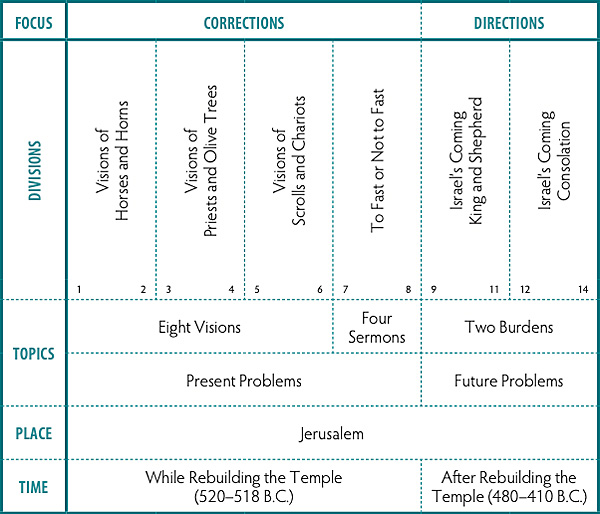
September 23
Zechariah 1

Overview
Zechariah, the longest book of the Minor Prophets, offers encouragement to the temple builders after the exile. A younger contemporary of Haggai, Zechariah delivers a similar message in a strikingly different manner. Haggai uses sermons; Zechariah uses visions. Haggai is an exhorter; Zechariah is an encourager. Haggai proclaims a strong message of rebuke; Zechariah brings a soothing message of restoration. Haggai is concerned with the present: "Take part and finish the temple!"; Zechariah is concerned with the future: "Take heart, Messiah is coming." The first six chapters of Zechariah's prophecy contain night visions describing Israel's fortunes and future both in Zechariah's day and the days to come.
Your Daily Walk
On a scale of 1 to 10 (1=hopeless, 10=excellent), how would you rate your managerial skills in the following areas?
Getting your family to help around the house
Supervising your subordinates at work
Motivating committee members to do their jobs
Encouraging members of your Sunday school class
Not all of these situations may apply to you, but this one does: challenging others to follow the Lord. Zechariah's task was to encourage his countrymen not to "throw in the trowel" in their walk with God. You can do the same.
Look for a small but sincere compliment you can pay to each person you encounter today. Watch how attitudes change as others see you seeking to build them up, rather than tear them down. After all, we are not put on this earth primarily to see through one another, but to see one another through, and encouragement helps.
Insight - Zechariah, Alias Smith and Jones
With the aid of a Bible concordance or Bible dictionary, do some "Scripture sleuthing" to see how many different people you can find in the Bible named Zechariah.
____________________
September 24
Zechariah 4

Overview
In his eight-part series, which might be titled "Visions to Revitalize a Nation," Zechariah uses an assortment of symbols and signs to portray the future of his people. Certain themes recur: the need for cleansing, the certainty of judgment, and God's sovereignty over sinful men and women. Like a candlestick in a darkened room, Israel will bear light to a darkened world, "Not by might nor by power, but by my Spirit,' says the LORD Almighty" (4:6).
Your Daily Walk
Becoming a Christian is like taking a step into the unknown and landing on a Rock. You may not fully understand many things about the Bible. You may have lots of questions about points of theology. But the most important issue you must face is simply this: Is Jesus Christ who He claimed to be? Either you will accept His claim as Messiah (as amply supported by the many specific prophecies in Zechariah), or you will reject it. But you cannot straddle the fence. What will you do with Jesus today?
Insight - The Messiah in Zechariah
Zechariah contains more specific prophecies about the coming Messiah than any other Old Testament book, except Isaiah. You may want to mark the following passages in your Bible for quick reference:
3:8 Servant (Mark 10:45)
6:13 Priest (Hebrews 6:20-7:1)
6:13; 9:9-10 King (Matthew 21:4-5)
11:12-13 Betrayed One (Matthew 27:9)
12:10 Pierced One (John 19:37)
13:1 Fountain (Revelation 1:5 KJV)
13:7 Shepherd (John 10:11)
13:7-9 God (John 1:1)
14:5, 9 Lord Over All (Revelation 11:15)
____________________
September 25
Zechariah 5

Overview
You'll notice a distinct change in emphasis in today's section. All Zechariah's visions so far have revolved around the nation of Israel: her temple, her future, her Messiah. But now the focus shifts to include "all the earth." (See how many times you can spot phrases such as "the whole land," "the earth," and "all the earth.") God's program is not limited merely to His chosen people. He is the Sovereign of all nations. The balance of Zechariah's book represents a concentrated package of messianic prophecies designed to encourage and motivate God's people to complete the task of erecting the temple.
Your Daily Walk
Often in the pages of Scripture you will find God preparing a worker for a particular task by displaying a dramatic picture of Himself. Think back over the experiences of Isaiah (Isaiah 6:1-7); Ezekiel (Ezekiel 1:1-2:1); and Moses (Exodus 3:1-8). Throughout history God has prepared the workers before He turned them loose to do the work. Armed with a fresh, clear understanding of the great God they served, His men and women then confidently went out to perform the task God had selected and equipped them for.
If you're sagging in your fervor and commitment for God's work, chances are you need to stop and refocus on His wonderful character. Before you tackle your Sunday school lesson, Bible study, sermon notes, or other ministry preparation this week, carve out some quiet moments alone with the Lord. Read long passages from His Word; talk to Him openly and honestly about your fears and frustrations; and fall in love with Him all over again.
Insight - Behold the Man...
The crowning of Joshua (6:9-14) prefigures the dual role of the coming Man "whose name is the Branch." He will be both Priest and King, and the resulting peace will spring from the union of the kingly and priestly functions in the one Person.
____________________
September 26/27
Zechariah 7

Overview
Two years after his night visions, Zechariah is commanded by God to deliver four messages to His people on the subject of fasting. The people are fasting in the fourth, fifth, seventh, and tenth months to commemorate events surrounding the siege and destruction of Jerusalem. Now that they have returned to the land and rebuilt the city, the question naturally arises, "Should we continue to observe the fasts as before?" God's reply through Zechariah is both sobering and comforting. The object of fasting is the key (7:5-7). It is more important how you live than how you fast (7:8-14). God's blessing falls on those who exercise truth and love-not empty rituals (8:1-17). True fasting can take place even during feasting (8:18-23).
Your Daily Walk
Have you ever been so captivated by the Lord's presence, so absorbed by His Word, or so engrossed in talking with Him, that you skipped a meal? Then whether you knew it or not, you were fasting!
Today's section gives God's commentary on fasting. Fasting is more an attitude than an action. You can go days without food and never be fasting if your motive is wrong (remember the hypocrites in Matthew 6:16-18?). Conversely, you can be in an attitude of true fasting even as you enjoy a banquet.
Using a good Bible concordance, take an expedition to discover what else the Bible has to say about fasting. (You'll discover that David, Hezekiah, Ezra, Nehemiah, Esther, Jesus, and many others fasted.) Notice especially the reasons why these individuals fasted. Then ask God what the role of fasting should be in your life.
Insight - Giving Credit (or Placing Blame) Where It's Due
Who was responsible for scattering the nation of Israel in judgment? According to Zechariah 7:8-14, there is a three-part answer. God initiated the judgment (7:14); God's enemies executed the judgment (7:14); but God's people are charged with the ultimate responsibility for the judgment because their sins were the underlying cause (7:11-13).
____________________
September 28
Zechariah 9

Overview
In an amazingly specific series of prophecies, Zechariah foretells Israel's immediate future. Israel's neighbors would be defeated by an invading force while Israel would be preserved to the day of her coming Messiah. He would arrive on the colt of a donkey, coming to defend His people and defeat His enemies, as He had promised. Tragically, the people would reject Him and betray Him for 30 pieces of silver. In His place, false shepherds would emerge to scatter the flock and lead His people astray.
Your Daily Walk
Does God have limitations? Is there anything God cannot do? A seminary student posed the problem to his professor as a riddle: "Can God make a rock so big that He cannot pick it up?" The teacher wisely responded, "Yes... and then He would pick it up anyway."
God is infinite, all-powerful, all-knowing, almighty. But He does have limitations-self-imposed restrictions that He has placed on His own activity. For example, He will never act contrary to His promises; He will never guide contrary to His written Word; and He will never release individuals from the consequences of (and responsibility for) their personal choices in life.
This explains why Jesus-the fulfillment of prophecy, God's only begotten Son, the Messiah-could be rejected by Israel. God would not force the nation to accept Him if they chose instead to reject Him. But though they were free to make the choice, they were powerless to escape the consequences of that choice.
Where in your life has God made His will clear to you through His Word, counsel, or prayer-and yet you are resisting it? Zechariah would be the first to tell you that saying no to God is dangerous.
Insight - Greece, a Sticky Problem for the Critics
Like Daniel (Daniel 8:21; 10:20; 11:2), Zechariah mentions a nation's rise to power long before it occurs (Greece in 9:13). And like Daniel, he faces critics' doubts for this supernatural insight.
____________________
September 29
Zechariah 12, 14

Overview
Consolation is coming for the people of God, and Zechariah closes his prophecy with a stirring portrayal of what will happen "on that day." God will destroy Jerusalem's enemies; the nation will be cleansed of idols and false prophets; hard hearts will melt; and the Lord will "be king over the whole earth" (14:9). What began as a vision of horror in chapters 1 and 2 ends as a vision of hope.
Your Daily Walk
If you had to select the three strongest men in the Bible, whom would you pick?
1.
2.
3.
Chances are, the names you listed above are examples of physical strength. Perhaps you chose men like Samson or David or Joshua-men of might, men of warfare, men of the outdoors. But did you ever stop to think that some of the strongest men in the Bible were, from a physical point of view, some of the weakest? Daniel (whose greatest claim to fame was sitting quietly in the corner of a lions' den); Jeremiah (who turned into a fountain of tears at the thought of his exiled people, yet preached with fire and faithfulness for 40 years); Timothy (who stood toe-to-toe with heretics in spite of his young age, sickly health, and timid nature).
As Zechariah looks ahead on the prophetic calendar, he predicts: "On that day... the leaders of Judah will say in their hearts, 'The people of Jerusalem are strong, because the LORD Almighty is their God '" (12:4-5). Their strength will come not from physical, material, or military superiority, but from their relationships with God. Is that true of you today? Regardless of your physical stamina or financial condition, you can be strong in the Lord. Place these words where you will see them: My strength is in the Lord Almighty. You'll be reminded of the strength that's available in limitless supply.
Insight - Jerusalem in the Forefront
In chapter 14, you will find at least 10 references to the city of Jerusalem-an important clue to the original intent of Zechariah's visions and to God's program "on that day."
___________________
September 30
Malachi 1, 4

Overview
Malachi marks the sunset of Old Testament prophecy. Malachi the prophet and Nehemiah the builder were contemporaries, and the situations that Nehemiah faced-corrupt priests, mixed marriages, neglected tithes-formed the basis for Malachi's sermons. The book follows a three-part pattern of accusation, interrogation, and refutation. For example:
Accusation: "Judah has broken faith" (2:11).
Interrogation: "You ask, 'Why?'" (2:14).
Refutation: "Because the LORD is acting as the witness between you and the wife of your youth, because you have broken faith with her" (2:14). Can you find more examples in the book?
Arrogant insensitivity shows that the nation has hit rock bottom spiritually. The people have become so sin-hardened that God's proddings no longer prick their consciences. With his intense, convicting words, Malachi ushers in 400 years of silence, which will finally be broken when John the Baptist emerges to proclaim, "Look, the Lamb of God, who takes away the sin of the world!" (John 1:29).
Your Daily Walk
It is fitting that the last word of the Old Testament should be the word curse. A curse is something to be avoided, the result of a neglected command or disobedient action. Malachi brings down the curtain on the Old Testament with a final reminder that sin must be dealt with. When the New Testament opens, the scene will be set for the only One who can cure humanity's sin sickness-Jesus the Messiah.
Close your study of Malachi with a time of prayer. If you know Christ as Savior, tell Him how much He means to you. If you don't, wouldn't now be a perfect time to put your trust in Him?
Insight - Will the Real Elijah Please Stand Up?
According to Jesus, John the Baptist fulfilled Malachi's prophecy that Elijah would come as the Messiah's forerunner (4:5; Matthew 17:11-12). Malachi also says Elijah will precede Christ's second coming (4:6).
____________________
Hosea
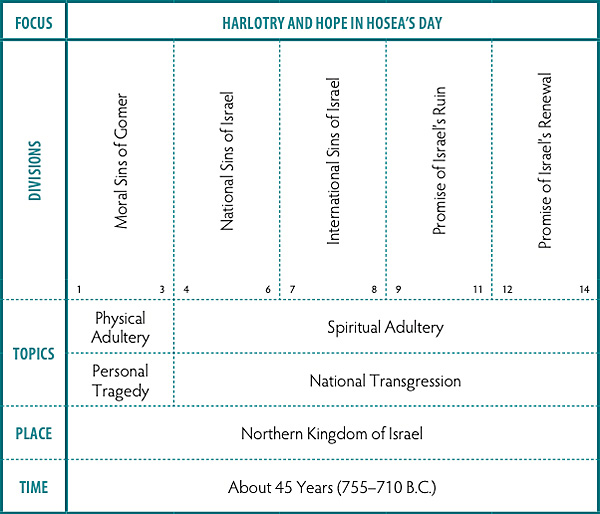
September 1
Hosea 1, 3

Overview
Hosea's family life becomes a painful but accurate picture of the problems within his nation. He marries a woman named Gomer who bears him three children appropriately named by God as signs to Israel: Jezreel, "God sows"; Lo-ruhamah, "no compassion"; and Lo-ammi, "not my people." All too soon, Hosea's home is shattered by Gomer's unfaithfulness. She leaves her prophet husband in search of other lovers and sinks to such depths that Hosea must redeem her from the slave market. Hosea's steadfast love in the face of such unfaithfulness parallels God's love for His people amid their idolatry.
Your Daily Walk
What do the following have in common: a conversation with a brick wall, a telephone call answered by a recorded voice, and a debate with a rock?
They all represent one-sided conversations. Try as you might, the brick wall, voicemail, and rock will never respond. Why? Because there is no life in them.
There is something pathetic about a one-sided relationship, the kind in which the love of one partner grows deeper with each passing day while the other fails to respond to that love. Romans 5:8 states: "God demonstrates his own love for us in this: While we were still sinners, Christ died for us." God has demonstrated His love for you; have you responded? If one-sided describes your relationship with God (as it did Hosea's love for Gomer and God's love for Israel), then today is a good day to respond. By putting your faith in the fact of Christ's love and sacrificial death, you can become a child of God right now. A love like that is just too profound to ignore (1 John 4:10).
Insight - The Prophet Who Outlived His Audience
According to 1:1, Hosea ministered during the reigns of four kings in Judah (the southern kingdom) and the last six kings of Israel (the northern kingdom), making him one of the few "Ten-King Prophets" in the Bible.
____________________
September 2
Hosea 4

Overview
Because of his own painful experiences, Hosea can identify with God's sorrow over the sinfulness of His people. Hosea's loyal love for Gomer pictures God's undying love for His people. But sin-hardened Israel refuses to respond to God's last gracious appeal. The people stand guilty and defenseless before God's accusations. Even now God would heal and redeem them, but in their arrogance and idolatry they refuse to return.
Your Daily Walk
Complete this sentence at least five different ways: "I know for certain that. . ."
Now examine the responses you gave. Is the level of your "knowledge" the same in all cases, or does it vary? Perhaps you said, "I know my name is Joe (or Joanna) Christian." That is knowledge from firsthand experience. But is that the same kind of knowledge as represented in the statement, "I know the world is round"? Or, "I know my car will start tomorrow morning"?
Death and destruction were coming upon the people of Israel. Why? Because, in God's own words: "My people are destroyed from lack of knowledge" (4:6). In a nation founded by God, built upon godly principles, and centered on the temple of God, it seems incredible to think there was no knowledge of God. But the issue was not facts about God; the issue was firsthand experience with God.
Might the shocking statement of Hosea 4:6 be true of your nation as well? Godly foundations and an abundance of churches are no guarantee of knowing God. Send a short email to an elected official today, sharing the truth of Hosea 4:6. Remember, if the knowledge of God is to permeate your country, it first must be the experience of your life.
Insight - The Tattered Ten Commandments
Chapters 4-6 show how the nation had broken each of the Ten Commandments (Exodus 20:1-17). Can you find at least one statement corresponding to each broken command?
____________________
September 3
Hosea 7

Overview
Israel's sin remains the focus of Hosea's prophecy. The nation's iniquity is like a raging fire. Her rebellion has weakened her to the point of spiritual stupor. She is beyond realizing who God is or what He has done for her. For this idolatrous, sin-riddled nation, there can be only one verdict: Exile.
Your Daily Walk
A bird lies fluttering on the ground, injured. You respond to this pitiful sight by reaching out to try and help. Instead of recognizing your intent, the bird jerks free in a frantic effort to escape. You are the only one who can help, and yet the bird refuses your assistance-perhaps at the cost of its life.
"How foolish! How wasteful!" you say. Yet, that is precisely how God's people responded to His overtures. "I long to redeem them," the Lord said, but Israel refused (7:13). Blinded by sin and devoured by wickedness, the children of Israel rejected God's gracious offers. And it grieved God's heart. Instead of compassion, He was forced to extend a hand of chastening-punishment in place of pardon, exile rather than encouragement.
Are you grieving the Lord today by your stubborn refusal to respond to His grace? Pinpoint a bad habit, an unchecked passion, or a persistent sin that is saddening your Lord. Then remember the illustration of the injured bird. The choice is up to you. Yield to God's love before you feel His hand of discipline.
Insight - Will They Never Learn? (8:5-7)
The golden calf, which nearly cost Aaron his life and resulted in the deaths of 3,000 Israelites, was later destroyed (Exodus 32). But the idea lived on during the reign of Jeroboam, the first king of the northern kingdom. He ordered similar golden calves to be erected at Dan (in the north) and Bethel (in the south). For years these calves were the focus of Israel's idolatrous worship (1 Kings 12:26-33). And perhaps it was in the very shadow of these same calves that Hosea stood as he prophesied destruction for idol and idolater alike.
The Minor Prophets
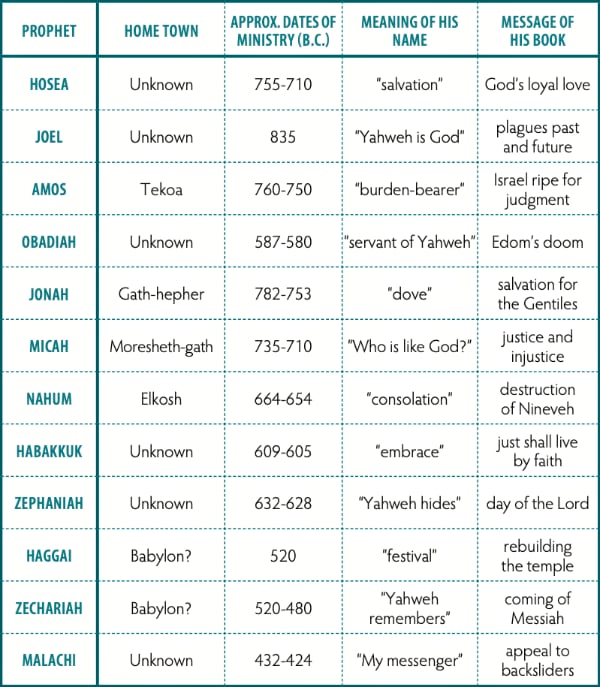
September 4
Hosea 9-11
Hosea 11

Overview
Like the pounding of a hammer, Hosea's indictment of Israel continues. Worship has no meaning for God when offered by people with idolatrous hearts. The nation has been wasted by unchecked sin. Once a fruitful vine, Israel now lies spiritually barren and fruitless. Yet God remains loyal to His people. His love will not permit Him to leave sin unpunished-just as a loving father must discipline his erring children. But in the midst of that painful process, God's promise shines brightly. Restoration and blessing await His people when the painful chastening is over.
Your Daily Walk
Contrast these two statements from today's reading: "I hated them [Israel]" (9:15); "My compassion is aroused [for Israel]" (11:8). How can we reconcile these verses? Is God contradicting Himself?
The answer lies in the ageless maxim, "God hates the sin but loves the sinner." A holy God cannot excuse or condone sin. Yet God never blurs the distinction between the sinner and his sin. His love for the sinner never ends, nor does His hatred for the sin.
How do you view people who have fallen into gross sin? Have you been so offended by their actions that you now shun them? Remember: "God demonstrates his own love for us in this: While we were still sinners, Christ died for us" (Romans 5:8). Pick someone whose lifestyle would normally cause you to avoid him or her, and prayerfully plan a way to demonstrate God's love toward that person. Ask the Holy Spirit to help the individual see in your love the extended hand of a loving God, whose compassions never cease.
Insight - Determined Declaration of Love
The concluding five verses of chapter 11 have been called "the finest presentation in the Old Testament of the tension between the love and justice of God." The final resolution of this tension is seen at the cross, where God becomes both "just and the one who justifies" (Romans 3:26).
____________________
September 5-6
Hosea 14

Overview
Hosea ends his book the same way he began by driving home his three-part theme: Israel's past is stained with disobedience and rebellion; Israel's future holds the ominous threat of calamity; and Israel's present demands a complete change of heart if that calamity is to be averted. Hosea's heart has already been broken by the harlotry and shame of his wife, Gomer. Now he pleads one last time with his countrymen that they not duplicate Gomer's folly: "Return, O Israel, to the LORD" (14:1).
Your Daily Walk
Few sentences in the English language are more difficult to say than the little two-word phrase, "I'm sorry." You've sinned; you've failed miserably. How do you tell God about it? How do you make it right with Him so you can enjoy fellowship once again?
Some call Hosea 14 the "backslider's chapter." It describes the steps necessary for God's erring people to be restored to fellowship with Him:
1. Return to the Lord (14:1). Remember, if God seems distant from you, it means you have moved.
2. Confess your sins to the Lord (14:2). Agree with Him that what you have done is wrong and needs to be forgiven.
3. Put your confidence in the Lord (14:3). Trusting your own strength or understanding can only bring disappointment. Instead, lean on the Rock that can never be moved.
Are you, like Israel in Hosea's day, estranged from your God? Restoration is only a prayer away. Read chapter 14 twice. Then do business with God. He's waiting for you, and His door is always open.
Insight - Great Truths in Tiny Capsules
Think through these fragments of thought from Hosea's pen. What great truths about God do they teach you?
"I desire mercy, not sacrifice" (6:6).
"How can I give you up?" (11:8).
"I will heal their waywardness" (14:4).
____________________
September 7
Joel 1-2

Overview
The headline in Joel's day screamed the news: "Locust Plague Strips Countryside Bare; Worst Disaster in Decades." But God uses the occasion to teach the prophet Joel-and through his pen, the nation of Judah-an important truth about the future. Though the land had been devastated by the locusts, its condition would pale by comparison with the destruction to be inflicted during the coming Day of the Lord-the time when the Lord will destroy His enemies and exalt His friends. There can be only one proper response to such warnings: obedience to God.
Your Daily Walk
You are driving down the highway when suddenly a little red light begins to flash on your dashboard. You are faced with a choice. You can either: (a) stop and take care of the problem (which will cause the red light to quit flashing), or (b) take out a hammer and smash the warning light. Which would you suggest?
Perhaps you chuckled at the second option. And yet, every day countless Christians take out mental hammers and smash the warning lights God has provided for their safety: conscience, counsel, the commands of His Word. Rather than correct the problem, they ignore the warning-and then wonder what happened when their spiritual "motor" sputters and stops.
God sent a locust plague in Joel's day to act as a warning light to the nation. Where is a warning light blinking on and off in your life? Perhaps it's a traffic ticket, a bad report card, or an ulcer. Don't ignore God's voice. In the margin, write the "lesson from the locusts" He wants you to learn today.
Insight - A Day Like No Other
Five times in Joel, the phrase "the Day of the LORD" appears, and you'll find it more than 20 additional times in the Bible. Do a treasure hunt through the following verses to discover more about this most remarkable "day": Isaiah 2:12; 13:6, 9; Ezekiel 13:5, 30:3; Amos 5:18; Zephaniah 1:7, 14; 2 Thessalonians 2:2; 2 Peter 3:10.
____________________
Amos
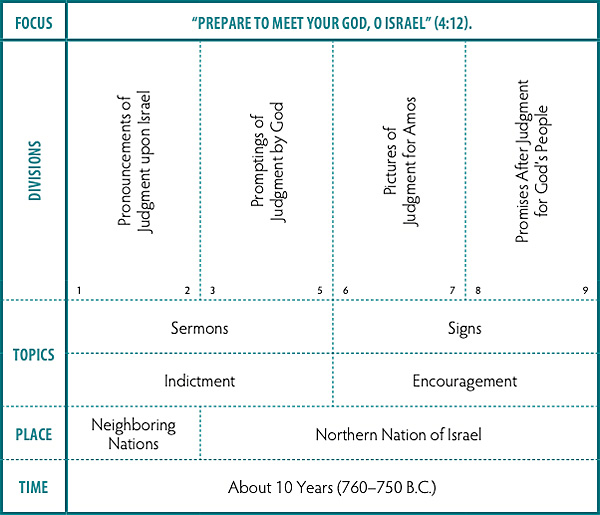
September 8
Amos 2:6-16

Overview
Amos, a herdsman and farmer from the rural regions of Judah, emerges as God's prophetic spokesman to Israel. In the midst of a period of prosperity and peace, the 10 northern tribes have become indifferent to their God. Their complacency, immorality, and idolatry will be tolerated no longer. First to Israel's neighbors, then to Israel herself, Amos forcefully delivers God's stern warning: "I will send fire..." (1:4, 7, 10, 12, 14; 2:2, 5).
Your Daily Walk
In The Chronicles of Narnia, C. S. Lewis portrays the Son of God as Aslan, a great and powerful lion. Over 2,000 years ago, the prophet Amos used the same imagery, describing God as a roaring lion ready to leap on His prey in judgment (1:2).
If you had to choose another animal to which God might be likened in today's section, perhaps it would be the elephant, the proverbial "animal that never forgets." Nation by nation, God carefully recounts the transgressions that have accumulated, showing that each nation is ripe for judgment. God never overlooks a sin.
But for His children, God has made a special provision-a gracious "lapse of memory." Both Isaiah (43:25) and Jeremiah (31:34) promise the repentant sinner that God erases from His memory all traces of past sins. Sadly, many Christians still live under the shadow of past sins that God has long ago forgiven and forgotten. If this describes you, try this exercise. Using a red pen, write out the sins from your past that God seemingly could never forget. Look at what you have written through a piece of red cellophane or red-stained glass. God sees your sins through the blood of Jesus, and then He forgets them. Forever.
Insight - Seven, the Painfully Perfect Number
Eight times in two chapters Amos uses the expression, "For three sins even for four." The total of seven is the prophet's way of signifying a complete multiplying of sin, deserving the fullness of God's wrath.
____________________
September 9
Amos 4

Overview
Amos now moves from the general to the specific in his description of Israel's injustice and God's indictment. Violence, oppression, rebellion, and drunkenness characterize the nation's lifestyle. Through famine, pestilence, drought, mildew, death, and defeat, God has patiently called the nation back to Himself: " Yet you have not returned to me,' declares the Lord" (4:11). As a result, there is but one recourse for the nation: "Prepare to meet your God, O Israel" (4:12).
Your Daily Walk
Make a list of as many activities as you can think of that regularly take place at your church. Then look up Amos 5:21-25 and draw a line through each item on your list that Amos mentions. Are you surprised at the result?
You will often hear messages preached on the love of God, but when was the last time you heard a message on "The Things God Hates"? And yet, in the space of only five verses, Amos outlines at least seven activities that God despises. The Israelites were giving offerings, holding feasts, praying prayers, and singing songs... but all were only empty religious motions. Though the people's actions were correct, their attitudes were corrupt-a condition that God found detestable.
Here's one sure way to help you avoid Israel's mistake. Take your list of religious activities and turn it into a prayer list today: "Father, may my worship be acceptable to You; may my singing in the choir bring praise to Your name; may my gifts and offerings be an expression of gratitude for all You have given to me."
Insight - Where Do You Get Your Sermons, Amos?
Amos shows a striking familiarity with the Pentateuch, the first five books of the Old Testament. For example, compare...
Amos 4:1 with Deut. 15:7-9
Amos 4:4 with Deut. 14:28; 26:12
Amos 4:5 with Leviticus 2:11; 7:13
Amos 4:6-7 with Deut. 28:23, 48
Amos 5:7, 10 with Exodus 23:6-8
Amos 5:21 with Numbers 29:35
____________________
September 10
Amos 7

Overview
Continuing his reprimand of Israel, Amos challenges those who have developed a false sense of security in their money, homes, beds of ivory, and lives of leisure. Possessions alone can never bring security. To picture this, the prophet visualizes a locust swarm, a devastating fire, and a plumb line. Though God has stayed the first two judgments, the nation has drifted far from God's righteous standards, and God's punishment can no longer be delayed.
Your Daily Walk
Thought for the day: Before you set your heart on something, look around to see how happy it has made those who have it.
If you want a quick barometer of your relationship to God, look at your attitude toward things. Do you possess them, or do they possess you? Do you find yourself content with what you have, or covetous of what others have? Do you love people and use things, or vice versa?
The Israelites enjoyed many material blessings from God. But instead of trusting the One who owned them, the people looked for security in what they owned. Because of the nation's misplaced affections, God declared He would remove both His people and their possessions.
What three material possessions do you prize above all others? Which of the three comes closest to possessing you? Thank God for the blessings He has entrusted to you. Then in an act of prayerful commitment, transfer the ownership of each one back to Him. You'll be showing by your life, as well as with your lips, that you are finding your security in Him alone.
Insight - Playing "Follow the Leaders"
Those leaders who were "complacent in Zion" (6:1) continued in their self-centered, extravagant lifestyles, totally insulated from the ruin that was overtaking their country. Amos warns that those leaders would later lead the pitiful columns of exiles going off into captivity (6:7).
Prophets
Chronologically
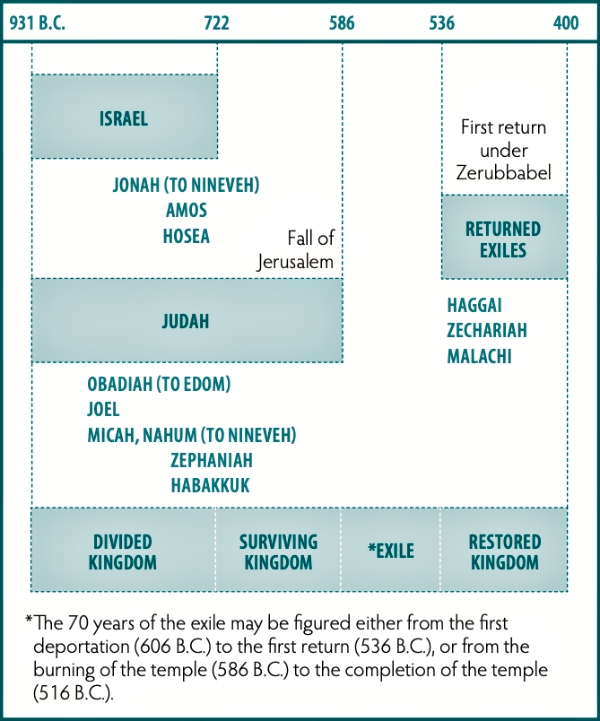
September 11
Amos 9

Overview
If a picture is worth a thousand words, then today's section provides one of Amos's most eloquent descriptions of judgment. He pictures the nation as a basket of summer fruit-fully ripened and ready for destruction. Next, the prophet shows God standing beside the altar in an ominous forecast of coming calamity upon the nation's worthless worship. Divine discipline must come, but in its wake will follow restoration and renewal. God will raise up the people again, restore them as a nation, and root them in the land.
Your Daily Walk
Perhaps you remember that Jesus said, "With God all things are possible" (Matthew 19:26). But in another sense, with God some things are impossible. After reading the last chapters of Amos, see how many ways you can complete this sentence: "It is impossible to..."
One thing you will discover in today's section is the truth that it is impossible to hide from God. Amos 9 sounds remarkably similar to Psalm 139 in its description of God's inescapable knowledge and judgment. Since today's reading is short, read Psalm 139 as well, particularly verses 7-12. Which locations does the psalmist consider and then rule out in his attempt to hide from God? (You should be able to find at least five.) And what does he conclude about the likelihood of hiding from God in the dark (v. 12)?
God's presence will either comfort you (if you are walking in obedience) or convict you (if you are walking in disobedience). Which of those two words (comfort, conviction) best characterizes your relationship with God today? If the answer disturbs you, get alone with God and take a hard look at your life. Remember, those who try to play hide-and-seek with God always lose.
Insight - The Get-Rich-Quick Scheme That Failed
Amos 6:1-7 answers the what and who of Israel's luxurious living; 8:5-6 describes the how: lax ethics and abuse of the poor. Money can buy only things that are for sale, and happiness is not one of them.
____________________
September 12/13
Obadiah 8-14

Overview
Sibling rivalry between twin brothers Jacob and Esau (Genesis 27) leads to national enmity between their respective peoples, Israel (Jacob) and Edom (Esau). In a moment of urgent need, with Israel's enemies knocking at the gates of Jerusalem, the Edomites are summoned to assist their brothers. But rather than play the role of "brother's keeper," Edom allies itself with Israel's enemies, even helping to sack the city of Jerusalem (Obadiah 10-14). Obadiah, an obscure prophet of unknown background, arrives with a word from God. Haughty with wisdom and false pride, Edom would be "destroyed forever" (v. 10). Justice would one day be served, God's people vindicated, and God recognized as Judge over all the earth.
Your Daily Walk
Medical science has yet to discover a hand or eye, kidney or lung that can "go it alone." Each organ needs the other members of the body to sustain and nourish it.
The same holds true in the body of Christ. Each member of the body (and you are one if you have put your trust in Christ as your sin-bearer) needs the other members for strength, support, encouragement, and nourishment. A divinely established sense of interdependence exists.
On a national scale, Edom refused to assume its rightful role as brother's keeper and paid a stiff penalty for its choice. What about you? Are you willing to get involved in the lives of your brothers and sisters in Christ? Call a friend facing a difficult decision or deep crisis, and make yourself available. That's what life in the body of Christ is really all about.
Insight - Epitaph on Edom's Doom
From the time of Obadiah's prophecy, Edom was continually subject to foreign powers. It lost its national identity before the time of Jesus, and in 70 A.D. Edom disappeared from the pages of history-exactly as the prophet had predicted centuries earlier.
____________________
September 14
Jonah 3-4

Overview
Running from God is not something reserved for thieves and murderers. Sometimes preachers get into the act too! Consider the story of Jonah, a prophet commissioned by God to preach an ultimatum ("Shape up or ship out!") to Israel's archenemy, Assyria. Jonah quickly goes A.W.O.L. (Absent Without Leave) and finds a ship headed in the opposite direction. Destination: Tarshish. God sends a storm, and then a hungry fish to turn Jonah around and head him back toward Nineveh. After delivering his one-sentence sermon, Jonah watches helplessly as the entire city of Nineveh-right down to the cattle-repents in sackcloth and ashes. When God spares Israel's enemies, it takes a hot wind, a shade-giving vine, and a hungry worm to teach Jonah a lesson about the mercy of God for sinful humanity.
Your Daily Walk
One of the most interesting discoveries about the Book of Jonah is that everyone obeyed God except the preacher. The storm, the dice, the sailors, the fish, the Ninevites, the east wind, the gourd, the worm-everyone and everything obeyed God's command except the one who claimed to be a follower of God.
Check up on yourself. Do your actions support or deny your claims of being a Christian? God often gives a second chance for obedience (as with Jonah), but wouldn't it be much simpler and less painful to obey Him the first time around?
Put yourself in Jonah's sandals and write a short, first-person account of how you would have reacted in one of these situations: on the ship, in the fish, in the city, or on the hillside. Can you identify the "Nineveh assignment" that God is asking you to tackle today?
Insight - A Fishy Story-Could It Happen? Did It Happen?
Could it happen? Read Baxter's Explore the Book (iv, 151-154) for two documented cases of men swallowed by sharks or whales who lived to tell about it. Did it happen? Check Matthew 12:39-40 for confirmation from an irrefutable source.
____________________
Micah
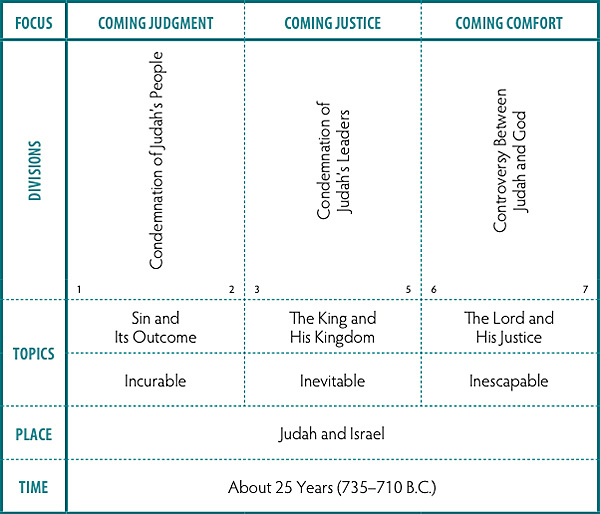
September 15
Micah 1:1-2:2

Overview
Micah begins his prophecy with a general declaration of coming calamity upon Israel (Samaria) and Judah (Jerusalem). Both kingdoms will be overthrown because of their treachery and brutality. Cities that before had known laughter and feasting would soon experience bitterness and distress at the hands of the cruel Babylonians. Corrupt leaders, scheming merchants, covetous people-all are evidence that Judah's wound is incurable. But though tears will flow freely in Judah when God's chastening hand is felt, there is hope in the Lord. Divine discipline will set the stage for God's Messiah to institute a rule of justice and peace.
Your Daily Walk
You are driving through a quiet residential neighborhood when you happen upon a house that catches your attention. The yard is three feet deep in weeds, the front porch is about to collapse, and the house hasn't seen fresh paint in years. The mailbox proclaims in letters three inches high, "The Wilsons live here."
Driving farther, you spot another house. The lawn is immaculate, the front porch is cozy and inviting, and the house sports a fresh coat of paint. The mailbox announces to the world, "The Walkers live here." Now, what are your preconceived notions about the Wilsons and the Walkers?
God's people were to be God's name-bearers to the world, demonstrating by their quality of life what the God of heaven is like. In the same way, you bear the name "Christian" in a world filled with conflicting definitions. How are you doing? Remember that the name "Christian" is not something to be borne lightly.
Insight - Roots of a Prophet
Micah's hometown of Moresheth (1:1, 14) was located about 25 miles southwest of Jerusalem on the border of Judah and Philistia. Like Amos, Micah was from the country. His occupation is unknown, but Moresheth was a productive farming area.
____________________
Ezekiel
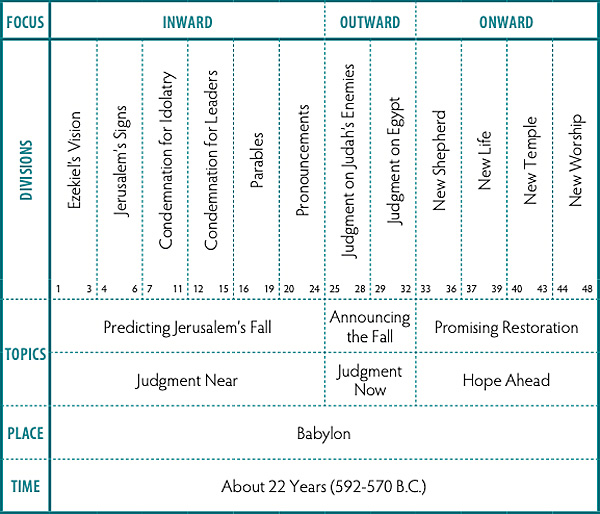
August 15/16
Ezekiel 1-2

Overview
While Jeremiah is in Judah prophesying the downfall of Jerusalem, his younger contemporary Ezekiel is in Babylon proclaiming the same message to the first group of his exiled countrymen. Unlike Jeremiah, Ezekiel bathes his harsh sermons in a soothing note of consolation. God's chastening is designed to prevent and correct apostasy in the nation, that His people might know that He is God. But before Ezekiel is ready to begin his strategic ministry, he needs a fresh glimpse of the greatness of his God. Only then is he ready to begin the task of visualizing the coming calamity for a spiritually-blind people.
Your Daily Walk
Put on a pair of dark glasses, look across the room, and describe what you see. Now remove the dark glasses and try again. Which did you find easier?
If you're going to describe to a sightless person the objects around you, then you'd better first have a clear picture of your surroundings. Otherwise, your description will be no better than your limited view. Ezekiel was given the task of describing to a band of spiritually blind Jews the Person and program of their God. But before he was qualified to do that, Ezekiel needed his own spiritual eyesight checked to gain a clear, fresh perspective of the great and glorious God he was called to represent.
How well do you know the God you represent? Look at God through Ezekiel's eyes as you read today's section, and write down each attribute of God that you find. Get a fresh glimpse of God, and you'll get a fresh motivation to serve Him.
Insight - A Call to Duty
"In the thirtieth year" (1:1) probably refers to Ezekiel's own age and, in the normal course of events, would have been the year he took up his duties as a priest in the temple. But Ezekiel's priestly call could not be denied because of deplorable conditions or because Jerusalem was hundreds of miles away. God made Ezekiel His messenger to the exiles to warn the remnant of His people.
____________________
August 17
Ezekiel 10-11

Overview
In chapters 4-6, Ezekiel sees a vision of Jerusalem's fall. In today's section, you will read another word picture as Ezekiel describes the calamity about to descend upon Jerusalem. The idolatrous population will be slaughtered, the city will be burned, God's glory will depart from the temple, and Judah's leaders will stand by helplessly. Although the outlook is bleak, the outlook is still as bright as the promises of God, for the Holy One of Israel declares: "I will give them an undivided heart and put a new spirit in them; I will remove from them their heart of stone and give them a heart of flesh" (11:19).
Your Daily Walk
Use it or lose it. "Whoever has will be given more, and he will have an abundance. Whoever does not have, even what he has will be taken from him" (Matthew 13:12).
Any way you state it, the principle remains the same: Spiritual privilege always brings spiritual responsibility. God expects you to use the spiritual blessings He has entrusted to you.
Tragically for the nation of Judah, the privilege of enjoying God's presence became a mark of national pride, but the people never took their responsibility to walk in holiness and righteousness seriously. As a result, the glory of God departed from the temple and eventually from the nation. Because the people had not fostered their relationship with God, they forfeited their fellowship with Him.
In the margin, write several spiritual privileges you enjoy today (freedom to study God's Word, to worship, etc.) and a corresponding responsibility each privilege brings. Then put into practice the lesson that Judah never learned: When it comes to your spiritual privileges, use them-don't lose them.
Insight - God's Glory-Going, Going, Gone
Notice how the removal of God's glory from the temple was gradual, moving from between the cherubim to the threshold of the temple (9:3; 10:4), then up from the midst of the city to the Mount of Olives (11:23) before disappearing completely.
____________________
August 18
Ezekiel 14-15

Overview
Like Jeremiah, Ezekiel is asked by God to illustrate his messages in some rather unusual-and highly picturesque-ways. In an attempt to capture the people's attention, Ezekiel picks up his "suitcase" and crawls through a hole in the wall to depict the coming exile of the nation of Judah. Then he lashes out at the false prophets and idolatrous elders of the land, piling up evidence upon evidence of Judah's rebelliousness. Clearly, the nation is a fruitless vine, profitable for nothing. As a result, both Judah's enemies and Judah's God have set their faces against that nation.
Your Daily Walk
Think back to the last time you spent an entire day taming the shrubbery around your house. Perhaps you found yourself pruning, gathering, and burning overgrown foliage that was long overdue for a trim. Do you remember the feeling of success when you hauled away or burned the last of those useless vines and sticks?
Now put yourself in God's place for a moment. For generations you have been working with a stubborn and rebellious nation-looking for the fruits of righteousness, but finding only useless vines. You have repeatedly sent your prophets, but their messages have fallen on deaf ears. Finally, your patience has been exhausted. It is no longer time to prune tenderly or wait patiently; it is time to pluck up and cast down the painful price of persistent fruitlessness.
What kind of vine have you been for God in the last six months? If you had to label your life, would it read "needs pruning," "needs patience," or "needs pulling down"? Remember that fruit-bearing is not just a good idea; it is the reason God has put us here.
Insight - Here a Sign, There a Sign, Everywhere a Sign
Throughout the Book of Ezekiel you will find 10 dramatic actions that Ezekiel uses to heighten the impact of his message. Today's section contains two such signs, both found in chapter 12. The others are located in chapters 4-5, 21, 24, and 37.
____________________
August 19
Ezekiel 18

Overview
Ezekiel continues to expand on the twin themes that have dominated his message: the great rebellion of God's people, and the harsh reprimand that is coming. Like an adulterous woman, the nation has played the prostitute (16:15) in her relationship with God. Her leaders have broken their covenants with Babylon and have turned to Egypt in a vain search for security. In the light of such waywardness and weakness from Judah's leaders, judgment cannot be far away.
Your Daily Walk
Which of the following have you been tempted to use as an explanation for an action in your life of which you were not proud?
a. "The devil made me do it."
b. "There was nothing else I could do."
c. "My parents used to do the same thing all the time."
d. "Everybody's doing it these days."
e. "I was wrong, and I take full responsibility."
According to chapter 18, any explanation other than "e" is contrary to what the Bible teaches. Search as you might, you will find no loophole out of personal responsibility for your actions. You cannot blame the devil, your circumstances, your parents, or your peers. God will hold you alone accountable for your choices in this life-whether good or bad, right or wrong.
When you stumble and fall because of wrong choices or actions, in which direction are you tempted to point the finger of blame? Outward (at others)? Upward (at God)? Or inward (at yourself)? Find a mirror and stand before it as you talk to God about being accountable for your actions. It will remind you that the responsibility lies not with your parents or your peers, but with you.
Insight - Justice in the Balance with Mercy
Lest you think God takes pleasure in inflicting pain on sinful people, don't overlook 18:21, 23, 32. God finds no delight in bringing retribution upon the wicked but desires repentance and restoration.
____________________
August 20
Ezekiel 21-22

Overview
Lest Judah think that God is judging her impulsively on the basis of present sins, Ezekiel retreats into the nation's past and catalogs the numerous periods of rebellion. God has been patient with the people down through the centuries, but now their cup is full, and judgment must come. As God wields the sword of judgment and prepares the smelting furnace of His wrath, it is clear that Judah is about to meet the same fate that befell her sister Israel: strong discipline for stubborn rebellion.
Your Daily Walk
Thought for the day: Parents who are afraid to put their foot down usually have children who step on their toes.
Discipline has been defined as "that painful reproof that everyone needs, but no one wants." It is the price you pay for failing to learn your lesson the first time, either as a child of your parents or as a child of your Heavenly Father. No parent enjoys disciplining a wayward child. But there is something even more painful than disciplining a child: repeatedly disciplining that child for the same offense. Why? Because discipline has only achieved its goal when it produces a change of conduct. Tears of remorse may show a contrite heart, but unless followed by acts of repentance, the discipline has failed to achieve its goal.
Where is God bringing divine discipline in your life today? What response is God looking for out of your momentarily painful experience? Ponder and complete this sentence: "Because I know that discipline, though painful, will be unprofitable until I respond correctly, today with God's help I will show that I have learned my lesson by __________________."
Insight - Parables, Old Testament Style
You are probably familiar with Jesus' parables in the Gospels. But did you know the prophet Ezekiel employs parables as well? In today's reading, you will find two parables, and in chapters 15-19, Ezekiel uses five others-a total of seven in all. See how many you can find.
____________________
August 21
Ezekiel 28

Overview
Ezekiel has spent 24 chapters describing the disobedience of God's people and the resulting discipline they are to experience. He now turns his attention to the east, west, north, and south of Judah to aim his verbal missiles of judgment at the neighboring nations. Because their sins are as abhorrent to God as those of Judah, their people will be punished in similar fashion.
Your Daily Walk
Pride has been called "the only disease known to man that makes everyone sick except the one who has it." Chapter 28 is the description of a proud king and what happened to him as a result of his pride. Before you dismiss these verses as interesting but impractical, consider this: Pride is perhaps the most slippery of temptations to cope with. You may not have a problem with pride and be proud of it, and in the process, you have just developed a pride problem.
Intelligence, beauty, money, possessions, family, position-each can represent a potential danger area. Notice the three proud steps of the king of Tyre that led to his downfall: (1) Pride began in the heart, when the king of Tyre let his beauty (or intelligence, or money, or position) become the focus of his life; (2) it moved to his head where his wisdom became corrupted; and (3) it ended in disaster as the king of Tyre was cast down from his privileged position. Three steps: conceit, corruption, and condemnation.
Knowing those three steps, map out a strategy for dealing with a possible pitfall of pride in your own life. Identify the danger area; confess any proud thoughts to God; commit your talents to God's service; and don't let Satan's subtle scheme (that tripped up the king of Tyre) become your undoing as well.
Insight - North, South, East, West-Zap, Zap, Zap, Zap!
Ezekiel follows the points of the compass as he delivers his messages of judgment upon Ammon, Moab, Edom (east), Philistia (west), Tyre (north), and Egypt (south) in chapters 25-32.
____________________
August 22/23
Ezekiel 30-31

Overview
Ezekiel's last and greatest prophecy regarding Judah's neighbors is reserved for Egypt. Unlike the other nations already mentioned, Egypt will not be utterly destroyed but will be reduced to "the lowliest of kingdoms" (29:15). Historically, though invaded and plundered by Nebuchadnezzar, Egypt has continued to exist as a nation. But to this day it has never again regained its former glory or influence in world affairs. Ezekiel's prophecies are delivered in the form of six visions that cover a period of more than 16 years.
Your Daily Walk
One of the greatest evidences for fulfilled prophecy is a present-day map of the world. If you have a map, atlas, or globe, glance at it as you read on.
Though God promised to tear His people from their homeland and punish them for their persistent disobedience, He also promised to restore them to the land. Can you find Israel on your map?
God promised to utterly destroy Israel's neighbors for their sins of pride, idolatry, and indifference to Israel's plight. Can you find the nations of Ammon, Moab, Edom, Philistia, or Tyre on your map?
The justice and mercy of God are either good news or bad news, depending on which of the two you are in line for. He promises to raise up those who are humble and repentant (mercy), and He promises to bring down those who are proud and arrogant (justice), (see 1 Peter 5:5-6). One glance at a map of the world should tell you He means what He says.
Insight - The Time to Turn Is Now
"Say to them, 'As surely as I live, declares the Sovereign LORD, I take no pleasure in the death of the wicked, but rather that they turn from their ways and live. Turn! Turn from your evil ways! Why will you die, O house of Israel?' "(Ezekiel 33:11). That question is applicable not only to the exiles, but to us as well. Since God has provided salvation through Jesus Christ, "why will you die?"
____________________
August 24
Ezekiel 36

Overview
Chapter 33 is a pivotal point in this book. Chapters 1-32 are saturated with statements of sin and punishment. But from chapter 33 until the end of the book, the prophet will fashion a catalog of comfort as he scans the prophetic horizon. Beyond judgment, God will gather and restore His people and, in the process, establish a new covenant with them. Glory will prevail when the groaning has ceased.
Your Daily Walk
Perhaps Mark Twain said it best: "Forgiveness is the fragrance that the flower leaves on the heel of the one who crushed it." When was the last time someone came to you and asked, "Will you forgive me?" Even more important, when was the last time you asked the forgiveness of someone else?
For the nation of Judah, the promise of forgiveness is woven throughout the fabric of chapter 36. Forgiveness provides a refreshing shower for the mind and spirit. It allows you to serve God freely, wholeheartedly, and unencumbered. It is like a heavy burden being lifted from your shoulders. Forgiveness provides hope for each new day-both for the giver and the receiver.
But you, like the nation of Judah, also have a role to play: confession (1 John 1:9). Is there anything in your life you've been trying to hide from God? A little sin? A big sin? A recent sin? A long-neglected sin? Maybe you've been thinking God could never forgive you and cleanse you from that secret sin. But according to His Word, nothing is beyond the reach of Christ's cleansing blood (1 John 1:7). He wants to remove the stain and guilt, and then renew a right spirit within you. Will you let Him?
Insight - Edom-A Blessing in Passing
You might wonder why the destruction of Edom (chapter 35) is included in today's passage. After all, Edom was included in the "Diary of Destruction" in chapters 25-32. The answer is that the demise of Edom is part of the future blessing of Judah, the major theme of chapters 33-36 (compare Lamentations 4:21-22).
____________________
August 25
Ezekiel 37

Overview
Two of Ezekiel's most striking prophecies make up today's section. Both the valley of dry bones (chapter 37) and the attack of Gog (chapters 38-39) reveal God's loving concern for the people of Israel. Though dead as bones, the nation would be restored to life again. And though outnumbered and seemingly defenseless, restored Israel would be supernaturally protected against Gog. All this serves to display God's incomparable glory before the watching world.
Your Daily Walk
Do you think that someone can be "too lost" to be saved?
If you find yourself with a long (and growing) list of "Hopeless Candidates for Salvation," then perhaps you need a fresh vision of God's miraculous, life-giving power. Read 37:1-14 thoughtfully. To whom did God give life? To a disbanded and dispersed people, exiled hundreds of miles from their homeland and convinced that God had given up on them. If God can raise up dead bones to make a new nation, what do you think He can do through you in the lives of others who are "dead in... transgressions and sins" (Ephesians 2:1)?
Cut out a cardboard "dry bone," write the name of an unsaved friend or loved one on it, and tape it to your bedroom mirror or car dashboard. Let it remind you that God specializes in breathing new life into lifeless bones. And pray for that person's salvation every time you are reminded.
Insight - Gog and Magog in the Pages of World History
Ezekiel 38-39 has long baffled Bible scholars. Who is Gog? Where is Magog? Is the battle Ezekiel describes past, present, or future? Revelation 20:7-10 sheds some light on the question. Your pastor, Sunday school teacher, or church librarian may be able to suggest a helpful commentary. Regardless of where and when the battle is fought, one truth remains certain: Humanity will never prevail against Israel's sovereign God.
____________________
August 26
Ezekiel 40:1-4; 43:1-5

Overview
Twenty years after beginning his ministry, Ezekiel is once again transported in a vision to Jerusalem. On his first visit, he gloomily prophesied the destruction of that rebellious city (8:1-9, 17-18). Now he joyfully goes to measure the dimensions of the rebuilt temple. Ezekiel's attention to detail underscores God's intent to carry out what He has so specifically promised. In the middle of Ezekiel's calculations, he witnesses the thrilling return of God's glory to the temple.
Your Daily Walk
What comes to mind when you hear the phrase "God's glory"? It's one of those concepts in Scripture, like love and grace, that is easy to discuss and often difficult to understand. What exactly is God's glory? As described by Ezekiel, it is a visible sign of God's presence-a brilliant, indescribable, blinding light that fills the whole temple (43:5). But is there more to it than that? Someone has well said that glory is an outward display of an inward reality. In God's case, His glory is a visible sign of His invisible attributes: power, majesty, holiness, perfection.
Where is God's glory visible today? In the lives of His children-in your life. Paul challenges his readers to reflect God's glory in their daily activities to a watching world. How? By submitting to the Holy Spirit's control and by allowing Him to transform their lives into the likeness of Jesus Christ (2 Corinthians 3:18). Are you letting your light shine so that others may see the glory of God in you (Matthew 5:16)? Pick one area of your personal life (such as study habits or use of free time) where God's glory can be made visible, and let your light shine.
Insight - Trouble with Ezekiel? Join the Club!
The closing chapters (40-48) of Ezekiel's prophecy contain many difficult passages. The rabbis of the Talmud (the official writings of Jewish interpretation and tradition concerning the Old Testament) remarked that only the prophet Elijah could fully explain the challenging terms and truths found in the Book of Ezekiel.
____________________
August 27
Ezekiel 48

Overview
Having discussed the new temple in detail, Ezekiel now turns to the new worship that will take place there. As in the past, Israel will rely heavily on the priests, Levites, sacrifices, and feasts. Strict stipulations are laid down regarding duties and privileges in the new temple. Finally, Ezekiel describes the new divisions of the land for the tribes, priests, princes, and people of Jerusalem. The book closes with a fitting statement: "The name of the city from that time on will be: THE LORD IS THERE" (48:35). At the end of this book, as in the beginning, Ezekiel's burden continues to be that the world might know the God of Israel, the Lord of glory and holiness.
Your Daily Walk
Think back over the 48 chapters of Ezekiel. Then complete these three sentences based on your impressions and observations from your study of the book:
Ezekiel was ________
God is ________
God's program for His people is ________
Now imagine that you have just died and gone to heaven. One of the first people you meet is an aged prophet named Ezekiel. (You know it is Ezekiel because he still has a yardstick in his hand.) He asks you, "What is the most important truth you discovered in my book?" What would you tell him?
Right now, thank God for the timely truths you have learned from the timeless Book of Ezekiel. Then share one lesson from Ezekiel's prophecy with two other people this weekend. It may surprise them to learn that a prophet from the past can speak to their needs today.
Insight - The Lord Is Here, There, and Everywhere
The concluding statement of Ezekiel, "THE LORD IS THERE" (48:35), becomes the recurring theme of John in the Book of Revelation. God's abiding presence becomes the chief joy of those in the new heaven and new earth (21:3-4, 7, 22-23; 22:3-5).
____________________
Daniel
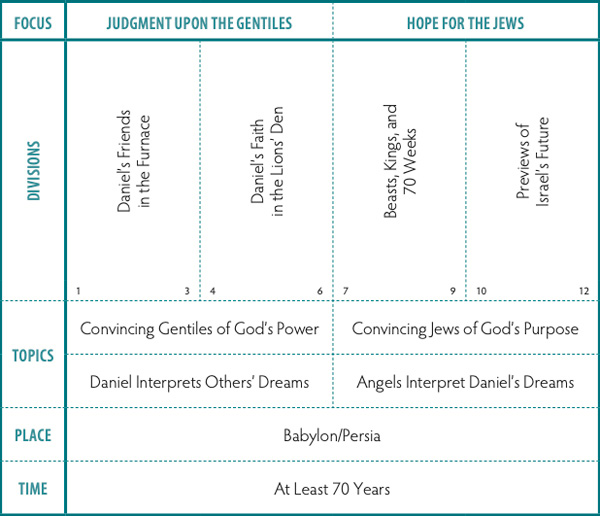
August 28
Daniel 1

Overview
Daniel lives and prophesies at the beginning of a unique period in world history-a time when Gentile nations, rather than God's chosen people, are dominant in the world. Cast away temporarily in judgment, the Jews must play the spectator as God demonstrates His power before Gentile kings and kingdoms, showing that He is sovereign over all nations, not just His chosen nation. Daniel's ministry in Babylon spans at least 70 years. During that time, he watches the reins of power pass from Babylon (Nebuchadnezzar and Belshazzar) to Media (Darius) to Persia (Cyrus), culminating in Cyrus's invitation for the Jews to return to their homeland and rebuild their city and temple. Today's section contains three familiar incidents from Daniel's life: his early days in the king's service, his interpretations of the king's dream, and his three friends in the fiery furnace.
Your Daily Walk
Three times in the book, Daniel is described as "highly esteemed." His life abounds with examples of godly behavior and outstanding character traits. As you begin your reading, start a notebook of "Godly Traits in Daniel's Life." List them day by day, and jot down ideas on how to build them into your own life.
Insight - Three Strikes and You're Out!
The books of Daniel and Ezekiel are set during the Babylonian Exile, the 70-year period of Jewish captivity and "transplanting" to Babylon following the destruction of Jerusalem. Actually, the downfall of Jerusalem came in three stages. In 605 B.C., Nebuchadnezzar overpowered the city and took back choice hostages, among them Daniel and his three friends (Daniel 1:1-6). In 597 B.C., Nebuchadnezzar returned to quell a rebellion and took 10,000 more captives, among them King Jehoiachin and the young prophet Ezekiel (Ezekiel 1:1-3; 2 Kings 24:8-20). Finally, in 586 B.C., Nebuchadnezzar besieged the city, destroyed the temple, and reduced the Jewish community to rubble (Jeremiah 52:1-11).
____________________
August 29
Daniel 6

Overview
Today's section shows the sovereignty of the God of Israel in the affairs of people and nations. Because of Nebuchadnezzar's great pride, he is "put out to pasture" to live like the cattle of the field. When his reason returns to him, he voices a testimony of praise to the One who is God of heaven and earth. His grandson Belshazzar sees the hand of God (literally!) in a different way. In the midst of a drunken feast, God's finger writes Belshazzar's death sentence on the palace wall. That very night, Darius conquers Belshazzar, and the kingdom of Babylon falls. During the reign of Darius, God displays His power to protect Daniel by shutting the lions' mouths.
Your Daily Walk
The little girl was only weeks old when she contracted an eye disease. Her parents took her to a physician, and in the process of treatment, the doctor accidentally prescribed the wrong medication. As a result, the girl became permanently blind. Yet in spite of her blindness, she composed more than 8,000 hymns during her lifetime.
Toward the end of Fanny Crosby's life, a friend asked, "Do you ever feel any bitterness toward the doctor?" She replied, "No, it may have been a mistake on the doctor's part, but not on God's part." Fanny Crosby's God was the God of Daniel-the God in perfect control of all things in heaven and earth.
Is Daniel's God your God? Do you have that same confidence in a sovereign Lord that sustained Fanny Crosby? Find a hymnal, turn to the author index, and select two or three hymns written by Fanny Crosby. Then prayerfully read some of the stanzas penned by a woman of God whose faith was unshakable. Does this testimony of praise express what is on your heart?
Insight - Not a Seal of Approval
Darius and his lords sealed the lions' pit, which was to have been Daniel's tomb, to prevent outside interference. Hundreds of years later, Pilate also sealed a tomb to prevent human interference with Jesus' body. But a mere earthly king's seal cannot stop the power of Almighty God.
____________________
August 30
Daniel 9

Overview
Today's section contains prophecies of breathtaking scope. Interestingly, much of what Daniel prophesied is explained right in the passage. Watch for keys to the interpretations of the various beasts and animals as you read through these chapters. Chapter 9 is a record of Daniel's prayer for himself and his countrymen, based on the truth he encountered while reading the prophecy of Jeremiah. In response to Daniel's prayer, God sends the angel Gabriel to give Daniel added insight into coming events.
Your Daily Walk
One night a soldier was caught creeping back to his quarters from the nearby woods. Taken before his commanding officer, the soldier was charged with communicating with the enemy. The man pleaded that he had gone into the woods to pray alone. "Then you'd better start praying now!" roared the officer. "You've never needed it so much!" Expecting certain death, the soldier knelt and poured out his soul in eloquent prayer. "You may go," said the officer when the soldier had finished. "I believe your story. If you hadn't drilled so often, you wouldn't be doing so well under fire."
How well do you pray "on the spot"? Have you learned through practice and persistence to communicate often with your Heavenly Father? Standing side by side with Daniel's confidence in God was his communication with God. The two are inseparable, for to trust God is to talk to Him, and to talk to God is to trust Him all the more.
How often have you talked to God in the last 24 hours? If the answer discourages you, try this. Tape the words "Pray Now" to the face of your watch or to your phone. Then, as often as you are reminded, talk to your Heavenly Father. You'll find your love for Him and your trust in Him growing with each passing hour.
Insight - Correlating the Creatures of Chapters 7-8
It may help you in your reading of chapters 7-8 to remember that the leopard and the goat represent Greece, while the bear and the ram represent Medo-Persia.
____________________
August 31
Daniel 12

Overview
You may find comfort in knowing even Daniel didn't understand everything that was revealed to him in his visions (12:8). (While you're at it, glance at 2 Peter 3:15-16 and notice that Peter had the same trouble with some of Paul's writings.) Don't be overly concerned about the parts of today's reading you don't understand. Instead, like Daniel, worry about the parts you do understand! In Daniel's final visions he sees a titanic struggle between kings from the south and north vying for control of "the Beautiful Land" (11:41) in a climactic "time of distress" (12:1). Though the final chapter of world history is not revealed to Daniel (12:9), the outcome is sure: purifying judgment.
Your Daily Walk
It does seem strange, but Daniel-God's great prophetic mouthpiece during the exile-probably knew less about his visions than you do.
Looking back over the course of history as it has transpired, with the great world powers all carefully documented by secular historians and archaeologists, you can match leaders and nations with parts of Daniel's visions in a way that Daniel never dreamed possible. Babylon, Medo-Persia, Greece, Rome-much of their history was foretold centuries before from the mouth of a godly government servant in Babylon.
Add to that the additional insight of the New Testament, and you have a sharper picture of the future course of this world than did any Old Testament prophet. What a responsibility to "correctly [handle] the word of truth" (2 Timothy 2:15).
Insight - Final Score: Daniel-100, Critics-0
Chapter 11 contains more than 100 specific prophecies of historical events that literally came true. It is little wonder that some critics attempt to place Daniel 200 years later in order to undermine the miraculous character of his prophecies.
____________________
Jeremiah
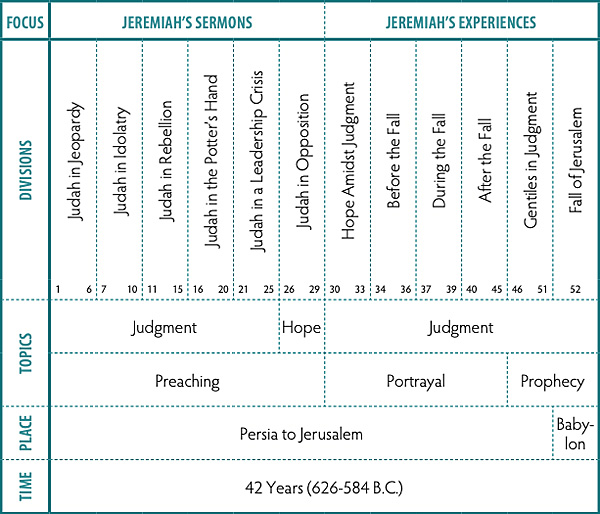
August 1/2
Jeremiah 1, 5

Overview
God has patiently sent warning after warning through His prophetic spokesmen in an attempt to turn Judah from her hard-hearted ways. Now for the last time, God sends an ultimatum through a tender man of steel, Jeremiah. With tear-filled eyes, the prophet from Anathoth tells the people exactly what they need to hear: God can bear the sins of the nation no longer. Even now, the gathering clouds of Babylonian conquest can be viewed on the horizon by those with eyes to see and a heart to repent.
Your Daily Walk
Working with people is not so difficult. All you need is inexhaustible patience, unfailing insight, unshakable stability, and a tremendous amount of experience.
God could have chosen to do His work another way, but He didn't. He chose to use people. People like Moses, Isaiah, Jeremiah, you. God asked Moses to walk boldly into Pharaoh's court and announce, "Let My people go!" Moses said, "I won't." God asked Isaiah to volunteer for an important mission. Isaiah said, "Woe is me!" God asked Jeremiah to prophesy to a rebellious nation. Jeremiah said, "I can't." Yet for each individual, God supplied a tailor-made program of training and encouragement to prepare His messenger to deliver His message.
What message is God asking you to deliver for Him today? And what is your response to His assignment? Have you answered "I can't," "I won't," or "I will"? As you begin your study of Jeremiah's life and ministry, take one of your "can'ts" or "won'ts" and turn it into a "will." In the last five minutes of your quiet time today, write a short note to God expressing your desire to be used by Him. Then watch Him work in you and through you.
Insight - Deaf Ears in the Palace
Jeremiah's ministry spanned the reigns of five kings in Judah: Josiah, Jehoahaz, Jehoiakim, Jehoiachin, and Zedekiah. All but Josiah were wicked kings who opposed or ignored the prophet's words.
____________________
August 3
Jeremiah 9-10

Overview
The malignancy of idolatry and hypocrisy has permeated every segment of Judah's national life, from the families (7:18) to the counselors (8:9), from the leaders (10:21) to the prophets and priests (8:10). Thinking that their privileged position as God's chosen people will ensure their immunity from God's wrath, they continue in a pattern of worthless worship. Because of their rebellion and indifference, their homeland will one day be reduced to a heap of ruins a thought that reduces Jeremiah to a river of tears.
Your Daily Walk
Make a list of some of the things you have reason to take pride in. Which item on your list gives you the greatest sense of satisfaction?
Do you know there is something God wants you to glory in? To "pop your buttons" in pride over? To derive an "ego boost" from every time you think about it? It isn't your bank account, your muscles, or your mind. It's your relationship with Him.
"This is what the LORD says: 'Let not the wise man boast of his wisdom or the strong man boast of his strength or the rich man boast of his riches, but let him who boasts boast about this: that he understands and knows me, that I am the LORD, who exercises kindness, justice and righteousness on earth, for in these I delight,' declares the LORD" (9:23-24).
Your personal relationship with the God of creation should be your source of greatest pride. But before you can enjoy that kind of relationship, you must first experience it through personal faith in His Son, Jesus. Turn to John 5:24 and read about the relationship that you can glory in today and every day.
Insight - Shiloh's Demise Recorded in the Digs (7:12)
Shiloh, present-day Seilun, was the place where the ark resided in the days of Joshua (Joshua 18:1; 1 Samuel 1:3). Shiloh was forsaken by God (Psalm 78:60) and destroyed by the Philistines in approximately 1050 B.C., probably after the battle of Ebenezer (1 Samuel 4:10-11).
___________________
August 4
Jeremiah 12

Overview
Through the prophet Jeremiah, God brings a stern accusation against His people: "They... have broken the covenant I made with their forefathers" (11:10). To shock the nation into realizing the seriousness of their sin, God commands Jeremiah to provide them with two object lessons: the ruined underwear and the wine jars. God's judgment will be swift and severe, involving drought, invasion, and exile. As Jeremiah laments over the fate of his nation, God promises him personal strength and protection as he carries out his prophetic ministry of doom.
Your Daily Walk
Make a list of the five people who, in your opinion, are the most popular personalities in the world today. Then ask yourself this question: How did they get where they are today? By being righteous? Serving God? Working hard? Getting big breaks? Keeping the law? Breaking the law?
Now read Jeremiah's complaint to God in 12:1-"Why does the way of the wicked prosper? Why do all the faithless live at ease?" In other words, why do the ungodly prosper while the righteous are persecuted?
Long before Jeremiah's day, Job raised the same question. So did Asaph (Psalm 73). So did Habakkuk. And God's answer to each of them was basically the same: Consider the fate of the wicked. Their lifestyles and their seeming prosperity are attractive. But in the light of their eternal destiny, are you willing to trade places?
Never forget the sure outcome of those outside of Christ. Make a list of five blessings you are experiencing as a child of God that those who do not belong to Christ know nothing about. Now thank God for the true riches you enjoy.
Insight - A Ruined Homecoming in Anathoth
Jeremiah's rude reception in his hometown is a grim reminder that "only in his hometown and in his own house is a prophet without honor" (Matthew 13:57)-the same kind of treatment that Jesus received (John 1:11).
____________________
August 5
Jeremiah 16-20
Jeremiah 16-17

Overview
Frequently, God asked His prophets to do unusual things to illustrate the message they were bringing, but that was all part of being God's mouthpiece to a wayward people. In today's section, Jeremiah is not allowed to marry or to attend funerals or feasts. Visually, Jeremiah shows the people that they, too, will lose their personal freedoms when the day of judgment finally arrives. Attempting to emphasize the coming calamity, the prophet smashes a clay pot at the feet of the leaders. But the response Jeremiah receives is discouragingly predictable. In place of the repentance he seeks, there is only rejection on the part of the people-a sure sign that judgment is near.
Your Daily Walk
Though few homemakers would enjoy the prospects of a dirt floor in their kitchen, there is one thing to be said in its favor: You don't worry about it getting dirty. However, it is equally true that no matter how much you clean it, your dirt floor will always be just as dirty as the day it was "installed."
What is true of dirt floors is equally true of the human heart. The more you "scrub" it, the worse it becomes. Jeremiah delivers the bad news: "The heart is deceitful above all things and beyond cure. Who can understand it?" (17:9).
But there is good news too. The Lord is a heart specialist (17:10). He is in the business not simply of repairing hearts, but of replacing them with new hearts that desire to know Him, love Him, and serve Him. Have you experienced a spiritual heart transplant in your life? If not, the Master Surgeon stands waiting to give you new life, hope, and a real purpose for living. Talk to Him right now. Tell Him you want to "believe in [my] heart... [and] be saved" (Romans 10:9). On the basis of His Word, that is exactly what will happen.
Insight - Now You Know... and Wish You Didn't
Today's reading contains the first recorded mention of where Judah would spend her years of exile, and who would lead the nation there. Can you find them? (Hint: Look in chapter 20.)
____________________
August 6
Jeremiah 23

Overview
Judah's downfall can ultimately be traced to the failure of her leadership-those wicked shepherds who plundered rather than protected the flock. In the midst of a dirge of doom upon the nation's false kings and prophets, Jeremiah prophesies the coming of the Messiah who will restore justice and righteousness. Exile is inevitable, but there is hope. In 70 years, the deported will return to Judah, while their captors will feel God's wrath.
Your Daily Walk
Have you ever heard someone claim that they have spoken audibly with God and have an authoritative word from Him? Or have you heard someone say, "God told me this"? With the ever-growing number of cults and "isms" today, how can you be certain who truly is speaking for God?
In Jeremiah's day, the people were plagued with false prophets who claimed to know God's mind. Though these deceivers didn't have TV, radio, or the Internet to help propagate their statements, they still managed to lull the nation into complacency.
Jeremiah's warnings concerning false prophets are timely indeed. The next time you encounter someone who claims, "God told me...," apply this twofold test: (1) Does his life match his words? (23:13); (2) Does the Bible back up his statements? (23:21-22). If not, watch out! Read and remember 1 John 4:1-6. Don't just accept what someone says, but learn to "test the spirits" in order to develop a discerning mind that won't be deceived.
Insight - No Secret About the Seventy (25:11-12)
The duration of the Babylonian Exile was a matter of public record. In fact, as the result of reading Jeremiah's prophecy of the 70 years, Daniel, in Babylon, began to pray specifically that God would restore the people to the land (Daniel 9:1-3). God knows the end from the beginning.
____________________
August 7
Jeremiah 26-27

Overview
Preachers usually hope for some kind of response after delivering their message, and Jeremiah is no exception. But in his case the audience's response is breathtaking-literally! After hearing his appeal for repentance, they rise up in unison and declare, "This man should be sentenced to death" (26:11). Arrested and tried by a murderous crowd, Jeremiah's life hangs in the balance until he is vindicated. But the message must go forth. Donning a wooden yoke, Jeremiah stresses the importance of Judah and her neighbors surrendering to (rather than revolting against) Babylon, for to do otherwise is to court certain death. Discredited by Hananiah, a prophet of false hope, Jeremiah pens a letter to the recent deportees urging them to settle down in Babylon.
Your Daily Walk
"I have learned to be content whatever the circumstances" (Philippians 4:11). Do you recognize those words? They aren't the declaration of the plaster saint, or the meaningless small talk of feather-bedded royalty. Rather, they are the carefully reasoned statement of Paul-a man who had been beaten, stoned, shipwrecked, imperiled, and impoverished. Yet, he had learned the secret of being content, regardless of the circumstances.
Jeremiah was much like Paul. On trial for his life, slandered by a fellow prophet, faced with a howling mob demanding his blood, Jeremiah calmly went about delivering his God-given message of judgment and doom. He lived above his circumstances, not under them, in his walk with God.
Write the following words on a slip of paper, carry them with you today, and read them often: "Sometimes the Lord calms the storm; more often He lets the storm rage and calms the child." Now relax in the Lord.
Insight - The Babylonian Exile-Slavery or Something Else?
The Hebrew exiles in Babylon were not slaves but deportees who were free to live as they pleased (29:4-9). Some became wealthy merchants, and others attained high places in court.
____________________
August 8/9
Jeremiah 32

Overview
It's always darkest just before the dawn, and Jeremiah's prophecy is no exception. The opening lines of chapter 30 paint the bleakest picture yet of Israel's coming calamity. The pinnacle of the nation's age-long sufferings will be a unique period of tribulation called "a time of trouble for Jacob" (30:7). But the bleakness of judgment will give way to the glory of restoration and blessing. The people will be replanted in their homeland (31:4-6); their mourning will be turned to joy (31:12); and God will make a new covenant with them (31:31-34). As a sign of his confidence in the promises of God, Jeremiah buys a field-knowing full well it would soon fall into Babylonian hands.
Your Daily Walk
Are you building a life on God's promises, or merely building a file full of them? Are you taking them to heart, or just reading over them?
There are more than 7,000 promises buried in the Bible, most of which are targeted for you. But once you find a promise, don't just write it down, memorize it, or file it away. Act on it. Rest in it. Let it change your life.
Jeremiah received a promise from God. His nation, though faced with the prospect of being swept away by a Babylonian tidal wave, would not be annihilated. God would bring them back. So Jeremiah bought real estate at a rock-bottom price, as if to declare to his nation, "I'm standing on the promises of God! He will restore us!"
Pick a promise from God that you may have read, filed away, and maybe even memorized-but never claimed. Now act on it!
Insight - A Mother's Tears
Rachel, the mother of Joseph and Benjamin, is pictured weeping for her sons and for the attempt to destroy the promised lineage. Many years later, other women of Ramah wept as Herod slaughtered their children in an attempt to kill the promised Messiah (Matthew 2:17-18), a fulfillment of Jeremiah's prophecy (31:15).
Three Prophets
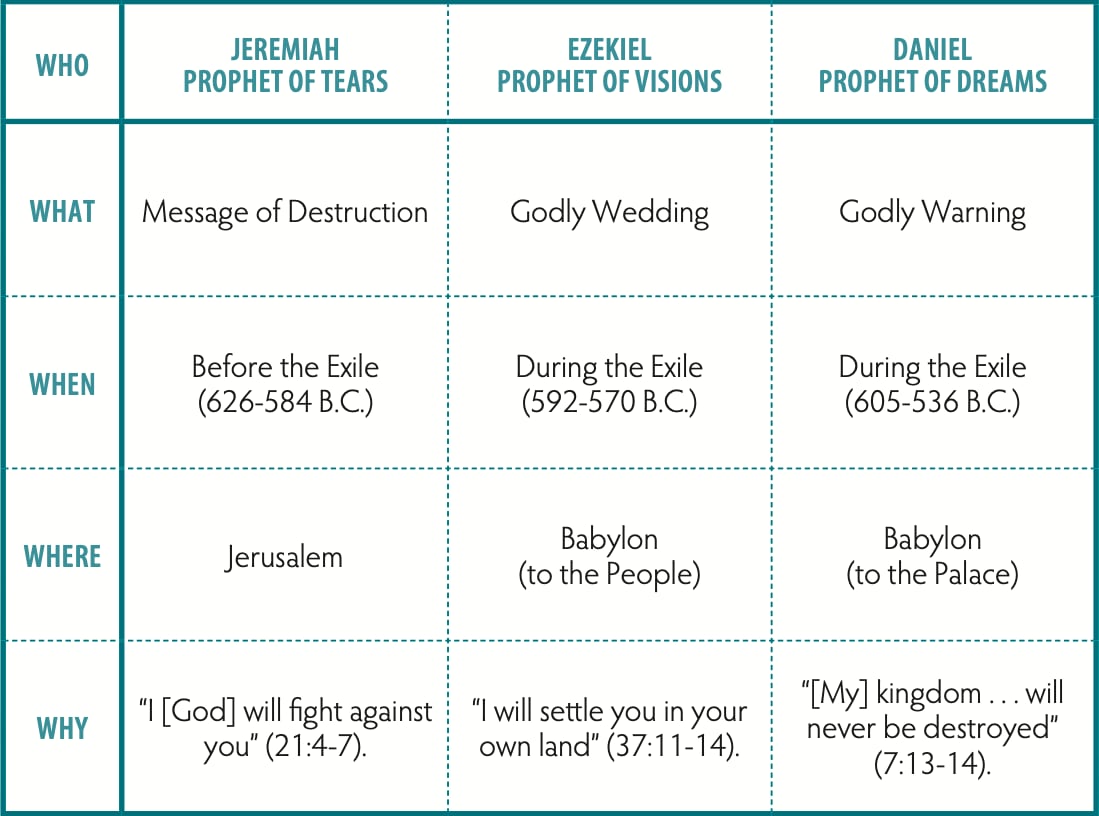
August 10
Jeremiah 36

Overview
With the close of chapter 33, Jeremiah completes the written account of his preaching ministry to the rebellious nation. Throughout the rest of the book, the prophet emphasizes his personal experiences during the nation's last days. Three events point out the advanced state of Judah's decline: the broken covenant under Zedekiah, the contrasting faithfulness of the Rechabite family, and the utter rebellion of Jehoiakim in burning the scroll of the Lord.
Your Daily Walk
The next time you read your Bible, try this exercise. Whenever you come to a passage that points out your sin or tells you what you ought to do, tear out that page and burn it.
Ridiculous? Of course. We as believers would not do to God's Word what Jehoiakim did to Jeremiah's scroll-or do we?
Have you ever read a command in God's Word you didn't like, and just ignored it and kept on reading? That's accomplishing the same spiritual damage as the penknife-wielding King Jehoiakim.
How should you read the Bible? The key is a responsive heart. God wants His Word to change your life as it convicts you of sin and instructs you in righteousness. Ignoring God's commands is dangerous business. In fact, it would be better not to know them at all than to understand (know) them and not obey.
Is there a command from Scripture you have been avoiding? Jehoiakim learned the hard way that you cannot alter God's truth by ignoring it. Confess your sin of omission to God (James 4:17), and like the servants in John 2:5, make a fresh commitment to obedience: "Do whatever he tells you."
Insight - God's Commendation of a Nonconformist Family
The Rechabites made the nomadic way of life and abstinence from drink a religious obligation (chapter 35). God commended them, not for their rules, but for their faithfulness to those rules-a striking contrast to Judah's infidelity.
____________________
August 11
Jeremiah 38:1-39

Overview
Jeremiah endures his worst persecution during the nation's last desperate days in the Babylonian siege. First, he is arrested on suspicion of treason. Next, his enemies conspire to throw him into a muddy cistern to die. Rescued at the last minute by order of King Zedekiah, Jeremiah offers yet again his familiar advice: "Surrender!" The king refuses, sealing the destruction of Jerusalem. All the horrors that Jeremiah has so long predicted are now fully carried out by the merciless Babylonians, but Jeremiah himself is spared.
Your Daily Walk
Have you ever received the pessimistic advice, "Cheer up, things could be worse?" So you cheered up, and sure enough, things got worse. Jeremiah could identify with that experience.
No sooner had he left the prison court of King Zedekiah than he was thrown into the dungeon pit-from the frying pan into the mire, so to speak. He no doubt prayed that things would get better, and instead they got worse. Yet, Jeremiah never wavered in his commitment to God, or in his calling to preach an unpopular message. How was that possible?
Jeremiah's faith never wavered because his focus never wandered. Imprisonment and intimidation could not take his eyes off his Sovereign. With his gaze firmly fixed on God, Jeremiah could fearlessly proclaim God's message, trusting Him to take care of the consequences.
In the midst of trials and discouragements, it's most important to check your focus. Are you looking at your problem-or your Problem Solver? Read Romans 8:37 right now, and underline the word in. Remember, it's not above or around all things, but in all things that we are more than victorious through Him who loves us.
Insight - The Obscure Man Who Made a Difference (38:7-13)
It was not a Jew but an Ethiopian eunuch who persuaded the king to rescue Jeremiah from sure death in the cistern. For his faithfulness, Ebed-melech was promised personal safety during the fall of Jerusalem (39:15-18) and received an eternal memorial in God's Word.
____________________
August 12
Jeremiah 42-43

Overview
Jeremiah's ministry does not end with the fall of Jerusalem. Given carte blanche by the Babylonian King Nebuchadnezzar, Jeremiah chooses to cast his lot with Gedaliah, the governor appointed to oversee Jerusalem. But after Gedaliah's brutal assassination by Ishmael, the Jewish remnant disregards God's specific command and flees into Egypt, taking Jeremiah along. This prompts Jeremiah to predict Egypt's destruction and the Jews' discipline at God's hands.
Your Daily Walk
It's a common practice for coin and stamp collectors (numismatists and philatelists, if you want to be a name-dropper!) to buy merchandise "on approval." That is, the company will send samples of coins or stamps through the mail. The buyer looks them over, keeps the ones he wants, and returns the rest. If you don't like what you get, you just send it back.
Sometimes we as Christians view God's will that way. We ask, "Lord, show me what You want me to do." And when He does, we decide whether we want to do all of it, part of it, or none of it.
After the fall of Jerusalem, the survivors came to Jeremiah and asked him to pray for them. They wanted to know God's will "on approval." They were looking for God to rubber-stamp what they had already decided to do: flee to Egypt. And when the answer came back "No!" they went anyway-with disastrous results.
Examine a decision you're wrestling with in prayer. Are you seeking God's will "on approval," or are you willing to go wherever He guides? Read Proverbs 3:5-6; then decide.
Insight - In Tahpanhes "The Word of the Lord Came"
Tahpanhes (43:8-13) has been linked with a site about 10 miles west of the Suez Canal. In 1886, Sir Flinders Petrie uncovered the ruins of a large castle, in front of which was a great open platform of brickwork, the very place, according to Petrie, where it is likely Jeremiah hid the stones predicting Egypt's downfall.
____________________
August 13
Jeremiah 52

Overview
In a last, far-reaching sweep of his prophetic pen, Jeremiah outlines the judgments to come on many of the ungodly nations of the world: Egypt, Philistia, Moab, Ammon, and Babylon. All will feel the sting of God's chastening hand. Even Babylon, the mighty conqueror of God's people, will eventually fall. The final chapter of the book, like the final brush strokes of a dark and dreary painting, portrays the fall of Jerusalem in all its stark horror. But the book closes on a significant note of hope, as the heir to Judah's throne receives kind treatment at the hands of his Babylonian captors.
Your Daily Walk
Immunity to disease is wonderful. But there are some immunities you would be wise to avoid.
One such immunity is typically-and tragically-found among those who regularly sit under the teaching of God's Word. Sunday by Sunday in church, or day by day in your private walk with God, conviction comes as God's truth "hits home" in your life. You promise to change-but don't. Later, conviction returns. Again you know what needs to happen-but somehow you never get around to it. And after a time, you begin to see conviction as an end in itself. "Immunity" has set in.
Think back over the way God has spoken to you through the life of Jeremiah this month. Then ask this question: "How many areas of my life about which I've been convicted have I actually attempted to change?" Choose one neglected area to work on today. Don't allow spiritual immunity to rob you of spiritual vitality.
Insight - Tracking the Action through Jeremiah
Josiah: 641-609 B.C. (Chapters 1-10, 18-20); Jehoiakim: 609-598 B.C. (Chapters 11-17, 22-23, 25-26, 35-36, 45-48); Zedekiah: 597-586 B.C. (Chapters 21, 24, 27-34, 37-39, 49-51)Exile: 586 B.C. (Chapters 40-44, 52).
____________________
August 14
Lamentations 3

Overview
Lamentations describes the funeral of a city. It is a tear-stained portrait of the once-proud Jerusalem, now reduced to a pile of rubble by the invading Babylonian hordes. In a five-poem dirge, Jeremiah lays bare his emotions. A death has occurred; Jerusalem lies barren. Jeremiah, traditionally acclaimed as the author of Lamentations, writes his lament in acrostic or alphabetical fashion. He progresses through the Hebrew alphabet, verse by verse, literally weeping from A to Z. Then, in the midst of this terrible holocaust, Jeremiah triumphantly cries out, "Great is your faithfulness!" (3:23). In the face of death and destruction, with life seemingly coming apart at the seams, Jeremiah turns tragedy into a triumph of faith. God has never failed him before. God has promised to remain faithful in the future. In the light of the God he knows and loves, Jeremiah finds hope and comfort.
Your Daily Walk
It's a strange paradox that while the pages of Scripture are soaked with the tears of Jeremiah, David, Hezekiah, the Lord Jesus, and a host of others, crying today is often looked upon as a sign of weakness.
Psalm 56:8 tells us that God puts our tears in a bottle and keeps track of them in a book. He must have a shelf of bottles labeled "Jeremiah's Tears."
Stoic insensitivity is nothing to be proud of. A man or woman with God's heart for people can't help but get emotionally involved. If you've never done so, ask God to break your heart for people-to give you the kind of compassion that caused Jeremiah and Jesus to cry over the city of Jerusalem.
Insight - Jeremiah's Two Glimpses of Jerusalem's Fall
The Book of Jeremiah looks ahead to the fall of Jerusalem (Warning). The Book of Lamentations looks back at the fall of Jerusalem (Mourning).
_____________________
Ezekiel
August 15/16
Ezekiel 1-2
Overview
While Jeremiah is in Judah prophesying the downfall of Jerusalem, his younger contemporary Ezekiel is in Babylon proclaiming the same message to the first group of his exiled countrymen. Unlike Jeremiah, Ezekiel bathes his harsh sermons in a soothing note of consolation. God's chastening is designed to prevent and correct apostasy in the nation, that His people might know that He is God. But before Ezekiel is ready to begin his strategic ministry, he needs a fresh glimpse of the greatness of his God. Only then is he ready to begin the task of visualizing the coming calamity for a spiritually-blind people.
Your Daily Walk
Put on a pair of dark glasses, look across the room, and describe what you see. Now remove the dark glasses and try again. Which did you find easier?
If you're going to describe to a sightless person the objects around you, then you'd better first have a clear picture of your surroundings. Otherwise, your description will be no better than your limited view. Ezekiel was given the task of describing to a band of spiritually blind Jews the Person and program of their God. But before he was qualified to do that, Ezekiel needed his own spiritual eyesight checked to gain a clear, fresh perspective of the great and glorious God he was called to represent.
How well do you know the God you represent? Look at God through Ezekiel's eyes as you read today's section, and write down each attribute of God that you find. Get a fresh glimpse of God, and you'll get a fresh motivation to serve Him.
Insight - A Call to Duty
"In the thirtieth year" (1:1) probably refers to Ezekiel's own age and, in the normal course of events, would have been the year he took up his duties as a priest in the temple. But Ezekiel's priestly call could not be denied because of deplorable conditions or because Jerusalem was hundreds of miles away. God made Ezekiel His messenger to the exiles to warn the remnant of His people.
____________________
July 16
Isaiah 8-9

Overview
Isaiah's family life becomes an eloquent testimony to the trustworthiness of his prophecies (8:18). His firstborn son, Maher-shalal-hash-baz, acts as a constant reminder of the Assyrian threat upon Jerusalem (8:1-4). But in the face of "distress and darkness and fearful gloom" (8:22), Isaiah proclaims a note of hope: "The people walking in darkness have seen a great light" (9:2). There is coming a Child whose names instill hope and confidence: Wonderful Counselor, Mighty God, Everlasting Father, Prince of Peace. Though shadows of judgment darken the horizon, the redeemed ones can sing His praises for the ultimate victory is sure.
Your Daily Walk
No more tragic summary of a general's life could ever be penned than this: "He won the battle but lost the war." In war, as in the Christian life, the ultimate outcome depends not on who wins every battle but rather on who wins the final battle. One setback does not mean the war has been lost.
As Isaiah looked at the prophetic horizon, he saw defeat and destruction for his nation. The battle would be lost. Judah would fall because of her pride and wickedness. But the war would not be lost. Messiah, the Prince of Peace, the Righteous Branch of Jesse, would come to turn seeming defeat into victory.
Think about the prophetic future of your nation and then list the trends you observe spiritually, morally, and politically. Looks pretty bleak, doesn't it? Now, across your list, write the last half of 12:6: "great is the Holy One of Israel among you." As in Isaiah's day, the future is as bright as God's promises.
Insight - The Open Road
Mentioned in Isaiah 9:1, the Via Maris ("the Way of the Sea") originated in Egypt and followed the northern coastline of the Mediterranean Sea. It turned inland across the Carmel Ridge at Megiddo, passed through the Valley of Jezreel, and continued to Damascus, giving both armies and caravans access to the great empires of the ancient world.
_____________________
July 17
Isaiah 13

Overview
God's kingdom is worldwide, and so is His judgment. Moving out from the borders of his nation, Isaiah aims his verbal missiles at Judah's pagan neighbors for their interference in God's program of righteousness. A hundred years before Babylon's rise to prominence, Isaiah predicts that the empire's role would first be as an oppressor, then as an oppressed. The same judgment awaits Assyria, Philistia, and Moab, enemies that would be broken in their apparent victories.
Your Daily Walk
In baseball, if a batter connects for a hit only three times in ten, he is called a good hitter. How often did an Old Testament prophet have to "connect" with his prophecies in order to be called a good prophet (see Deuteronomy 18:20-22)?
Isaiah devoted all of chapter 13 to the "Rise and Fall of the Babylonian Empire." How was his prophetic batting average?
Isaiah predicted that Babylon's destruction would come from a far country, not a neighboring power (v. 5). Babylon fell in 539 B.C. to a warring people living 350 miles east of Babylon.
Isaiah predicted the name of that conquering nation: Media (v. 17), a fact that history confirms.
Isaiah predicted permanent extinction for Babylon (vv. 19-22). The site has been deserted since the 4th century B.C.
Isaiah predicted even the nomadic Arabians would avoid once-mighty Babylon (v. 20). The desolate site has been regarded with superstitious dread by Arabian bedouins ever since.
If Isaiah's God-given prophecies are that trustworthy, what does that tell you about Isaiah's God? Take one of your burdens to the Lord right now and leave it there. You'll be glad you did.
Insight - Burdens, Burdens Everywhere
Chapters 13-23 contain a long list of burdens oracles of divine judgment upon offending nations. As such, they form a fitting interlude between Isaiah's predictions of Assyrian invasion (chapters 1-12) and the onset of that invasion (chapters 28-39).
___________________
July 18/19
Isaiah 17, 19

Overview
Damascus, Ethiopia, and Egypt next feel the chastening strokes from Isaiah's prophetic pen. The glory of Damascus would be removed, leaving behind leanness of body and soul. But a handful would repent and, like the last gleanings from an olive tree, provide hope for a future harvest. Ethiopia's people would be pruned away like branches and would fall in battle. But one day they would come to Zion and pay homage to God, acknowledging Him as their Sovereign. Egypt would experience civil war, economic ruin, and spiritual poverty, showing the bankruptcy of Egypt's false gods.
Your Daily Walk
With the help of an atlas or map of the world, answer the following questions:
1. Can you locate Babylon? Why not? (13:19-20)
2. Can you locate Moab? Why not? (15:1)
3. Can you locate Ethiopia? Why? (18:1, 5, 7)
4. Can you locate Egypt? Why? (19:1, 4, 16, 24)
God is not merely in the business of casting down nations; He also sustains them, chastens them, purifies them, and prepares them for the worldwide role He has for them to play.
To say that God chastens and purifies Ethiopia or Egypt or Australia or America is to say that God chastens and purifies Ethiopians, Egyptians, Australians, and Americans. The process is seldom pleasant, but it is always beneficial.
Think of your life as if it were a tree. Have you been drawing deeply from the nutrients of God's Word? Are there "branches" of your life that need pruning? If Isaiah began a chapter, "An oracle concerning you," how would it read? Take the words of 17:7 and let them guide you to the response God desires from you right now.
Insight - A Noisy Shadow (18:1)
Ethiopia is literally a land "of whirring wings." The Hebrew term is similar to the word tsetse, imitating the sound of buzzing insects.
______________________
July 20
Isaiah 21-23
Isaiah 21

Overview
Even in the midst of declaring prophecies of doom and destruction, Isaiah's heart breaks for the guilty nations involved. Babylon, "the Desert by the Sea," will be crushed by the Medes, causing Isaiah heartache and dismay. Doomed men are never a pretty picture, and, for Isaiah, Babylon has become more than simply a vision of death row. The same holds true for Jerusalem. Though her coming judgment is richly deserved, Isaiah finds it difficult to divorce himself from the grim fate of his countrymen. The prophet can draw meager comfort from God's promise that the coming judgment will not happen during Isaiah's lifetime (22:14).
Your Daily Walk
For the next 60 seconds, go to the nearest window and count the number of people you see from your vantage point. Now ask yourself this question: "How many of those people do I really care about?"
The faceless crowd has become a common and accepted part of life on this planet. It is often so easy to become calloused, indifferent, and unmoved by the lost condition of those around you. Isaiah knew that one of the best ways to develop a passion for souls is to ponder the destiny of lost men and women. Where are they going? And what awaits them there if no one cares enough to confront them with God's love and their own lostness?
The thought of judgment coming upon his countrymen caused Isaiah to bow in prayer and then to move into action. What about you? Go back to the window for another minute, this time to pray for those you count. You cannot reach them all, but can you reach one today? Ask God to give you boldness and a door of opportunity to do precisely that.
Insight - God's Plan and Purpose
At least four purposes were served by prophets such as Isaiah: They pointed out the people's immoral condition; they called the nation back to the law of Moses; they warned of coming judgment; and they predicted the coming of the Messiah.
___________________
July 21
Isaiah 26-27

Overview
For the last 11 chapters, Isaiah has been looking at his world through a magnifying glass, targeting devastating judgments for specific nations. But in today's section, he steps back to survey the prophetic landscape with a telescope, and what he sees causes him to respond in jubilation. Earth and heaven alike experience God's sifting judgment. The redeemed ones, vindicated at last, break forth in spontaneous song, exalting the Lord of the universe. Though often downcast and downtrodden, the people of God now truly have something worth singing about: refuge, deliverance, and ultimate triumph in the Holy One of Israel. Is that the song on your lips today?
Your Daily Walk
The dictionary defines crisis as "the turning point for better or worse in an acute disease or time of distress." Using this definition, find a news magazine and circle the headlines of at least 10 crises in the world today.
Isaiah 24-27 has been called "Isaiah's Apocalypse," for in it you will read of the ultimate downfall of earthly enemies, angelic hosts (24:21), and even death itself (25:8). The theme of the section is judgment, but permeating nearly every paragraph is a note of joy: singing by the remnant of God's people (24:14-16); gladness for God's greatness (chapter 25); and praise for the praiseworthy God of Zion (chapter 26). Truly, God's people are blessed, even in times of crisis.
What is your attitude as you face the crises of today? Is your countenance as glum as the news? Or can you smile and sing in the midst of the storm, knowing Who allows the winds to blow? Place the words "Smile-You have something to smile about!" in a prominent place. Let them remind you, as you face each new challenge today, that victory is already assured.
Insight - What Do You Get at a Feast of Rich Food?
The "rich food" Isaiah refers to in 25:6 is choice dishes prepared with olive oil and bone marrow-the most desirable items of food to the ancient Near Eastern palate.
____________________
July 22
Isaiah 28

Overview
Like lightning crackling in the distance, Isaiah's prophecies begin to focus on the ominous approach of the Assyrian armies. Ephraim (the northern kingdom) reels like a drunkard, oblivious to the danger and falsely confident in the armies of Egypt to deliver her in time of trouble. But there will be no such deliverance. Ariel (Jerusalem, symbol of the southern kingdom) stands next in line for judgment if her citizens follow Ephraim's sorry example by relying upon Egypt for protection.
Your Daily Walk
Place a check ( ) next to each of the following calamities you have experienced in your lifetime:
Sat in a chair that collapsed under your weight.
Had a flat tire on a busy street.
Loaned something of value and had it lost or damaged.
Set the alarm clock for 6 a.m., and it rang at 8 a.m.
What do these traumas in everyday life have in common? They are all examples of misplaced confidence. You put your trust in an object (such as a chair, a tire, or an alarm clock), and it lets you down. Or you relied on another person who failed you.
Isaiah warned both Ephraim and Ariel not to trust in the armies of Egypt, for they would fail. He told them to trust in the Lord, for He will never fail. Heedless of the prophet's warnings, the nations misplaced their trust and felt the sting of God's discipline.
Are you in danger of doing the same? See if you can complete this sentence in 10 different ways: "Today, I am trusting God for..." If you have difficulty coming up with 10, perhaps a good deal of your trust is in objects and people. What needs to change in order to make God the One you lean upon?
Insight - Feeling the Full Force of Judgment (28:19-20)
The coming judgment upon Jerusalem would be so severe that beds and blankets would run out, and even the news of what God was doing would bring sheer terror to the listeners' ears.
____________________
July 23
Isaiah 33

Overview
As Isaiah continues to study the prophetic horizon, he sees more than coming calamity. True, the prospects are not pleasant for the rebellious people of God. But there is also a coming King who will bring peace like a river, freedom for the captives, justice for those suffering oppression, and judgment upon heaven and earth. In the light of His sure coming, the people of God are urged to watch and wait patiently, expectantly, and purposefully. Their redemption is nigh!
Your Daily Walk
Picture this scene: You quietly enter your church and wait for the prelude to the worship service to begin. But to your surprise, a brass band bursts through the doors playing a rousing march.
The prelude sets the mood for what is to follow. A good prelude does not draw attention to itself, but rather prepares the listener for what is to come. In the same way, Isaiah's prelude of pain (chapters 31-35) prepares the people of God for the consolation that follows (chapters 40-66). The Lord is both Sovereign and Savior. Those who deny His strength will have difficulty accepting His salvation.
Can you think of a way that each of the following attributes of God acts as a prelude to what He wants to do in your life?
God's creative power (Psalm 19:1-3) prepares me to learn that _______________
God's infinite knowledge (Psalm 139:1-6) gives me the confidence that _______________
God's perfect holiness (Isaiah 1:18) warns me of the importance of _______________
Insight - Don't Bet on the Horses
In biblical times, horses were owned only by the rich. The average Hebrew used the more sturdy donkey or ox for travel and plowing. In general, the horse was a "weapon" of war and represented military power. For this reason, God repeatedly warned the Israelites not to place their confidence in nations with horses and chariots (Isaiah 31:1), but rather in Him alone.
____________________
July 24
Isaiah 36-37

Overview
Isaiah the prophet becomes Isaiah the historian during chapters 36-39. Two major historical events dominate the narrative: the attempted invasion of Judah by the Assyrian army in 701 B.C., and the critical illness that threatened King Hezekiah's life. The taunts of the Assyrian invaders are turned into cries of anguish and retreat as 185,000 die at the hand of the angel of the Lord-a direct answer to Hezekiah's specific prayer. God answers another of Hezekiah's prayers by extending his life by 15 years. But by using those extra years for selfish pursuits rather than for God's purposes, Hezekiah seals the fate of his nation. The stage is set for Babylon to conquer and carry off the people of Judah, bringing down the curtain on God's judgment.
Your Daily Walk
No one likes to be ridiculed for taking a stand. But as the apostle Paul warned young Timothy, "Everyone who wants to live a godly life in Christ Jesus will be persecuted" (2 Timothy 3:12). As a Christian called upon to stand for God in a godless world, you may find yourself asked to swallow the bitter pill of ridicule and to swallow it regularly.
It happened to Hezekiah and his countrymen. Jeered by the Assyrian hordes and belittled for their faith in God, the people of Judah had the last laugh. Through it all, they learned that ridicule means little when you know the great God of heaven.
Has the thought of ridicule or verbal abuse stopped you from taking a stand for God? Have you avoided suggesting an office Bible study or evangelistic house party in your neighborhood because of the fear of what others might say? Take a tip from Hezekiah: You're on the winning team!
Insight - Rats, Foiled Again!
Herodotus, an ancient Greek historian, cites instances of mouse infestations in Assyria. Perhaps the deadly overnight destruction brought by the angel of the Lord was bubonic, and thus ironic.
___________________
July 25/26
Isaiah 40, 42

Overview
The Book of Isaiah has been likened to a miniature Bible, its 66 chapters paralleling the 66 books of the Old and New Testaments. The first 39 chapters of Isaiah, like the 39 books of the Old Testament, proclaim judgment upon sinful humanity. God's patience is great, but He will not allow persistent sin to go unpunished. Beginning with today's section, the final 27 chapters of Isaiah, like the 27 books of the New Testament, proclaim a message of comfort and hope. The Messiah is coming to be the Savior of sinful people. Therefore, "'Comfort, comfort my people,' says your God" (40:1).
Your Daily Walk
What would need to happen for you to feel totally comfortable? What would need to change about your finances, your job security, your relationships with other people, your health, your appearance, or your academic performance before you would be able to relax and feel totally at ease without a worry in the world?
"I'd have to have all my bills paid." But what about the new ones that will certainly arrive tomorrow? "I'd have to have a fortune in the bank." But what if the bank went bankrupt and you lost it all? "I'd have to enjoy perfect health." But what if you were in an accident and lost your ability to work?
The measure of your comfort will always be the measure of your confidence in God. For Isaiah to declare "Comfort" after 39 chapters of judgment would seem ludicrous-unless you recall who is providing the comfort. Write the first five verses of chapter 40 on a notecard, and put it under your pillow tonight. When you wake up tomorrow, let it be the first comforting thought of your day. God will go before you all day-so relax and enjoy His presence.
Insight - The Thoroughly Comfortable Chapters (40-66)
Though the idea of comfort is found only twice in the first 39 chapters (12:1; 22:4), you will find it numerous times in the rest of the book (40:1-2; 49:13; 51:3, 12, 19; 52:9; 54:11; 57:18; 61:2; 66:13).
____________________
July 27
Isaiah 44-45

Overview
In an amazing collection of specific prophecies, Isaiah foretells which agent of comfort God will use in delivering His people (Cyrus, king of Persia) and the means of comfort God will employ (the destruction of idolatrous Babylon). Isaiah taunts those who would put their trust in mere images of stone or wood. From the same piece of wood, a workman fashions gods to be worshiped and logs to be burned (chapter 44). By contrast, the God of Israel writes history in advance, predicting kings by name centuries before their birth! Is it any wonder God declares, "I am God, and there is no other; I am God, and there is none like me" (46:9)? Is it any wonder God calls forth judgment upon Babylon-or upon anyone who would dare to substitute trees and rocks for the omnipotent Lord of Hosts, the holy One of Israel?
Your Daily Walk
Idolatry is such a harsh-sounding word. It's a good thing God's people don't struggle with idolatry today-do they?
What is idolatry, really? One commentator defines it this way: "Idolatry is anything that comes between you and God." Using that definition, an uncomfortably long list of things could potentially fall into the category of becoming idols:
Television, Your sweetheart, Clothes, Your spouse, Your job, Your child, Your car, Your ambition, Eating, Golfing, Skiing, (You fill in the blank of the last one.)
Pick one item from the above list, and ask yourself the question: "Is this thing drawing me toward God or away from Him?" Then do what Isaiah 46:8-9, 12 suggests.
Insight - Would the Real Servant Please Stand Up?
When you find the word servant in Isaiah, pay close attention to the context. The word can refer to any of the following four, and you must carefully decide: Is it David (37:35); Isaiah (44:26); the nation of Israel (41:8-9); or the Messiah (49:5-6)?
____________________
July 28
Isaiah 51

Overview
For the people of God, the path of restoration is the path of servanthood and suffering. There is coming One who will pardon iniquity and restore righteousness to Zion. In contrast to the rebellion of Israel, this Servant will come willingly and humbly to offer Himself as a sacrifice for many (50:6). Therefore, the faithful ones are called upon to hearken to God's voice (51:9, 17), for "righteousness draws near" (51:5).
Your Daily Walk
Take a sheet of paper and divide it in half. Now pretend for a moment that you can afford to hire a servant to do all the tasks you normally perform but find unpleasant. On the left side of your paper, list those tasks. On the right side, list the tasks you presently do that you would want to keep for yourself, even if you had a servant.
Chances are, the tasks you listed on the left side are menial and repetitive. They require you to fit your schedule to someone else's; they demand time, money, and inconvenience.
The remarkable thing about Isaiah's depiction of the coming Messiah is this: Though Christ could have come with swords flashing and armies marching to impose His righteousness upon humanity, He chose instead to come as the Suffering Servant, allowing people to beat Him and shame Him (50:6), in order to show the full extent of His love. And the Supreme Servant calls all who would follow Him to a similar lifestyle of servanthood, demonstrating God's love in action.
It's easy to be served; it's difficult to serve. But with God's help, even the activities on the left side of your paper can become joy (rather than drudgery) in your life. Thank God for the opportunities He gives you each day to serve others.
Insight - A Trilogy of Comforting Truths
The final 27 chapters of Isaiah form three 9-chapter "sections of solace": The Deliverance of God's People (40-48); The Deliverer of God's People (49-57); and The Glory of God's Delivered People (58-66).
____________________
July 29
Isaiah 52-53

Overview
Nowhere in the pages of the Old Testament will you see a clearer picture of the horrible price of your redemption than in the section you will read today. Meditate upon the many verses that show the anguish your Savior endured in paying the awful price of sin.
"His appearance was so disfigured beyond that of any man" (52:14).
"He was pierced... crushed... the punishment that brought us peace was upon him, and by his wounds we are healed" (53:5).
"The LORD has laid on him the iniquity of us all" (53:6).
"He was cut off from the land of the living" (53:8).
"It was the LORD's will to crush him.... He poured out his life unto death... he bore the sin of many" (53:10, 12).
Your Daily Walk
Today's passage contains the single most important piece of good news you will ever hear. It can be summarized in just three words: Incarnation, Redemption, Invitation.
Incarnation: Jesus Christ, the Son of God, came in the flesh (53:2-3), becoming all of God in a human body.
Redemption: He came to suffer and die, to make "his life a guilt offering" (53:10), to bear "the sin of many" (53:12).
Invitation: He stands ready to provide mercy and forgiveness for all who will respond. "Come, all you who are thirsty, come to the waters" (55:1).
What have you done with the invitation of the Suffering Servant? Have you ignored it, rejected it, or accepted it? If you have never done so, take Him at His word today. Say yes to the One who died that you might live eternally.
Insight - A Servant Song in Five Stanzas
Think of 52:13-53:12 as a 15-verse song with five stanzas of three verses each. (Mark them in your Bible.) The Servant Song begins and ends with exaltation (stanzas 1 and 5), moves through rejection (stanzas 2 and 4), and climaxes in agony (stanza 3).
____________________
July 30
Isaiah 59-60

Overview
As Isaiah looks at his situation, there is little to commend it. Empty ritual, meaningless fasts, and broken fellowship mark the spiritual life of the nation. But like the first rays of sunlight after a storm, Isaiah catches a glimpse of the glorious future awaiting the people of God. A day is coming when darkness will be swept away, affliction will cease, "no longer will violence be heard in your land" (60:18), and the glad tidings of salvation shall be proclaimed throughout Zion. The desolate land shall be inhabited and prosperous, prompting praise to the ends of the earth that God has not forsaken His people after all. Groaning has indeed given way to glory.
Your Daily Walk
Have you ever built a bridge?
The priest in the Old Testament was instructed to do precisely that: build a bridge between holy God and sinful humanity. He did it through the offering of endless sacrifices, the blood of animals to cover the sins of a nation.
The nation of Israel was selected by God to be a bridge-builder to surrounding nations, to show by her lifestyle of faith that God rewards those "who earnestly seek him" (Hebrews 11:6).
And the same job description has been passed down to you. As a Christian, you are to be salt in a decaying world, light in the midst of darkness, and a priest bringing people back to God (Matthew 5:13-16; 1 Peter 2:9).
Think of today as a unique opportunity to build a bridge between a lost sinner and his loving God. Perhaps you can't build an entire bridge in a single day, but you can begin that all-important process with your speech, conduct, and genuine concern for another person's life.
Bridge-building. It's time-consuming, costly, and worth it!
Insight - Glory in the Old, Glory in the New
With one Bible open to Isaiah 60 and another to Revelation 21, see how many similarities you can find between those two glory-filled chapters. There are nearly a dozen.
____________________
July 31
Isaiah 66

Overview
In the light of present calamity and coming glory, there can be only one fitting response from God's people: repentance for their pride and rebellion. "LORD, You are our Father; we are the clay, and You are our potter; we all are the work of Your hands" (64:8). The twin themes that have dominated Isaiah's message-condemnation and consolation-appear again in the concluding verses: "The LORD'S power will be revealed to His servants [consolation], but He will show His wrath against His enemies [condemnation]" (66:14). Therefore, "Let the LORD be glorified" (66:5).
Your Daily Walk
Congratulations! You have just completed reading the 1,292 verses of the Book of Isaiah, the fifth longest book in the Bible. As you conclude another month in this devotional guide, pause to consider what you have learned about the great God you worship and serve.
In Proverbs you learned that the fear of the Lord is the beginning of wisdom, giving you the skill to make decisions that please God and that can keep you on the path He wants you to follow. In Ecclesiastes you learned that life's possessions and pursuits will never fill the void that God alone can fill. In the Song of Songs you learned that your marriage relationship is to be a picture to the world of God's selfless love for you. And in Isaiah you learned that God cannot allow sin to go unpunished. That's why He sent His Son as the Suffering Servant.
Write the above paragraph on a postcard and mail it to yourself. When it arrives, pray those thoughts back to God as your daily commitment to make your choices, pursuits, and relationships please the Holy One who bought you with His blood.
Insight - Every Nation and Tongue
God has a place in the New Jerusalem for people from all nations and tongues. Isaiah 66:18-20 depicts people streaming to God's holy mountain from "Tarshish,... the Libyans and Lydians,... Tubal and Greece, and... the distant islands."
Among Us
As the prophet Isaiah’s warnings echoed through the homes and courtyards of Judah, few were listening. What God was saying through His prophet was not what the people wanted to hear. But deep within the warnings and indictments was an astonishing statement: God would one day come to earth.
Eight hundred years later, Jesus announced that He was God in the flesh who had come to pay for the sins of the world. He was the fulfillment of Isaiah’s prophecies. Again, few were listening.
Yet the life of Jesus Christ fits Isaiah’s profile of the “God who would come to earth.” The Anointed One would be:
- a descendant of Jesse (Isaiah 11:1);
- miraculously born of a virgin (7:14);
- a miracle-worker (35:5);
- wounded and bruised for us (53:5);
- our sin bearer (53:12);
- rejected by His people (53:3);
- buried in a rich man’s tomb (53:9).
The overwhelming evidence points to Jesus as “God among us.” He came to bring us into a complete and satisfying relationship with God. Isaiah explains how Jesus would do this:
“We all, like sheep, have gone astray, each of us has turned to his own way; and the Lord has laid on him the iniquity of us all” (Isaiah 53:6).
Our sins separate us from a holy and righteous God. Christ’s death paid for our sins—past, present, and future. He now invites you into a relationship that will last beyond time. Why not trust in Jesus Christ as your only way to heaven?
If you want to begin a personal relationship with Jesus, call 1-888-NeedHim.
_____________________
Proverbs
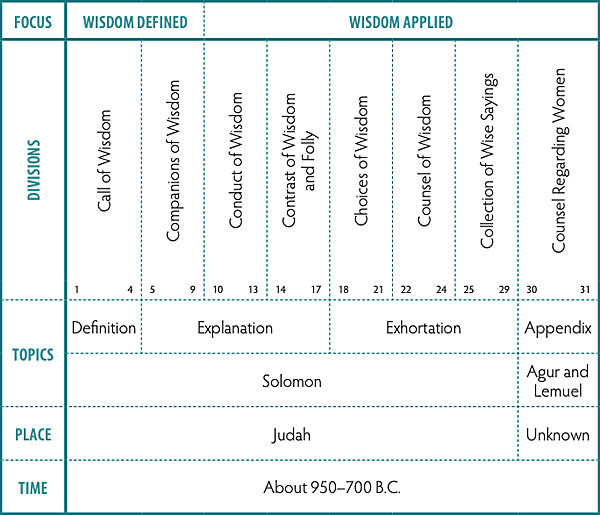
July 1
Proverbs 1:1-2:6

Overview
There's no better person to speak of wisdom from God's point of view than Solomon: son of David, king of Israel, and wisest man in the Old Testament. From the opening verses, Solomon gives us his purpose and theme in writing: "For attaining wisdom and discipline; for understanding words of insight; for acquiring a disciplined and prudent life, doing what is right and just and fair" (1:2-3). How do you develop that kind of skill in living life to God's glory? Solomon is quick to answer: "The fear of the LORD is the beginning of knowledge" (1:7). By learning to reverence God, you are in line for benefits that only God's wisdom can bring: moral purity, true prosperity, and guidance in the difficult decisions of everyday life.
Your Daily Walk
A piano virtuoso, hearing her talents described as "sheer genius," was quick to respond, "Genius? For 38 years, I practiced six hours a day, and now they call me a genius!" Few people play the piano with such style and mastery because few are willing to pay the price. It is not so much a matter of what they are gifted to do as it is what they have given themselves to do with a whole heart.
All too few of God's children experience the wisdom God has for them in making decisions and in setting priorities because few are growing in their fear of the Lord. As you begin your study of Proverbs, ask this question: "If wisdom from the Lord begins with the fear of the Lord, where do I need to begin today?" Solomon learned the key to wisdom. Have you discovered it yet?
Insight - Fostering the Fear of the Lord
What does it mean to "fear the Lord"? Look up the following verses to see what the Book of Proverbs says about this important response to God's greatness and grandeur:
2:1-5 You will find the fear of the Lord when...
9:10 The fear of the Lord is...
14:26-27 The fear of the Lord provides...
23:17-18 You should fear the Lord because...
____________________
July 2
Proverbs 6, 9

Overview
Throughout the Book of Proverbs, you will find the repeated exhortation to attentiveness. It is not enough merely to give casual attention to the words of wisdom. Hearing without heeding is folly. Nowhere is this more crucial than in the moral choices of life. The wise person avoids the tantalizing invitations to adultery and moral looseness, knowing the terrible price of such temporary pleasures. Fidelity, not immorality, is the path of true happiness for the man who will "rejoice in the wife of [his] youth" (5:18).
Your Daily Walk
If you could take one lesson you learned from your parent or guardian to pass on to your children or grandchildren, what would it be?
Solomon's childhood must have been a trying time. Think of the trials and tremors that rocked the palace during those turbulent years: Tamar's defilement by Amnon, David's abdication, Absalom's shameful conduct and equally shameful death (2 Samuel 13-18). Do you suppose Solomon was pondering the sins of his parents as he wrote these words of warning to his son about sin's enticements?
The path that leads to immorality is a slippery one indeed. Flattering lips, deceitful invitations, alluring pleasures-they all lead to one inescapable end: destruction. Solomon's wise advice to his son is the same advice received from his father, David: To avoid the slippery path, don't watch your feet; instead, watch your heart (6:20-23; Psalm 119:9, 11), for that is where sin's temptations begin.
As you read Solomon's "Words for a Son to Live By," use the following outline: Immorality-its pain (6:20-29); its price (6:30-35); and its subtle plan (7:1-27). Then talk with your spouse (or a trusted Christian friend) to discuss how Solomon's counsel can guide your conduct around members of the opposite sex.
Insight - When Is a Wise Man Not a Wise Man?
A man is no longer wise when he says he is wise enough to stop learning: "Instruct a wise man and he will be wiser still" (9:9).
____________________
July 3
Proverbs 10

Overview
Wisdom can be defined in a single sentence: "The fear of the LORD is the beginning of wisdom" (9:10). But for wisdom to be demonstrated fully would take a lifetime. Consider the many facets of daily life that demand wise actions and reactions: speech, stewardship, friendships, business ethics, and family relationships. In each case, Solomon's words guide you into God-honoring paths. The first nine chapters of Proverbs ask and answer the question, "Who pleases the Lord?" How would you answer that question?
Your Daily Walk
The balance of the book (chapters 10-31) asks and answers the question, "How do you please the Lord?" The answer is complex, for life's situations are complex and varied. But for each decision you are called upon to make, there is a divine principle to guide you. God is concerned about the most minute details of your walk with Him. Nowhere is this more evident than in the dozens of one-verse maxims you will read, ponder, and begin to apply today.
Read the proverbs below. Next to each one, jot down a way you could put the proverb to work in situations in your own life.
"The LORD abhors dishonest scales, but accurate weights are his delight" (11:1).
"The way of a fool seems right to him, but a wise man listens to advice" (12:15).
"He who spares the rod hates his son, but he who loves him is careful to discipline him" (13:24).
Insight - A Rod to Lean On and Learn By
In biblical times, a rod was a stick used for many purposes. Mentioned several times in Proverbs as an instrument of correction (22:15; 23:13; 29:15), it could also be a staff to aid in walking (Genesis 32:10); an instrument of punishment (2 Samuel 7:14); a shepherd's crook (Ezekiel 20:37); a measuring stick (Ezekiel 40:3; Revelation 11:1); or a scepter of authority (Exodus 4:20).
____________________
July 4/5
Proverbs 16

Overview
The first half of today's section (chapters 14-15) consists mostly of antithetic proverbs in which the word but sets up a contract between the two parts of each verse. The second half (chapters 16-17) employs many synonymous proverbs in which the linking word is and, and repetition and expansion emphasize the point of the proverb. The structure of these proverbs is simple, but the range of topics is immense. Your temper and tongue, paths and pursuits, thoughts and motives should all demonstrate your commitment to make godliness the pattern of your life.
Your Daily Walk
What do the first seven verses of Proverbs 16 have in common? (You may need to read this section several times until you discover the answer.)
Did you find it? All those verses contain the name LORD. In fact, LORD occurs more than 25 times in today's section, and more than 80 times in Proverbs. It is a helpful reminder that the Lord is the key to wise and godly living. He is the Maker of Life (14:31); and the Bible is His divinely provided owner's manual to tell you how to live life to the fullest.
When was the last time you thanked God for creating you or acknowledged His daily presence and provision in your life? If it's been too long, then try this helpful exercise. Circle the word LORD each time it occurs in today's reading. Then pray those verses that contain God's name back to Him as a testimony of praise: "Lord, thank You that You are my secure fortress" (14:26), "You are a fountain of life" (14:27), etc. You'll find that putting the Lord in the center of your life is precisely where He fits best.
Insight - Peacemakers and Troublemakers
For an interesting study, divide a sheet of paper in half. Label the left side "How to Be a Peacemaker" and the right "How to Be a Troublemaker." Then read chapter 17 and jot down what you find in the appropriate column. When you've finished, you should have expert insights on both.
Daily Walk
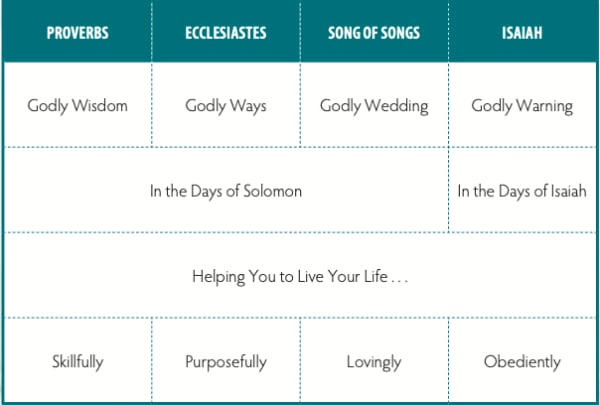
July 6
Proverbs 21

Overview
Though the proverbs in today's section are varied in their subject matter (and no clear grouping of proverbs can be readily found), they deal repeatedly with the same important topics: how to speak, how to act, how to avoid evil, how to use money, how to please the Lord, how to avoid judgment, how to guard your heart, and how to be truly wise.
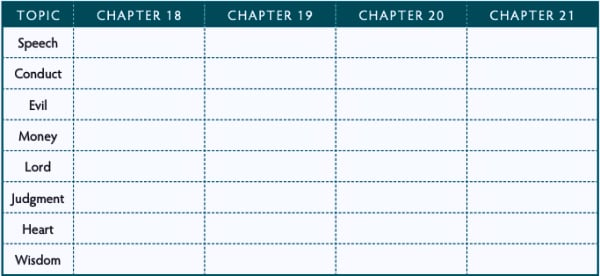
As you read each chapter (or the Key Passage), jot down the references in the appropriate column for future study.
Your Daily Walk
Eight Timely Topics in Proverbs
Now pick one verse that speaks to an area of your life that needs renovation (such as the use of your tongue), and write it on an index card. On the back, answer these questions: What will I begin to do? How will I begin? When will I begin?
Insight - A Thousand Years Older, and No Wiser
Although more than a thousand years separate the writing of Proverbs 21:23 and James 3:6-8, both of these passages testify to humanity's continuing inability to tame the tongue.
____________________
July 7
Proverbs 23

Overview
Chapters 10-21 define godly and ungodly living through actions, reactions, priorities, and relationships. Now, beginning with chapter 22, Solomon shifts the emphasis from knowing the truth to living the truth. The issue is not how many proverbs you know in your head, but how many proverbs you apply in your heart. "Pay attention and listen to the sayings of the wise; apply your heart to what I teach" (22:17)-wise words in any generation.
Your Daily Walk
Here is a scene that has probably been repeated many times in the average Christian home. Names have been changed to protect the guilty.
Father: "Son, please do what I told you."
Son: "Why, Dad?"
Father: "Because I told you to, that's why!"
This drama can unfold with almost limitless variations. Sometimes it's mother and daughter, or mother and son, or father and daughter. On occasion, the "do what I told you" is as crucial as life and death or as trivial as picking up a pair of shoes or pajamas.
While there is good reason for children to learn to obey instantly, it is equally important for parents to be able to explain the convictions behind their commands. At least nine times in chapter 23, the command to do something is followed by the reason why the command is given. (Watch for the telltale word for.)
Parents, have you ever fallen back on the words "because I told you to" rather than take the time to explain your convictions to your children? Carve out some time to do that today. Your children will respect you all the more for it.
Insight - Striking a Balance in Your Child's Discipline
While corporal punishment is biblical (23:13-14), there is also a balance to be maintained. Proverbs 19:18 says, "Discipline your son, for in that there is hope; do not be a willing party to his death." Firm but gracious discipline should characterize the home.
____________________
July 8
Proverbs 25-26

Overview
Nearly three centuries after the death of Solomon, King Hezekiah of Judah commissioned scribes to compile the five chapters of proverbs you will read today (25:1). Think of them as a four-volume dissertation on wise leadership. Volume 1: How to Be a Wise King (chapter 25); Volume 2: How to Avoid Being a Lazy Fool (chapters 26-27); Volume 3: How to Be a Discerning Son (chapter 28); Volume 4: How to Be a Disciplining Father (chapter 29).
Your Daily Walk
After reading chapters 25-29, close your Bible and complete each of the following proverbs. As you do, notice the picturesque imagery that Solomon uses:
1. "A word aptly spoken ..."
2. "Like a club or a sharp arrow..."
3. "Like cold water to a weary soul..."
4. "Wounds from a friend..."
5. "Like one who seizes a dog by the ears..."
a. "... is the man who gives false testimony" (25:18).
b. "... is a passerby who meddles in a quarrel not his own" (26:17).
c. "... is good news from a distant land" (25:25).
d. "... apples of gold in settings of silver" (25:11).
e. "... can be trusted" (27:6).
Now pick one of the proverbs you have just completed and put it to work in your everyday life. Is there an overdue email of "good news from a distant land" that you need to send? A "word aptly spoken" that you need to give? A matter of "false testimony" that you need to correct? Do it today.
Insight - Making Sense Out of Proverbial Hash
The apparently random proverbs in these five chapters are, in fact, carefully arranged groups of proverbs all dealing with the same general topic. (For example, the tongue in 25:11-15 and laziness in 26:13-16.) How many groups can you find?
___________________
July 9
Proverbs 31

Overview
It may surprise you to learn that not all of Proverbs was written by King Solomon. In fact, chapter 30 begins, "The sayings of Agur... to Ithiel and Ucal." None of these people are found anywhere else in the Bible, but the words of Agur live on in the timeless truths he shares. You might think of it as "Wisdom in Twos, Threes, and Fours." Agur describes four things that are never satisfied (vv. 15-16); four that are amazing (vv. 18-19); four that are insufferable (two from each sex! vv. 21-23); four that are small and yet extremely wise (vv. 24-28); and four that are stately (vv. 29-31). The concluding chapter of Proverbs was penned not by King Solomon, but by King Lemuel. In it, you will read godly advice handed down from his mother, and you will find a description of a virtuous woman who honors the dignity of womanhood. A godly wife is a rare treasure indeed.
Your Daily Walk
Can you think of 22 good reasons to applaud your wife or mother? The Book of Proverbs closes with the exhortation: "A woman who fears the LORD is to be praised" (31:30).
Then, just to show it can be done, Lemuel writes 22 verses (vv. 10-31, one verse for each of the 22 letters in the Hebrew alphabet) extolling the virtuous women in his life. Think of it as going from A to Z in his praise of the godly women who have impacted his life for God.
Take a sheet of paper and try it yourself. Across the top, write the name of your wife, mother, or another virtuous woman in your life. Down the left side of the paper, write the 26 letters of the English alphabet. Then begin combing 31:10-31 for praiseworthy characteristics of your "Mrs. Far Above Rubies." For example: T = Trustworthy (v. 11), Z = Zealous about her housework (v. 27). When you've finished, invite the woman in your life out for a special dinner and present her with your "Scroll of Praise."
Insight - Women to Be Avoided, Women to Be Applauded
Contrast the immoral woman of Proverbs 7 with the impeccable woman of Proverbs 31 in dress, speech, and conduct.
____________________
Ecclesiastes
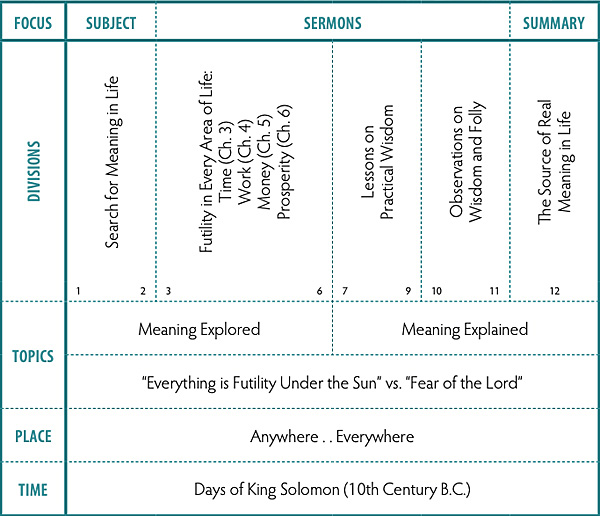
July 10
Ecclesiastes 1-2

Overview
Making sense out of life is not always easy. This is the problem facing the Teacher of the Book of Ecclesiastes as he thinks his way through what he has seen and experienced in life. Every enterprise he has undertaken from acquiring wisdom to amassing wealth-has ended in emptiness. In a sudden burst of emotion, the Teacher realizes that God does indeed appoint the times and purposes of life. But his insight fades as he focuses on the futility of life under the sun, and he overlooks the One who alone can put life together into a meaningful whole.
Your Daily Walk
Think about the people in your school, office, or neighborhood, and select the three you would consider "Most Likely to Succeed." Now analyze what caused you to select them: their money, intelligence, position, or possessions.
If any Old Testament character was ever a candidate for success, Solomon was the one. Blessed with wisdom, wealth, power, and prestige, he had everything a man could want. Or did he? Look at his evaluation of it all: "Pleasure... [is] meaningless.... Laughter... is foolish. Silver and gold... wisdom... this was the reward for all my labor... everything was meaningless... nothing was gained under the sun" (2:1-11).
A depressing picture? Perhaps. But don't miss verse 24. As Solomon sees the events and endeavors of life from God's perspective and the good things of life as gifts "from the hand of God," his life takes on meaning and purpose. Make a list of the good things you are enjoying today that come from the hand of God: health, employment, family, education, etc.
Insight - Silver Threads Among the Gold
One of the most moving passages in Ecclesiastes is the figurative description of the aging process (12:1-7). Realizing that the afflictions of age will catch up with everyone, the writer of Ecclesiastes counsels his audience: "Remember your Creator in the days of your youth, before the days of trouble come" (12:1).
___________________
July 11/12
Ecclesiastes 7, 9, 12

Overview
Up to this point the Teacher has concentrated mainly on the problems of life without seeking an explanation. But the deeper he probes life's patterns and perplexities, the more conclusive becomes the evidence that points him to the solution: Fear God. When wisdom becomes meaningless, fear God (7:18). When God's ways seem unsearchable or uncertain, fear Him (8:12-13). When all is said and done, fear God (12:13), "for this is the whole duty of man."
Your Daily Walk
If life to you seems meaningless, then you could be on the verge of the greatest discovery of your life. God has many unusual ways of drawing individuals to Himself and of demonstrating His love and care. With Job, He used tragedy; with the psalmist David, He used the life of a fugitive; with the Teacher of Ecclesiastes, He used the emptiness of existence on earth. What is He using in your life today to teach you the same important lessons?
It is interesting to note that every time the word God appears in the Book of Ecclesiastes, it is the Hebrew word meaning Creator. The personal name Lord never appears. The Teacher is speaking not of a God he knows personally, but of a God who is far above-like many speak of God today. And this is why the discovery of life's meaninglessness apart from God can be so important. If an empty, unsatisfying life causes you to search for the personal God of the universe, then you are about to meet the most important Person in life! The Bible says that meaningful life, eternal life, abundant life, only comes through knowing God and His Son, Jesus Christ (John 10:10; 17:3). Read those two verses several times. Then tell God the desire of your heart. He is waiting to meet you right now.
Insight - An Atheist's Testimony Concerning Ecclesiastes
An atheistic professor, after reading Ecclesiastes, commented that it was the only book in the Bible that made sense to him. Too bad he overlooked the last two verses of the book.
____________________
July 13
Song of Songs 1, 3, 6

Overview
Song of Songs is a love song written by Solomon that abounds in metaphors and oriental imagery. Historically, it depicts the wooing and wedding of a shepherdess by King Solomon and the joys and heartaches of their love for each other. Many have seen in the book a majestic picture of God's love for His people Israel, and of Christ's love for His bride, the church. As human love finds its highest fulfillment in the love of husband and wife, so spiritual life finds its highest fulfillment in the love of the Creator for His creation.
Your Daily Walk
True or False: "Love means never having to say you're sorry." The writer of the old song with this line seems to imply that apologizing is out of vogue when true love exists. (If the Shulammite had followed that ill-guided advice instead of seeking her lover's forgiveness, she might still be in the locked bedroom!)
Nothing could be further from the truth. But on the other side of the coin, Solomon's response to his lover's request for forgiveness is equally noteworthy. It would have been easy to take advantage of the apologizing partner and make her suffer through a series of "I told you so's." But look at Solomon's response in 6:4-10. He compliments her beauty and dignity, praises her hair and bright smile, and sets her apart as the one and only woman for him. In short, he reassures her of his forgiveness and continuing love.
What a pattern for forgiving and being forgiven in family disputes! Have you wronged your mate (or parent or child) through something you have said or done? Then take the initiative in asking for forgiveness. Remember, "Love means wanting to say you're sorry, and in God's strength, doing it."
Insight - Potent Lessons from a Moving Love Story
Apart from its historical significance, the Song of Songs pictures for the reader the strength of Christ's love (8:6-7); His delight in hearing and answering prayer (8:13); and the danger of failing to respond immediately to His knocking (5:2-6).
____________________
Isaiah
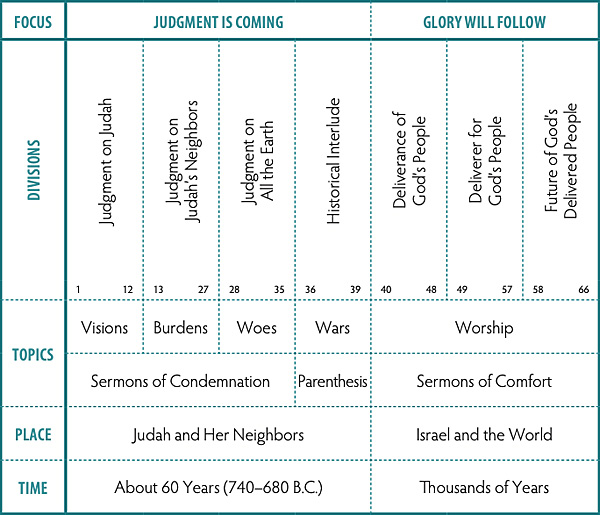
July 14
Isaiah 1

Overview
A crisis exists in the nation of Judah. Wickedness has permeated deep into every fiber of the social, political, and spiritual life of the country, a condition that God finds intolerable. Divine indictment falls from the lips of His prophet Isaiah. Unless repentance sweeps the nation, God will reduce His people to ruin. Famine and pestilence will replace feasting and pleasure to show that the Holy One of Israel still rules in Zion. King and commoner, priest and prophet, no one will be safe when the terrifying day of God's wrath descends upon His people.
Your Daily Walk
What do these three cities all have in common: Pompeii, Hiroshima, and Sodom? They are all sites of historic disasters. Pompeii was destroyed in the eruption of Mt. Vesuvius; Hiroshima was destroyed by an atomic bomb in World War II; and Sodom was destroyed by heavenly fire and brimstone in the days of Abraham.
Now add to that list the name of Judah. Until the days of the prophet Isaiah, Sodom stood alone as the universal symbol of depravity and shameful disgrace. If your nation was compared to Sodom, you had sunk as low as you could possibly go morally, spiritually, and socially (1:9). But now, in God's eyes, Judah had replaced Sodom as the object of scorn and ridicule (1:10). And Judah's judgment would be even more severe because Judah's privilege had been even more significant.
Opportunity brings responsibility-in Judah's day and in yours. Make a list of the religious freedoms you enjoy today: freedom to pray, to memorize Scripture, to share your faith without fear of physical harm. If judgment fell today in proportion to your use (or abuse) of those privileges, what might happen? And what can you do today to see that it doesn't?
Insight - From the Tragic to the Trivial (1:21-23)
In Isaiah's funeral dirge over Jerusalem, the prophet shows that every aspect of city life has been affected by the nation's spiritual revolt: justice, morals, money, and even the quality of the beer.
____________________
July 15
Isaiah 6-7

Overview
Isaiah's national call for repentance is so urgent that even his personal call and commission to the prophetic office must wait until chapter 6. Isaiah's "Woe" (I am sinful, v. 5) is met by God's holiness (I am holy, v. 7), resulting in Isaiah's "Here am I. Send me" (I am available, v. 8) and God's "Go" (I want to use you, v. 9). The task set before Isaiah is an unenviable one, for God promises from the start that the people will be spiritually deaf and nearsighted. But armed with confidence in his Immanuel, Isaiah begins to declare harsh words from on high in the courts and palaces of Judah.
Your Daily Walk
It is not so much what God can do through you as it is what you will allow God to do to you that determines the measure of your effectiveness for Him.
God had a message for Isaiah to deliver a message of holiness and judgment, a message of hope in the midst of heartache. But before His prophet could carry the message, Isaiah first had to carry the burden. He had to come to grips with his own sinful condition-his own waywardness and spiritual lukewarmness-before he could confront an entire nation suffering from the same tragic conditions. Before Isaiah could stand toe-to-toe with the king of Judah, he first had to kneel before the King of the universe. With a rekindled sense of God's awesome holiness and grandeur, Isaiah had no trouble volunteering for the Lord's service.
Are you trying to serve God before you have seen Him? Take a tip from Isaiah: Make no appeal till first you kneel, for that's the way to serve with zeal. After you have walked with God today, share with at least one other person how he or she can walk with Him too.
Insight - An Object Lesson in the Palace (6:1)
Isaiah received his call "in the year that King Uzziah died." Thus, his call is linked with the king's death, a premature death from leprosy for flouting God's holiness the very condition that would bring about the death of the nation as well.
_____________________
June 16
Psalm 78

Overview
Rounding out the psalms of Asaph (50, 73-83) are six testimonies to God's greatness. Psalm 78, the second-longest psalm in the Bible, is filled with lessons from Israel's history; Psalm 79 draws painful lessons from the destruction of Jerusalem; Psalm 80 provides a moving prayer for the restoration of God's chastened people. In the face of affliction and injustice, the believer in God can still sing for joy (81), for he knows that God rules in the affairs of humans (82-83).
Your Daily Walk
Are you profiting from the mistakes of the past generation, or are you destined to repeat them?
Psalm 78 contains "dark sayings of old" regarding rebellious decisions and their painful consequences for the people of God. You'll find the psalm depressing, because God never whitewashes the bad conduct of His children. But in spite of Israel's failings and faithlessness, God remains faithful. Time after time, He demonstrates that a disciplining Father can also be a loving Father.
Parents, do your children ever see you fail? Do they ever hear about the times when you disobeyed your Father in heaven, felt His hand of discipline, and learned to love Him more because of the experience? Don't hide your frailties; learn from them. And allow your children to do the same. In this way, you can show "the next generation the praiseworthy deeds of the LORD, his power, and the wonders he has done... so the next generation would know them and would not forget his deeds" (78:4, 6-7).
Your children will follow your footsteps more easily than they will follow your advice, particularly in the matter of learning from past failures. Turn bedtime into an opportunity to help your children profit from one of your past mistakes.
Insight - Whatever Happened to Ephraim?
Until David's time, Ephraim was the most powerful of the twelve tribes. But Ephraim repeatedly disobeyed God (78:9-66). Thus God chose Judah instead, making a city of Judah (Jerusalem) the capital, and a man of Judah (David) the king.
____________________
June 17
Psalm 89

Overview
Four authors penned the psalms you will read today, and the subject matter is as diverse as the composers. Korah yearns for a place in the house of the Lord (84) and for God to restore His favor to His people (85) so that the greatness of God may be displayed in the city of God (87). David seeks the Lord's joy and restoration in the midst of opposition (86). Heman cries from the doorstep of death for God to come to his rescue (88). And Ethan bursts into song at the thought of God's faithfulness (89).
Your Daily Walk
If someone makes a promise to you, and then circumstances change, making it seemingly impossible for that person to keep his word, you are faced with a choice: you can either let your problems cast a shadow on his promise or allow his promise to shed light on your problems. It all depends on the trustworthiness of your promise-maker.
God made a promise to David (89:3-4) that's recorded in 2 Samuel 7:13-16. God promised David an everlasting house, throne, and kingdom. Yet, at times, it appeared David's family line was doomed. On at least two occasions, the "royal family" was reduced to but a single member (2 Chronicles 21:4; 22:10-12). Did that mean God's promise was faulty? Not at all! It only highlighted the importance of daily faith in the Promise-Giver.
Label one side of a sheet of paper "God's Unkept Promises"; the other, "Promises God Made-and Kept." Then do your own survey of Noah, Abraham, Jonah, and others. What did they discover about the promises of God? Does that shed light on God's promises for you?
Insight - Bethlehem? Don't You Mean Jerusalem?
The fulfillment of the Davidic covenant is accurate in every detail. Isaiah 7:13-15 speaks to the "house of David" (v. 13) regarding the sign that the Lord Himself will give: "The virgin will be with child" (v. 14). Isaiah 9:6-7 foretells that a child will be born to reign upon David's throne. Micah predicts the very town in which this child will be born: the city of David-Bethlehem (Micah 5:2).
____________________
June 18
Psalm 91

Overview
The psalmist knew a God of incomparable greatness-a God of eternity (90), security (91), righteousness (92), sovereignty (93), and vengeance (94). Surely He is worthy of worship (95) and exaltation (96), for He is far above all other so-called gods (97).
Your Daily Walk
Transport yourself mentally from where you are sitting to a distant, sultry desert. The sun is your fiercest foe, and a shady spot your most desired friend. But as far as the eye can see, there are no trees, no caves, and no shady places of refuge. Then suddenly you remember a secret place-a haven that the casual eye might miss. And there, protected from the heat, you find shade and shelter.
God's love is like that-a haven; a refuge; a shady spot in the noonday afflictions of life. Perhaps that's just the breath of fresh air you need today to persevere in your service for Him. If so, then "take five" in the shadow of the Almighty (91:1-2) as you look for and circle the six "I will's" that God has promised in 91:14-16 for the objects of His love. Be refreshed in His presence today!
Insight - Bridging the Chasm of a Chiasmus
Moses, like other psalmists, was a master of the chiastic or stair-step poem, one in which the psalmist builds to a climax, then reverses directions in the middle and repeats himself using synonyms. Psalm 90:1-2 is an excellent example.
A Lord
B You have been our dwelling place
C Throughout all generations
D Before the mountains
E Were born
E Or you brought forth
D The earth and the world
C From everlasting to everlasting
B You are
A God
____________________
June 19
Psalm 101

Overview
In today's section you'll discover songs of affection and affliction: "Sing to the LORD a new song" (98); "The LORD reigns" (99); "Shout for joy to the LORD" (100); "I will sing... to you, O LORD" (101); "Hear my prayer, O LORD" (102); "Praise the LORD, O my soul" (103).
Your Daily Walk
David knew from reading the Old Testament Law that holiness was to be the hallmark of his administration. Why? Because the character of David's God radiated mercy and justice. But it wasn't enough to know that truth. David had to find practical ways to apply that truth in his daily decisions as king. That's what Psalm 101 is all about. He wanted each habit and activity, each friend and employee, to reflect the primary focus of his life, the holiness and purity of God.
Is that the goal of your Christian life as well? Blameless behavior; a blameless heart; a blameless walk with God (vv. 2, 6)? Does your commitment to holiness filter down to affect your reading habits, TV viewing, choice of friends, integrity on the job, and selection of leisure-time activities?
Holiness in personal and professional life was not a one-time decision for David, but a daily pursuit. "Every morning I will put to silence all the wicked [influences] in the land; I will cut off every evildoer from the city of the LORD" (v. 8). As one commentator has described it, David nurtured a king's concern for a clean administration, honest from the top down. What is one way that you can build on David's godly example today so that wholeness and holiness characterize your walk with God?
Insight - The Politician's Psalm
Here's a challenge for you. Write a short note to your congressman, governor, or mayor, enclosing a copy of Psalm 101 as a statement of your commitment to godliness in government.
____________________
June 20/21
Psalm 106

Overview
The evidence of God's greatness is visible everywhere: in the natural world He has created (104), in His daily provision for His nation Israel (105), and in His patient dealings with His wayward and stiff-necked people (106). As the songwriter has stated, "He's big enough to rule this mighty universe, yet small enough to live within my heart!"
Your Daily Walk
In a well-known poem titled "The Rime of the Ancient Mariner," the poet depicts the plight of some ancient voyagers whose ship has drifted off course. A beautiful seabird, the albatross, accompanies the ship and brings favorable winds-a good omen. But when one of the sailors shoots the bird with a crossbow, the winds die along with the albatross. The dead bird is hung around the neck of the guilty sailor as a constant reminder of his foolish error.
Israel, too, could have hung a dead albatross around her neck as a reminder of her frequent (and tragic) mistakes. In Psalm 106, the psalmist first confesses the sins of the nation during the period of Egyptian bondage (vv. 1-6). Next, he moves on to the nation's rebellion during the wilderness wanderings (vv. 7-33). And he concludes with the sins of the people in the land of promise (vv. 34-39). Yet in each case, God forgave His people and restored their fortunes (vv. 8-12, 23, 30-31, 44-46).
What albatross do you have around your neck? What sin from the past sneaks up to haunt you? Read Psalm 106:8, 44. Then underline the word yet and complete this statement: "Even though I have ______________ yet God has forgiven me." Fill in the blank with a mistake from the past, and realize that you've been forgiven.
Insight - A Psalmist's Paraphrase of Genesis 1:1-2:3
Psalm 104 closely parallels the seven days of creation found in Genesis 1-2. Notice how each section of the psalm acts as a free translation of the corresponding passage in Genesis. Can you match up all seven days of creation?
____________________
June 22
Psalm 108

Overview
God's goodness gives the redeemed cause to sing (107); God's faithfulness provides hope in times of helplessness (108); God's justice shows that the joy of the wicked is short-lived (109); and God's majesty puts human history in sharp perspective (110). In short, when the wicked prevail, the righteous can sing By simply recalling the Lord is King!
Your Daily Walk
How do you react under stressful circumstances? Do you find yourself panicky or peaceful? Helpful or helpless? Productive or paralyzed?
Now consider this: King David, a man to whom stress was no stranger, found that in God's strength, you can hold up rather than fold up in even the most pressurized situation. That's no idle boast; it is the testimony of his life.
Has your life ever hung in the balance? David's life hung in the balance in the palace, in the cave, and on the battlefield.
Have you ever been misunderstood to the point where people hurled abuse at you? David was.
Have you ever faced a giant-sized problem, knowing that when the dust settled, either the problem would be licked, or you would? David could identify with that feeling.
But in spite of such stress-filled moments, David could still write a song like Psalm 108-a song of confident trust, combining the best elements of Psalm 57 (when David was on the run) and Psalm 60 (when he was reeling from the pain of defeat in battle). In God's strength, he stood up to both, and so can you!
Insight - God's Strength in Stressful Times
Identify the stress test being experienced in...
Psalm 73
Psalm 78
Psalm 91
Psalm 108
How will you respond to God's "stress test" in your life?
____________________
June 23
Psalm 115

Overview
Think of the collection of psalms you will be reading today as a "praise package"-praise for God's care (111), God's commands (112), God's compassion (113), God's power (114), God's help (115), God's goodness (116), God's faithfulness (117), and God's enduring love (118). From the cradle to the grave, there is ample reason to praise the Lord.
Your Daily Walk
How many "Gods" are there in the world? How many "gods" are there in your life?
The answer to the first question is simple. There is only one God: "Hear, O Israel: The LORD our God, the LORD is one" (Deuteronomy 6:4). "I am God, and there is no other; I am God, and there is none like me" (Isaiah 46:9).
The second question is more difficult because it asks you to search your life for idols that have no place there. In Psalm 115, the psalmist chides his readers for worshiping gods made by men's hands-gods that cannot speak, see, hear, smell, feel, or walk. His conclusion: "Those who make them will be like them, and so will all who trust in them" (115:8). By contrast, the God of Israel is the Help and Shield of His people; the Provider of every blessing; the Possessor of heaven and earth. What other god is equal to Him?
The folly of idols is a sobering reminder, not just for Old Testament Israelites but for New Testament Christians as well. Is there some work of human hands that has become the focus of your time and affection? It can be a car, a club, a sport, or an investment. Verse 8 provides an exhortation; verse 11 offers an invitation. Will you turn from your false god and back to your true God, right now? It's never wise to follow folly.
Insight - Psalms, the Heartbeat of the Bible
The psalms are literally at the heart of the Bible. The middle chapter of the Bible is Psalm 117. The middle verse of the Bible is Psalm 118:8-"It is better to take refuge in the LORD than to trust in man."
____________________
June 24
Psalm 119:1-11, 97-105

Overview
Psalm 119, the longest psalm and longest chapter in the Bible, spotlights the multifaceted Word of God. Using a dozen synonyms for God's Word, the psalmist magnifies the law of God and the God of the law in virtually all of the psalm's 176 verses. Just as the reading of Psalm 119 seems to go on forever, so your praise and love for God's matchless Word should be your eternal preoccupation.
Your Daily Walk
If someone were to walk up to you on the street, thrust a microphone into your hand, and ask, "In your opinion, what is the Word of God?", how would you respond?
If our "man on the street" had accidentally picked the psalmist who wrote Psalm 119, he would have received more of an answer than he bargained for. The psalmist describes God's Word as law to be obeyed; testimony to be shared; the way to be followed; precept to be kept; statute to be observed; command that carries responsibility; judgment that rules between right and wrong; word that God has authoritatively spoken; promise that carries reward.
But Psalm 119 was not given as an exercise in reading. Rather, it is in the Bible to give you exercise in walking as you translate its eternal truths into the daily disciplines of life: your business decisions, your response to authority, your choice of counselors, your approach to times of testing and discouragement. Before beginning your Bible reading today, write across the top of a sheet of paper, "My Most Pressing Problem." Write out your thoughts. Then, as you read Psalm 119, compile a list of the principles and precepts the psalmist shares that speak directly to your situation.
Insight - The Long and the Short of It
Only one chapter separates the shortest chapter in the Bible from the longest! Psalm 117 is the middle chapter of the Bible and the shortest, with only two verses. Contrast that with today's chapter, which has 176 verses and is thus 88 times longer than chapter 117.
____________________
June 25
Psalm 126

Overview
Psalms 120-134 are called "songs of ascents" sung by Jewish travelers on the way up to the Jerusalem temple for the annual days of festival. These hymns of the highway reflect the thoughts of a pilgrim traveling far from home and looking for peace, protection, and provision along the journey.
Your Daily Walk
Homecoming brings a remarkable feeling-the feeling of being back where you belong, back where the family is together and the surroundings are familiar. Only those who have been away from home for long periods of time can appreciate the feeling.
Psalm 126 describes a homecoming. God's people, absent from their land of blessing and promise, have come home at last. It is like a dream come true-unspeakable joy punctuated by laughter, singing, and tears of gladness. The pilgrims have returned!
But lest the emotions of the moment sweep you away, don't miss the principle the psalmist underscores: "He who goes out weeping, carrying seed to sow, will return with songs of joy, carrying sheaves with him" (126:6). The agony of waiting, like the toil of the farmer, will one day bear fruit. Your tears and toil-as a parent, a Sunday school teacher, a faithful employee, a praying neighbor-will one day produce a harvest. God has staked His reputation on it. So rejoice! Sing! Laugh! And dream just a little as you labor for the Lord. Weeping will turn to reaping at the harvest.
Insight - What Goes Down (to Jerusalem), Must Come Up!
The old city of Jerusalem is located on a hill rising 2,600 feet above sea level. Because of its elevation, pilgrims arriving for the festivals of Passover, Pentecost, or Booths would go "up to Jerusalem," regardless of the direction from which they were arriving. Thus Jesus, traveling "down" from Capernaum (in the north) to Jerusalem (in the south), was still going "up" (John 2:12-13).
____________________
June 26
Psalm 128

Overview
Walking to the temple, the pilgrim contemplates the blessings of walking with the God of the temple. Whether with family (128) or foes (129), in the midst of cries (130) or quiet moments (131), in the house of God (132, 134) or among the people of God (133), it is good to praise the Lord, for that is the pilgrim's most joyous privilege.
Your Daily Walk
Which does your home most closely resemble: (a) the eye of the hurricane, or (b) the hurricane itself?
Psalm 128 describes a family scene, with father, mother (the fruitful vine), and children (olive plants) assembled around the table. It's a picture of tranquility, harmony, and stability. And at first it may be a scene you have trouble envisioning at your house. (As one harried mom described it, "Getting my kids to sit still at the dinner table is like trying to nail jelly to the floor!")
But don't miss the point of the psalm. The psalmist is not trying to turn your dining room into a setting for Better Homes and Gardens, but rather to show you the path to true happiness in the home. Even in the midst of chaotic schedules, you can find satisfaction and stability as a family if you will keep uppermost these three things: reverence (fearing the Lord, v. 1a), obedience (walking in His ways, v. 1b), and perseverance (laboring to make it work at any price, v. 2). This evening, call a family council to discuss ways to put Psalm 128 to work in your home. God has a blessing for your family if only you will follow the blueprint. Will you commit yourself to reverence, obedience, and perseverance in your home?
Insight - Fifteen Psalms for Fifteen Steps
According to the Mishnah (the body of Jewish tradition compiled about A.D. 200), 15 steps led up from the Court of the Women to the Court of the Israelites in the Jerusalem temple, and these corresponded "to the fifteen Songs of the Ascents in the Psalms, [which] the Levites used to sing."
____________________
June 27/28
Psalm 139

Overview
Sometimes it is easy to praise the Lord simply by recalling the past (135-136); at other times, memories of the past produce more pain than praise (137). But even times of tears and troubles can produce shouts of praise to God for His loyal love (138) and His infinite knowledge and presence (139).
Your Daily Walk
Nothing is quite as comforting-and at the same time quite as disconcerting-as the truth that God knows everything.
He knows your thoughts, your actions, and your words. He knows when you get up and when you go to bed. He understands your motives and intentions even when no one else does.
He also knows your secret sins that no one else ever sees: pride, lust, jealousy, covetousness. And He holds you accountable for all of it.
Similarly, God's presence can be both a comfort and a concern. There is no mountain you can climb, or depth you can descend, where He is not there. His presence shines through the darkness and transcends distance. But at the same time, that puts the lie to rest of any notion of secret sins you can commit without His being there. His presence with you is persistent.
God knows you completely, and He still wants to accompany you everywhere you go. That's loyal love! What should be your response to the knowledge that "God knows me; God goes everywhere with me; God created me to be the unique person that I am"?
The last two verses of Psalm 139 will tell you. Make them your prayer of commitment as you close your devotional time today.
Insight - Psalm 139 in a Nutshell (Four Stanzas of Six Verses)
Verses 1-6: God knows all about me.
Verses 7-12: God goes everywhere with me.
Verses 13-18: God made me.
Verses 19-24: God, search me!
____________________
June 29
Psalm 145

Overview
Your enemies will either drive you from God or cause you to walk closer to God. As the psalmist finds himself surrounded by those who would harm him, he cries out to be rescued (140), avenged (141), sustained (142), acquitted (143), and delivered (144). Truly God is great and glorious, a fact deserving to be acknowledged and broadcast by all His creatures (145).
Your Daily Walk
How many times did you worship God last week? Perhaps your first reaction to that question was to count how often you attended church: Sunday morning worship, Sunday evening, mid-week... but read Psalm 145 and you'll come away with a totally different picture of what it means to worship God. In verse 2, David describes worship as the daily joy of his life: "Every day I will praise you and extol your name for ever and ever." If David were alive today, this psalm might read something like this: "All through my day, as I drive on the road, work in the office, meet with clients, tend to the home, my thoughts will be on You and Your praiseworthy actions for me."
Worship can take place even when you are nowhere near a church. You can worship God with your children at bedtime (145:4) or declare His greatness on a crowded bus to those who do not even know Him (145:11-12). And if you think you've exhausted your thoughts about God or run out of things to worship Him for, remember verse 3: "His greatness no one can fathom."
Using one of David's suggestions from Psalm 145, spend a few minutes right now worshiping God.
Insight - A Fitting and Final Volley of Praise
Psalms 144-150 conclude the Psalter with a crescendo of praise. Psalms 144-146 are examples of personal praise (employing the pronouns I, me, and my); Psalms 147-150 contain corporate praise, imploring the nation as a whole to join in the chorus and "praise the Lord!"
____________________
June 30
Psalm 150

Overview
The psalmist's emotions have ridden a roller coaster in the psalms you have read thus far, from the pit of depression to the pinnacle of exaltation. But the final segment of the Psalms leaves one clear impression on the reader: God is worthy of praise! Praise Him from one generation to the next; praise Him for His help in time of trouble; praise Him as Creator and Sustainer, Savior and Lord.
Your Daily Walk
Psalms 146-150 all begin and end with the same Hebrew word: hallelujah, which means "praise the Lord!" It's the psalmist's way of saying, "Shout from the rooftops the praiseworthy character of the Lord and His mighty deeds on behalf of His people!" Psalm 146 alone catalogs a dozen things for which God should be exalted, including His creation, truth, judgment, provision, healing, protection, and rule. Every part of creation-from the sun to the sea creatures, from snowflakes to stars-shouts forth the news of a great God in heaven (Psalm 148).
Psalm 150 provides the capstone of the section, and indeed the Book of Psalms as a whole. In just six short verses, the psalmist issues the command to "praise" a total of 11 times! The point of the psalm is clear: With every breath you take, let your life be an anthem of praise to God, for He is worthy of your public proclamation of His greatness.
You are surrounded by people who need to hear about the praiseworthy character of your God. Construct your own list of 10 friends, relatives, neighbors, and associates who need to hear and respond to God's love. Begin to pray for each person, each day, by name. And pray for yourself, that when God opens the door of opportunity, you'll be ready.
Insight - An Acrostic to Teach You How to Praise
Simply put, praise is: Publicly recounting the Acts of the Incomparable Sovereign of Eternity. A handy acrostic to remember!
____________________
Psalms
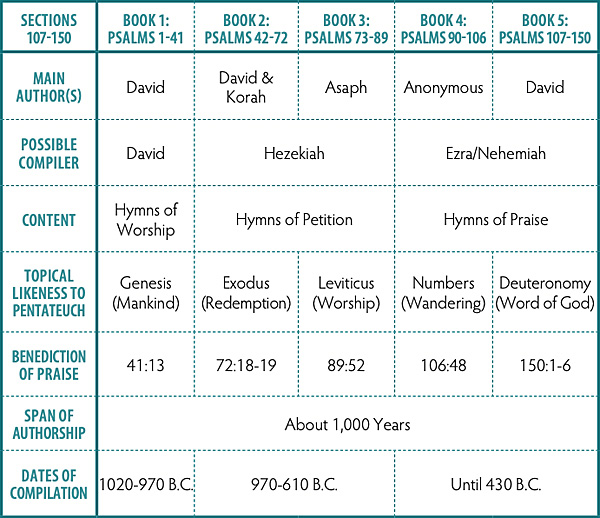
June 1
Psalm 1

Overview
The Book of Psalms opens with a collection of the faith's foundation stones. The life-giving Word (Psalm 1) is the guidebook that the trustworthy Lord (2) will use to direct you into paths of blessing. The foundation of a righteous life is sure even in times of seeming defeat (3), opposition (4), or woeful circumstances (5). The repentant believer has the confidence that God hears his prayer as soon as it's uttered (6). Morning and evening, through tears of joy and tears of grief, God's faithfulness is unchanging on behalf of His people.
Your Daily Walk
Imagine how much grayer your life would be without music. No hymns of praise or songs of celebration, no majestic symphonies to remind you of the greatness and grandeur of God, no love songs to help you give expression to your feelings, no patriotic marches to rekindle your love for country, no bedside lullabies to soothe your child's restlessness, no tunes to whistle on the highway, no songs to sing in the shower, and no Christmas carols or Easter anthems. Take away music, and you have taken away one of the believer's vital channels of communication. The Book of Psalms is an inspired collection of songs, the overflow of human hearts experiencing grief and gladness, pain and praise. Read it as you would a journal, noticing the author's choice of words, looking for the emotions behind each carefully constructed phrase. As you do, frequently ask yourself, "Does this express the desire of my heart? The need of my life? The question on my mind?" And if you feel like breaking into a song from time to time, go ahead!
Insight - Wherefore the Psalms?
The singing of psalms was a regular part of worship in the early church (1 Corinthians 14:26; Ephesians 5:19; Colossians 3:16). The common name for the 150 songs in the Book of Psalms, the Psalter, comes from a Latin word meaning "harp song." The Hebrew title, Tehillim, means "praises."
____________________
June 2
Psalm 10

Overview
Overview
A prominent theme in the Psalms is the request that God rescue His people, judge His enemies, and vindicate His righteousness. The man or woman of faith can rest assured that justice will ultimately prevail (7), the wicked will be brought low (9-10), and God's holy name will be exalted (8, 11-12). But in the meantime, God is calling for restful confidence in Him as the One who can calm life's troubled waters.
Your Daily Walk
"Why, O LORD?" (10:1). What Christian hasn't asked that question, particularly when the wicked seem to prosper without punishment, and God does nothing in answer to the prayers of His children? In Psalm 10, the psalmist touches on the nerve of this painful problem and seeks God's divine perspective on it. True, the proud and self-sufficient are prospering in their ways; true, they are seemingly getting away with murder; true, God has seemingly forgotten about bringing justice to bear (at least from the perspective of the wicked). But don't be lulled into following their wicked course. God has seen the injustice they commit; God has not overlooked their mischief and spite; the day of payment for their wickedness will come. And when it does, you will be glad you didn't walk with the wicked. Are you struggling with feelings of bitterness toward God or revenge toward another person over an injustice you suffered at their hands? There are two paths you can follow: (1) Nurse your grudge and demand that God answer your why; or (2) turn your grudge over to God and, in exchange, find His strength to bear up under your sufferings. Read verses 16-18 out loud as your confident testimony that "the LORD is King."
Insight - What Do You Do When You See a Selah?
The word selah occurs more than 70 times in the Book of Psalms and three more times elsewhere in the Old Testament (Habakkuk 3:3, 9, 13). It is probably a signal for an interlude or a change in musical accompaniment. The Hebrew root means "to lift up," possibly indicating the place where the psalm should crescendo.
____________________
June 3
Psalm 15

Overview
Only a fool would say there is no God (14). But for those who acknowledge God's existence and seek to serve Him with a whole heart, there are benefits and blessings that the world knows nothing about: hope in times of anxiety (13); a holy standard (15); protection from the wicked (17); strength in times of peril (18); and best of all, the promise of eternal life (16).
Your Daily Walk
What are the responsibilities of a citizen of America? Answer: to protect, defend, and abide by the Constitution of the United States. What are the responsibilities of a citizen of heaven? Answer: to protect, defend, and abide by the Word of God. Psalm 15 resembles, in miniature, the Christian Constitution. In it, you will find a description of godliness to strive for. It provides a conduct manual to guide you in activities consistent with your citizenship. There are 11 parts to the psalmist's answer, and they touch on virtually every area of daily life: integrity in speech and conduct (v. 2), use of the tongue (v. 3), attitude toward sin and worship (v. 4), faithfulness in keeping promises (v. 4), use of money (v. 5). In short, your fellowship with God is vitally affected by your obedience to the precepts contained in His Word. Now apply the psalm to where you live and work. Every time you encounter "who..." in Psalm 15, substitute the words "Do I...?" Let the mirror of God's Word reflect back to you an accurate picture of your conduct as a citizen of heaven.
Insight - The Psalmist and Prophet-David
"The Psalmist David" is a phrase we hear often. But Acts 2:29-31 also speaks of David as a prophet who "spoke of the resurrection of the Christ" (v. 31). Psalm 18 is not just a song of thanksgiving; it also foretells Christ's experience of death and depicts God's power on Christ's behalf (vv. 1-18). Verses 19-27 tell of God raising Christ from the dead and giving Him glory.
Poetical Books
The poetical books deal with life in the present tense and seek to answer timeless questions: “What is God like? How can I relate to Him? What does He expect of me?” These books differ from the historical books in both content and style. They are poetry rather than prose, parallel thought rather than narrative.
The poetic books occur at the very center of the Old Testament and form the pivotal hinge linking the historical books (past) to the prophetical books (future), showing the lifestyle that pleases God—a lifestyle of dependence upon what God has done in the past and anticipation of what He will do in the future.
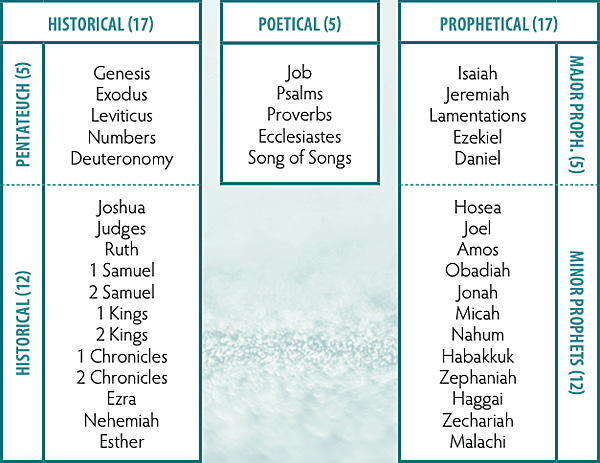
____________________
June 4
Psalm 22

Overview
Today, you will catch a glimpse of the many-sided plan and person of God. You will read about Him in His role as Creator (19) and Sustainer (20-21), the Lord who died as the Sacrifice for sin (22), lives as the Shepherd of the sheep (23), and rules as Sovereign over all that He has made (24). Truly, He is worthy to be praised!
Your Daily Walk
Have you ever stood in line at the customer service counter of a department store listening to the arguments of a customer and a clerk? It's a little like experiencing a ping-pong game with words:
"I thought this product was made of..."
"But ma'am, it says right on the label..."
"I know what it says, but the sales clerk told me..."
"There must have been a mistake, but I'm sure we can..."
No "buts" about it, they have a problem on their hands! It's a little like the problem the psalmist encountered when he allowed "buts" to cloud his trust in God. His complaints are spelled out in Psalm 22, verses 1-2, 6-8, and 12-18. But after each complaint, there is a corresponding statement of confidence that God is bigger than his problem (vv. 3-5, 9-11, 19-21). Having seen God at work in the past, the psalmist realizes no problem is too big for God in the present or in the future as well. In moments of crisis, do you wrestle with the "God can do anything, but..." mentality? Remember today that there are no "buts" in God's promise to meet you at your point of need.
Insight - Catching a Glimpse of the Cross
Though Psalm 22 was penned about 1,000 years before Jesus was born, it contains a remarkable prophetic description of the Savior's death by crucifixion, including the details of His mockery, thirst, unbroken bones, pierced hands and feet, and broken heart. In addition, there are two verses in the psalm that would later be quoted on the day of Jesus' death: one spoken by Christ, the other spoken by the crowd. Can you locate both?
____________________
June 5
Psalm 27

Overview
What is God like? How would you describe Him to someone who has never heard about Him? One good way would be to itemize the ways in which He works in your life. For example, He is your Teacher to instruct you (25), your Judge to vindicate you (26), your Salvation to save you (27), your Rock to defend you (28), your Glory to be worshiped by you (29), and your Uplifter to rescue you (30).
Your Daily Walk
On a scale of 1 to 10, with 1 being low and 10 high, how would you rate your "fear quotient" on the following?
Fear of standing before a large group
Fear of snakes or lizards
Fear of the dark
Fear of the future
Fear, like acid, can destroy even the strongest resolve. That which terrifies you controls you. But it needn't be that way. "For God did not give us a spirit of timidity, but a spirit of power, of love and of self-discipline" (2 Timothy 1:7). David knew what it was to be afraid of the dark, afraid of the future, afraid of the enemies encamped all around him. But he learned the secret of overcoming those fears: not denying his fears, but relying on Someone bigger than they were. In Psalm 27:1, you'll discover what David found: The Lord is the cure for what intimidates you! He has light to dispel your darkness and strength to replace your weakness. And you, like David, have the privilege of drawing upon those resources today. David took God at His word (27:5). Will you?
Insight - A Trio of Psalms About the Temple
Psalms 26-28 are all written with the house of the Lord in view. In Psalm 26, the worshiper rejoices to find access to God's house; in Psalm 27, he sees God's house as a sanctuary from his enemies; and in Psalm 28, he spreads his hands toward the place of God's presence and there receives the answer to his petition.
____________________
June 6/7
Psalm 32

Overview
A proper perspective can help you face even the darkest of circumstances. The Book of Psalms was not written in a vacuum. Rather, it was composed by godly Old Testament believers who wrestled with the same daily struggles you face: fear, guilt, loneliness, anxiety, need, and frustration. In God's strength, they discovered you can move from pity to praise (31-32) and from the cave to the mountaintop (33-34). Even in cases of unmerited hate, you can respond with unconditional love (35-36) when the Lord is your light and salvation.
Your Daily Walk
"Confession," the saying goes, "is good for the soul." More than that, confession is good for the entire person: body, soul, and spirit. In Psalm 32, David describes the deep joy of a person who has experienced true forgiveness (vv. 1-2). Next, he lists some physical and emotional symptoms of harboring unconfessed sin (vv. 3-4). The psalmist pens a powerful prescription in verse 5: Confess your sins to the Lord. Uncover and expose your sin for what it is. Agree with God that it is in your life and doesn't belong there. Then receive God's forgiveness that washes your life like a cool, refreshing rain. What restoration awaits the repentant sinner (vv. 6-7)! Don't wait until you are forced to submit to God, David counsels; willingly seek His mercy (vv. 8-11). Tape the words "Forgiven and Forgiving" to a clock. Let it remind you that because God has forgiven you in Christ Jesus, it's always the right time to forgive others (Ephesians 4:32).
Insight - The ABCs of the Psalms
On occasion, a Hebrew poet would write down the 22 letters of the Hebrew alphabet and construct his psalm to correspond with them. In this way, he would have a cohesive, easily remembered song that could then be sung from "A to Z." Such is the case with minor variations of Psalms 9-10, 25, 34, 37, 111-112, 119, and 145. (Notice how many are 22 verses, or a multiple of 22, in length.)
____________________
June 8
Psalm 37

Overview
The five psalms you will read today, all authored by King David, provide a many-sided look at David's walk with God. While Israel's king often expressed praise to God, he also wrestled with fretfulness (37), failing strength (38-39), sinfulness (40), and the unfaithfulness of trusted friends (41). But for every situation of life, David found a source of support and strength that was inexhaustible and unchanging: the faithfulness of his covenant-keeping God.
Your Daily Walk
A major struggle that believers have faced through the ages is the seeming prosperity of the wicked. David struggled with this question and, in Psalm 37, suggested a course of action to address it. We could summarize his advice this way: "Look at the wicked in the light of eternity; live your life in the strength of today."
Begin by understanding the fate that awaits the ungodly: "Like the grass they will soon wither" (37:2); "Evil men will be cut off" (37:9); "The wicked will perish... they will vanish like smoke" (37:20). Their judgment is sure.
In the light of eternity, what does it matter if for a short time the righteous suffer and the wicked prosper? God will settle all accounts justly. And so David exhorts: "Do not fret because of evil men or be envious of those who do wrong" (37:1).
Instead of worrying about things we cannot change, David exhorts us to concentrate on attitudes we can change. "Trust in the LORD... delight yourself in the LORD... commit your way to the LORD... be still before the LORD and wait patiently... refrain from anger. do not fret" (vv. 3-8).
Pick one of the above commands and write out one way that you can develop that attitude in your life, starting today.
Insight - Seven Penitent Prayers in the Psalter
Psalm 38 is one of the seven so-called "penitential psalms"-those in which confession, repentance, and forgiveness are prominent themes. The other six (which you also might want to mark in your Bible) are Psalms 6, 32, 51, 102, 130, 143.
____________________
June 9
Psalm 44

Overview
Today you will read a collection of psalms mostly attributed to the "Sons of Korah"-songs that express a longing for the nearness of God and the furthering of His program. Psalms 42-43 speak of a deep yearning for the Lord and for His house of worship, while Psalm 44 pleads with God to turn defeat into victory. The lament of the psalmist's heart is answered in the remainder of the section, which speaks of God's majesty (45), might (46-48), and wisdom (49). What is earthly wealth when compared to the awesome grandeur of God?
Your Daily Walk
Do you believe God was active when your grandparents were growing up? And your great-grandparents? If that is true, then why is it so difficult to put into practice the wise words of Henry Ford? "Anyone who stops learning is old, whether at 20 or 80. Anyone who keeps learning stays young." God has something for you to learn from the previous generation, and only those growing old before their time will fail to learn it.
With that thought in mind, read thoughtfully and prayerfully the opening three verses of Psalm 44. How long has it been since you really listened to the distilled wisdom of the previous generation-the eloquent testimonies of God's mighty works on their behalf? If the answer is "too long," then you've been missing a treat.
Invite a Christian senior citizen to your house this week for dinner or dessert. Then settle back and listen!
Insight - Psalms 151, 152, 153...
It may surprise you to learn that there are other psalms outside the Book of Psalms. Here is a partial list:
"The Song of Moses" (Deuteronomy 32:1-43)
"Deborah's Song" (Judges 5:1-31)
"Hannah's Prayer" (1 Samuel 2:1-10)
"A Poem by Hezekiah" (Isaiah 38:9-20)
"Jonah's Prayer" (Jonah 2:1-9)
____________________
June 10
Psalm 53

Overview
God is the righteous Judge (50), and those who call themselves His people must view wickedness from His perspective. Sin is something to be confessed and forsaken (51); the tongue is often a tool of wickedness (52); the pursuit of evil is folly (53); but God is the Helper and Deliverer of those who rely on Him (54).
Your Daily Walk
Here are some wise words about fools:
• If fifty million people say a foolish thing, it is still foolish.
• A fool and his money are soon parted. Then again, a fool and his money were lucky to get together in the first place!
• No one can make a fool out of a person if he isn't the right kind of material for the job.
We smile at such humorous maxims. But here is another wise statement about fools that we dare not take lightly:
• "The fool says in his heart, 'There is no God" (53:1).
Only a fool would deny God's existence, the problem of sin, and the need for a Savior. Paul, in Romans 3:10-12, shows that sin is the universal malignancy of humanity. There is none righteous, understanding, seeking after God, doing good, no, not one. That's why it's so important to be sure you have "This righteousness from God comes through faith in Jesus Christ" (Romans 3:22). Only a fool would try to make it on his own merits when the only way has already been provided by God.
Have you wisely reached out to Jesus as your Savior or foolishly sought to save yourself? There is no other way than through Jesus Christ. No fooling.
Insight - Not a Rerun Already!
Psalm 53 is almost identical to Psalm 14, which you read only one week ago. Compare the two chapters. The primary difference is the use of the word "God" instead of "LORD". In Hebrew, this represents the use of the word Elohim instead of Yahweh. The other main difference is found in verse 5.
____________________
June 11
Psalm 56

Overview
Is it possible to praise God, even in the midst of trials (57-59), tears (56), and betrayal by trusted friends (55)? David would respond with a ringing "Yes!" With an unshakable trust in God, it is possible to praise Him even in the face of cruel and treacherous dealings from friends and enemies alike. In each psalm you read today, note the way David's plea in the midst of crisis gives way to an expression of praise in the midst of confidence.
Your Daily Walk
What do Psalm 56 and a penny have in common? They both bear the message, "In God We Trust."
In the space of these 13 verses, David repeats the phrase "in God" or its equivalent a total of six times, not because the psalmist has a limited vocabulary, but because trust in God is the focus of his hope. Like a brilliant jewel, David holds up his confidence in God and slowly turns it to reveal the many facets of his faith. Even under enemy attack, in the midst of fearful circumstances, when tears flow in the solitude of his suffering through it all, God is with him and for him (56:9).
That may be just the message of hope you need to face the challenge God has set before you. Tape a few pennies in unusual places as a reminder. Trust in the Lord, for He is for you!
Insight - Doubly Trapped, Doubly Trusting
Don't miss the historical context behind Psalm 56, as noted in the superscription. It was written "when the Philistines had seized him [David] in Gath"-an event described in 1 Samuel 21:10-15. While fleeing from the murderous pursuit of King Saul, David made his way in desperation to the city of Gath, a Philistine stronghold and hometown of the recently deceased Goliath. Already a marked man in Saul's book, David now found himself on the "Ten Most Wanted List" in Philistia. Doubly encircled by those who wished to see him dead, David picked up pen and parchment to write these moving refrains.
____________________
June 12
Psalm 61

Overview
In times of distress, the best place to be standing is on the promises of God, for there you can never be moved. In the face of defeat and discouragement, God has promised to be your Help (60), your Strong Tower (61), and your Rock (62). No wonder David bursts forth in praise for his praiseworthy Lord! God will satisfy the thirsty (63) and deliver the downcast (64-65), surely causing them to shout His mighty acts to all the earth (66).
Your Daily Walk
Psalm 61 contains only eight brief verses. But buried in the psalm are word pictures describing five kinds of protection for the psalmist. Can you find all five in less than a minute? Ready?...go!
1.
2.
3.
4.
5.
Rocks and towers may not seem like anything special until you remember the terrain in which David lived and fought-much of it parched, waterless wilderness, without trees for shade or many cities for protection. In such an environment, every promontory is of vital importance for shade, defense, observation, and protection.
Find your own observation point (an upstairs window, scenic view, or high-rise building) as you meditate on this thought: "If you're doing all right under the circumstances, you could be doing a lot better under His wing." That is the heritage of those who fear God's name (61:4-5); make it your heritage today as well.
Insight - A Moving Hymn from the End of the Earth
Psalm 61:2 prompted William O. Cushing to compose the well-known hymn, "Hiding in Thee," the first verse of which reads:
O safe to the Rock that is higher than I,
My soul in its conflicts and sorrows would fly.
So sinful, so weary-Thine, Thine would I be;
Thou blest "Rock of Ages," I'm hiding in Thee.
____________________
June 13/14
Psalm 71

Overview
The six psalms you will read today provide ample reason to take time to praise. God is big enough to rule the affairs of nations (67) and ride on the clouds of heaven (68), yet small enough to tend to the hurts of His people (69-71). Truly, He is worthy of your worship and adoration as King over creation (72).
Your Daily Walk
Aging is a paradox. For the first twenty years, we can't grow up fast enough. During the middle years, we're appalled at how time flies. And for the last twenty years, time has stood still.
With an average of 80 or more years to serve in the family of God, what is God's purpose for those crowning years? Where can the senior saint turn for strength and security? And how can he or she find meaningful service?
Psalm 71 shows that for every need the elderly experience, God can richly supply it. Security? "You are my rock and my fortress" (71:3). Hope? "You have been my hope, O Sovereign LORD" (71:5). Stamina? "I will go in the strength of the Lord GOD" (71:16). Encouragement? "You will... comfort me once again" (71:21). Purpose for living? "Even when I am old and gray, do not forsake me, O God, till I declare your power to the next generation, your might to all who are to come" (71:18).
Read Psalm 71 again thoughtfully. Then write an encouraging note to a senior citizen you know, sharing God's love with them.
Insight - Four Ways to Praise
At the conclusion of Psalm 71, the psalmist looks for ways to exalt the name of the Lord, even in his crowning years, and he discovers four. Can you find them in verses 22-24?
"I will praise you with the harp."
"I will sing to you with a lyre."
"My lips will shout for joy when I sing praise to you."
"My tongue will tell of your righteous acts all day long."
____________________
June 15
Psalm 77

Overview
Asaph, composer of the five psalms you will read today, struggles with some of the most difficult questions of life: Why do the wicked prosper (73, 75)? Why do the righteous suffer (74)? Why do prayers seemingly go unanswered (77)? In the midst of fear and uncertainty, Asaph discovers there is an immovable Rock.
Your Daily Walk
How do you respond when your thoughts turn to memories of the past? Is it a painful experience? Do you find yourself longing for the good old days?
Memories of the past play a vital role in Asaph's thinking as he records Psalm 77. Lying on his bed at night and anxiously searching for God's comfort (vv. 1-6), he finds himself asking, "God, have You changed? Are you still interested in me and my personal problems?" But then Asaph remembers God's works down through history (vv. 10-12): His redemption of the nation from bondage, His guidance of the people through the Red Sea, His provision of food and water where there was none. And suddenly, aided by his good memory of God's past dealings, Asaph finds his self-pity turned to praise.
Have you been battling the blues lately? Here's a divine remedy that worked for Asaph and one that will work for you, too. Think back over yesterday, and identify at least one good thing God did for you. Now do the same with last week, last month, and last year. If your memory fails, enlist the help of your spouse, children, parent, or friend.
Insight - Putting Together a Profile of Asaph's Life
According to 1 Chronicles 25:1, Asaph and his sons were skillful players of the harp, lyre, and cymbals. Asaph was an accomplished singer, according to 1 Chronicles 15:16, 19. In 1 Chronicles 25:6, we are told that Asaph was under the king's direct supervision for the music of the Lord's temple. Asaph also wrote many psalms.
____________________
Job
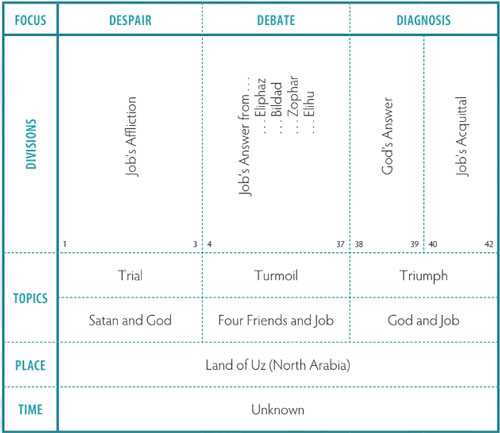
May 16/17
Job 1-2

Overview
Job, a godly and wealthy resident of Uz, watches helplessly as his life of health, blessings, and prosperity collapses around him. Unknown to him (but known to you because of chapters 1-2), Job's problems do not begin on earth, but rather in heaven. With God's permission (and within divinely imposed limitations), Satan launches a series of devastating attacks in an attempt to force Job to renounce God. In the midst of each trial, Job's faith in God shines brightly, though personal turmoil tears at Job's heart as he asks repeatedly, "Why, God?"
Your Daily Walk
Satan is alive and well on Planet Earth! If you doubt that, just ponder the story of Job, a man who was "of perfect integrity, who feared God and turned away from evil" (1:1). Job was a man of integrity, moral consistency, and submission to God. And the very attributes of godliness that made Job such a usable vessel for God's service also made him an inviting target for Satan's attacks. Paul wrote: "Everyone who wants to live a godly life in Christ Jesus will be persecuted" (2 Timothy 3:12). Job is clearly "Exhibit A."
Three times in the New Testament, Satan is referred to as a wild animal. How many of the three can you recall before looking up the Bible passages? Why is each symbol appropriate?
1 Peter 5:8
Revelation 12:9
Revelation 20:2
Have you appropriated the protective armor that God intends for you to use to ward off the flaming missiles of Satan? Before you go any further, take a look at God's armor checklist in Ephesians 6:11-17. Make sure each piece is firmly in place.
Insight - A Name from Antiquity
The name of both the book and its hero, Job (Hebrew, 'iyyôb), appears in extra-biblical texts as early as 2000 B.C., indicating that Job is perhaps the oldest book of the Bible.
_____________________
May 18
Job 4, 6

Overview
After a week of silently commiserating with Job and his fate, Job's three human counselors begin to analyze his situation. Eliphaz, apparently the oldest, reasons that righteous conduct brings blessing, while sin brings suffering; therefore, Job must be guilty of sin and needs to repent. Job responds by stressing that his despair is justifiable. He challenges Eliphaz to produce one shred of evidence against him. After silencing his accuser, Job turns to God. He bombards God with questions about the painfulness of life and pleads with Him not to treat him like a marked man (7:20).
Your Daily Walk
Are the following true or false?
1. Suffering in your life is always due to personal sin or disobedience (Job 1:8).
2. Suffering in your life is a sure sign that you are doing what God wants you to be doing (1 Peter 4:15-16).
3. Sometimes there is no earthly reason (though there may be a heavenly one) why you are allowed to suffer physically or emotionally (Job 1:12; 2:6).
Eliphaz was not the first to reason that suffering is always a telltale sign of sin in the life of the sufferer. Jesus Himself laid that untruth to rest when the disciples questioned Him about a man blind from birth: "Rabbi, who sinned, this man or his parents, that he was born blind?" (John 9:2). Jesus responded: "Neither... this happened so that the work of God might be displayed in his life" (v. 3). God sometimes permits suffering that He might demonstrate His perfect strength in the face of human weakness.
Are you being afflicted through loss of health, finances, or family? Check to be sure there is no earthly cause for your pain; then trust God that there may well be a heavenly reason.
Insight - Eliphaz, "Wise Man" from Teman
According to Jeremiah 49:7, Eliphaz's hometown of Teman was famous for its counselors and wise men-just what Job needed!
____________________
May 19
Job 8-9

Overview
When Bildad speaks, he lays aside the normally courteous introductions (compare 4:1-6) to confront Job directly. His charge is the same as Eliphaz's: "God is just; Job is guilty." Bildad seeks to bolster his argument from tradition and history. As in Job's previous rebuttal, he first addresses his human counselor (9:1-24) before turning his complaint to God. Job recognizes the justice of God, but cannot reconcile that same justice with his unexpected affliction. This leads Job even deeper into despair as he laments his very birth.
Your Daily Walk
Have you ever felt as if there was a communication gap between you and God? Did God seem too big or too remote to be genuinely concerned about your little hurts? Did you sense that you needed a go-between, an umpire, an advocate to carry your complaint personally to God and see that it was communicated accurately?
In the midst of his turmoil, Job lamented: "If only there were someone to arbitrate between us, to lay his hand upon us both" (9:33). But you have an Umpire! "There is one God and one mediator between God and men, the man Christ Jesus" (1 Timothy 2:5). You have a distinct advantage over Job, for you have the Lord Jesus Christ ready to intercede for you (see Hebrews 7:25).
Open your spiritual closet and conduct a search for skeletons of hurt that you have never entrusted to God. List them in the margin, and commit each to your intercessor. Remember, it is His job to go before the Father on your behalf. Then be prepared to enjoy the day, confident that your seeming communication gap with God has been bridged.
Insight - More Than 99.44 Percent Pure
Job knew that the purest water and the strongest soap were powerless to remove the stains of sin. Only cleansing from God could accomplish that (Psalm 51:7; Isaiah 1:18). Have you allowed the Word of God to bring cleansing to your life today (John 15:3)?
_____________________
May 20
Job 11, 13

Overview
Zophar leaves courtesy even farther behind (11:2-6) as he multiplies the accusations against Job. He reminds Job that God is both awesome and all-knowing, and therefore Job must repent. Only then will God restore him. Job begins his third defense on a note of sarcasm (12:2). He acknowledges God's awesome character but still proclaims his own innocence. Again, Job turns his comments from his earthly counselors to his Heavenly Father as he bemoans man's fragile condition. But in the midst of Job's despair, there shines a glimmer of hope as he contemplates life beyond the grave.
Your Daily Walk
Criticism hurts, but slander pierces. Job's "friends" turned out to do little more than "smear [him] with lies" (13:4; literally, "falsehood plasterers"). The Bible has many references to accusers plastering untruths or half-truths on blameless believers. For example, the psalmist cried out: "The arrogant have smeared me with lies" (Psalm 119:69). But even in the face of such undeserved treatment, the psalmist restrained himself, saying: "I keep your precepts with all my heart." Even slanderous attacks do not justify hurtful retaliation. For the believer, God has a better way.
God wants you to react scripturally to your accuser in a sanctified way. In the words of the apostle Paul: "Do not be overcome by evil, but overcome evil with good" (Romans 12:21). Is there someone who has hurt you deeply with words? You can attempt to get even by retaliating, or you can respond in love. Map out a strategy today to turn one of your false accusers into a friend through the irresistible love of God.
Insight - Malpractice or Something Worse!
Job uses imagery similar to the revocation of a physician's license for malpractice (13:4). By contrast, the ancient law Code of Hammurabi provided that if a doctor operated unsuccessfully on someone's eye, the doctor's eye was to be blinded as well.
____________________
May 21
Job 15-16

Overview
The second cycle of debates begins with Eliphaz driving straight to the point of his accusation: "Why has your heart carried you away, and why do your eyes flash, so that you vent your rage against God and pour out such words from your mouth?" (15:12-13). Eliphaz graphically describes the anguish and ultimate end of the wicked, hoping that Job will apply it to his own situation. Job immediately reacts by proclaiming Eliphaz and his companions "miserable comforters" (16:2). After declaring that God alone has crushed him, he sinks deeper into despair until at last he hits bottom, seemingly hopeless and alone. And then he discovers that God has been there all along.
Your Daily Walk
Job's argument in 16:7-17 could be summarized this way: "If God is against us, who can be for us?" He would, however, ultimately come to know the truth: "If God is for us, who can be against us?" (Romans 8:31). The answer to both questions is nobody! But is God for us or against us? How can we be sure in the face of discouraging circumstances?
On slips of paper, write the difficulties you are facing now that might make you conclude God is not on your side: prolonged illness, overdue bills, loss of a job or a loved one, etc. Turn to Romans 8:35-39 to see how many of your problems can actually separate you from His love. Death, distress, and famine can't. Nothing can!
Now take a match and burn those slips of paper one by one. As you do, thank God that His love is stronger than any care you have written down or any problem you will encounter today.
Insight - Silence Is Golden
Do you know the difference between minor and major surgery? It's minor when somebody else has it. It's major when you have it right? Just so, it is easy for Job's friends to talk when it's Job who bears the pain. Their silent sympathy (2:13) helped more than their well-meaning words. Often, the best thing we can do is just sit in silence and share the hurt that is in our friend's heart.
____________________
May 22
Job 18:1-19:6

Overview
In his second attempt at counseling Job, Bildad paints the darkest picture yet of the fate of the wicked: his light will be extinguished, his schemes will trip him up, his strength will be depleted, and his every step will be accompanied by darkness, weakness, and terror. Estranged from his family and friends, Job turns once again to his Heavenly Father for consolation. Rebounding from the depths of depression and desperation, Job's faith is rekindled in a majestic stanza of faith and trust: "I know that my Redeemer lives, and... in my flesh I will see God" (19:25-26).
Your Daily Walk
Be careful what or who you lean on in times of need. If your source of strength proves inadequate, you will be left broken and disillusioned.
Job counted on his friends and family to understand his plight. After all, if you can't turn to your loved ones in time of need, where can you turn? Notice the outcome of Job's misplaced trust: "He has alienated my brothers from me; my acquaintances are completely estranged from me. My kinsmen have gone away; my friends have forgotten me. My guests and my maidservants count me a stranger; they look upon me as an alien" (19:13-15). Mired in disillusionment and despair, Job lifts his eyes heavenward. From the valley of dark depression, he soars to the mountain peak of God's consoling presence.
Insight - Climbing the Summit of Faith with Job
Notice Job's growing faith in a heavenly solution to his earthly woes.
"I know my Redeemer lives" (19:25).
"My witness [advocate] is in heaven" (16:19).
"There is no one to judge between us" (9:33).
____________________
May 23/24
Job 20:1-11; 21:22-34

Overview
Zophar, not noted for his originality, continues on the same theme as his two companions: the retribution of the wicked. He sidesteps Job's hope-filled defense to declare that the wicked's satisfaction will be short-lived and his doom certain, generalizations that Zophar expects Job to apply personally! Job's rebuttal employs many of the same terms, questions, and arguments his accusers have used. There are exceptions to the theory that only the righteous prosper, and only the wicked suffer. God showers His blessings on the wicked as well as the righteous-a fact which undermines Zophar's argument but brings no comfort to Job.
Your Daily Walk
Optimism is akin to faith; pessimism is akin to doubt. To which are you akin?
The story is told of a man who went into a restaurant with no money, figuring on paying for his meal with the pearl he hoped to find in the oyster he planned to order. That's an optimist! Then there was the man who refused to get married because he was sure he could never find a girl who deserved to be as happy as he would make her. That's a pessimist!
Somewhere in between is the biblicist, the person who, without denying the harsh realities of his present situation, can still focus on all the promises and provisions of God and live above his circumstances. Zophar had only pious cliches to offer Job. As a result, his counsel brought anguish instead of comfort.
How can you truly comfort a friend or family member who is hurting emotionally, physically, or spiritually today? Plan carefully what you will say-and won't say. Then pay that person a comforting visit.
Insight - Words with a Hollow (but Familiar) Ring
In his rebuttal, Job skillfully employs his opponents' words. For example, in the space of a single verse (21:28), Job paraphrases (and parodies) the words of all three counselors: Bildad (8:22), Eliphaz (15:34), and Zophar (20:26).
____________________
May 25
Job 22-23

Overview
Still refusing to admit the possibility of an innocent man having to suffer, Eliphaz begins round three of the dialogue. However, this round does not go full cycle. Bildad's contribution is very brief (ch. 25), and Zophar does not speak. The arguments are now painfully pointed. Eliphaz confronts Job with the question, "Is not your wickedness great? Are not your sins endless?" (22:5). In the face of Eliphaz's direct accusations, Job does not retaliate.
Your Daily Walk
Hide-and-seek is an entertaining children's game, where the object is to find someone who is trying to evade you.
Hide-and-seek in the spiritual realm is neither entertaining nor enjoyable. In fact, it can be scary and frustrating. The question, "Where are You, God?" is as old as the days of Job.
Job 23:8-12 contains a striking mixture of doubt and trust. Job had kept God's ways, obeyed God's commands, and even "treasured the words of his mouth more than my daily bread" (23:12). And yet, wherever Job turned in the midst of his crisis-"east...west.. north... south" (23:8-9)-God seemingly could not be found. Although Job could not put the pieces of the puzzle together, he realized that God could. And that was the key, for God wanted his unquestioning confidence. Trust, not knowledge, was the issue.
A jigsaw puzzle makes a great family-fun project after dinner. If you don't have one around the house already, buy one on the way home from work. And as you struggle together to make the pieces fit, share with your family a lesson from Job's life about what to do when the pieces of life don't seem to fit.
Insight - Do You Get the Point Yet, Job?
In each cycle of debates, the accusing tone of Job's counselors becomes more persistent and pointed. In cycle #1, they speak about the wicked and good; in cycle #2, the wicked; and now in cycle #3, the object of their accusations is clearly Job himself.
____________________
May 26
Job 25, 28

Overview
Bildad does not argue with Job, but he does offer two generalizations: God is great, and man is a worm, conclusions that Job finds utterly comfortless. Job's rebuttal is a discourse on God's sovereignty, in which he reemphasizes his innocence and reaffirms his confidence that God's scales of justice will ultimately balance. Job then ponders the magnitude of God's wisdom, concluding: "The fear of the Lord-that is wisdom, and to shun evil is understanding" (28:28)—though that understanding still eludes him.
Your Daily Walk
Do you understand the importance of understanding? Look up the following verses to see what each has to say about the importance of understanding in the life of a believer:
Proverbs 3:5 Don't lean on your own understanding.
Proverbs 4:7 Whatever else you get, get understanding!
Proverbs 9:10
Proverbs 16:16
Job 28:28
Psalm 111:10
The Hebrew word for understanding in Job 28:28 signifies moral discernment. It involves taking an objective look at your circumstances, having a proper perspective of God's will in the matter, and finally proceeding down the correct path of action.
To understand God's will, therefore, means more than simply knowing what to do; it means doing what you know. It means being doers of the word and not hearers only (see James 1:22). Where in your walk with God do you know more than you are doing? How can you show God you truly understand His will?
Insight - Counselors Out of Counsel
As each cycle of debate progresses, Job's accusers find they have less and less to say. Notice the number of verses spoken by each accuser as he moves through the three cycles: Eliphaz (48, 35, 30); Bildad (22, 21, 6); Zophar (20, 29, 0).
____________________
May 27
Job 29:1-7; 30:1-8; 31:5-15

Overview
Zophar, realizing the debate has reached a stalemate, maintains his silence rather than giving a third rebuttal. But while Job's advisors have at last grown silent, the problem of his suffering lingers on, prompting Job to think back to the good old days. In the past, God had blessed him with protection, prosperity, and the respect of his neighbors. But now all that has changed. Poverty has replaced prosperity; respect has given way to ridicule; disease has destroyed his health and vitality. Looking inward, Job concludes his punishment is unjustified. Looking upward, he can only plead: "Let God weigh me in honest scales, and he will know that I am blameless" (31:6).
Your Daily Walk
A piece of bread gets stale when left in the wrong environment for too long. A room becomes stale when fresh air fails to circulate. Even a Christian life can grow stale without daily exposure to God's Word. If you don't believe it, just ask Job. His concluding statement in 31:40 is short but significant: "The words of Job are ended." There was nothing more to say. His friends had run out of arguments; Job had run out of explanations; in a word, the situation had grown stale-until God spoke.
Do you sense that your walk with God has been growing stale or stagnant? Then try what Job tried. Be still for a time and let God do the talking. Find a place free from distractions (phone, children, computer), and spend an uninterrupted 15 minutes reflecting on God's Word and listening for His voice. It's not easy, but it's worth it.
Insight - Past Blessings, Present Woes
In chapters 29-30, Job contrasts his lot in life ("months gone by," 29:2) with his present state of despair ("But now," 30:1). Can you discover at least three of the contrasts Job mentions?
"Months gone by..."
"But now..."
____________________
May 28
Job 32:1-9; 33:8-22; 34:10-15

Overview
Throughout the lengthy debates, three men have dialogued with Job. But standing in courteous silence is a fourth man, younger than the rest. At last, angry with Job for his self-proclaimed innocence and indignant with Job's three friends for their deficient answers, Elihu can remain silent no longer. In four lengthy monologues, he declares his evaluation of Job's situation. The problem, as Elihu diagnoses it, is pride. Although Job has not brought on his trials by sinning, he does sin in the midst of his trials by proudly demanding an answer from God. Elihu reminds Job that a gracious God sometimes uses affliction to gain our attention and save us from even more serious consequences.
Your Daily Walk
Pride is a curious, competitive thing. You are not proud because you are rich; you are proud because you are richer. You are not proud because you are good-looking; you are proud because you are better-looking.
In Job's case, he was not proud because he was righteous; he was proud because he was more righteous than other sufferers, and therefore felt he had the right to demand an explanation from God.
C. S. Lewis was right: "A proud man is always looking down on things and people; and, of course, as long as you're looking down, you can't see something that's above you"-even if that "something" is God! Here's a thought to copy and carry with you through the day: "Pride" always demands that "I" be in the middle, but there's no place for "I" in "humble." Take it from Job: the quickest remedy for "I" trouble is to look into the face of the great "I Am."
Insight - Who Is Elihu?
Elihu (the name literally means "my God is He") was a Buzite living near Edom. He acted as a moderator, and his speeches thus prepared the way for the time when God Himself begins to speak in chapter 38.
____________________
May 29
Job 35; 37:14-24

Overview
Job has observed: "It profits a man nothing when he tries to please God" (34:9). Elihu now attempts to prove that there is real profit in serving God, regardless of the price of pain. Through suffering, people can learn much about God's justice, chastening, and holiness. Truly, "the Almighty is... exalted in power; in his justice and great righteousness, he does not oppress" (37:23). Only in a clearer picture of God will Job find the answers to his questions.
Your Daily Walk
A young son once approached his father to ask, "Dad, why does the wind blow?" To which the father responded, "I don't know, son."
The boy continued, "Dad, where do the clouds come from?"
"I'm not sure, son."
"Dad, what makes a rainbow?"
"No idea, son."
"Dad, do you mind me asking you all these questions?"
"Not at all, son. How else are you going to learn?"
The earthly father, unable to answer questions about nature, left his son with little hope that his father could handle the thornier questions about life. But there is a Heavenly Father, the God of creation, the One who made the thunder and rain, wind and clouds (37:5-11), who also knows the answers to life's deepest riddles. Is He your Heavenly Father? You can't buy your way in or work your way in. You must be born into the family of God. Sound impossible? Then spend a few minutes reading John 3:1-18. Nicodemus learned what it means to be "born again." You can, too!
Insight - God's Works-Mighty, Yet Mysterious
Elihu draws on images from the physical and natural world (36:26-37:24) to show the majesty and might of God's creative power. And yet, these wonders of nature that are a daily part of life are at the same time incomprehensible (36:26, 29; 37:5), for they perform God's bidding both as a curse and as a blessing (37:13). Even the forces of nature do not escape God's control.
____________________
May 30
Job 38:1-18

Overview
God now speaks "out of the storm" (38:1) and begins to direct probing questions at Job, questions designed to illustrate the greatness of God and the smallness of man. Obviously, this breaking of the heavenly silence is not exactly what Job had in mind in 31:35. He can only tremble in awe, silently answering, "No... No... No..." to God's divine interrogation. God invites Job to review the whole realm of creation from A to Z, astronomy to zoology. His questions do not answer Job's specific "why?" but they do begin to answer the bigger and as yet unasked question: "Who?"
Your Daily Walk
Have you ever experienced the thrill of meeting a dignitary or world leader-a queen, ambassador, president, or prime minister? Relatively few people have, but millions dream of such an event. Perhaps you have even rehearsed what you would say if such a meeting were to take place.
Job's deepest longing was to be granted an audience with the Lord of the universe. However, when that dream came true, Job found himself powerless to voice his accusations or offer his excuses. God's awesome presence silenced him totally!
How many accusations or excuses have you offered to God recently for your actions (or inactions)? Would you feel comfortable offering those same excuses to God if you were to meet Him face to face? Or, would you, like Job, stand silently before Him? The exciting (yet sobering) truth is that someday you will stand before Him and see Him as He is (1 John 3:2). That purifying truth is designed to help you be prepared (not paralyzed) for that long-awaited meeting. How can you prepare today to meet the Lord gladly face to face?
Insight - Job's Astronomy Lesson
In 38:31-33, God demonstrates His sovereignty over constellations of stars. Look up the names mentioned in verse 31 online. Try to locate the constellations in the sky on some night when conditions are good. Remember, your God brings them out and leads them all.
____________________
May 31
Job 40:1-14; 42

Overview
After Job's initial confession of God's sovereignty (40:1-5), the Lord continues His interrogation. Using illustrations drawn from the animal world, the Almighty shows Job his own frailty and finiteness until at last Job cries out in repentance: "Surely I spoke of things I did not understand, things too wonderful for me to know" (42:3). Understanding God's control instead of asking God questions meets the need of Job's heart. Job's story is nearly at an end. Having learned the lesson for which God allowed the suffering, Job now watches as his trials and turmoil turn into triumph. The divine Judge not only restores Job's prestige, but also the patriarch's possessions and family.
Your Daily Walk
The most unsavory meat you will ever be called upon to eat is the time you will have to "eat crow," or "eat your words." If you don't believe it, ask Eliphaz, Bildad, and Zophar (42:7-9). Not only was their evaluation of Job's situation wrong (and as a result, their counsel was misguided), but in the end, Job offered a prayer for their healing.
Think back over your study of the Book of Job. How many times were you tempted to agree with the diagnosis of one of Job's three friends? Would you have had to "eat crow" along with them?
Two lessons emerge from the aftermath of Job's suffering: Be quick to carry another's burdens (Galatians 6:2), but be slow to judge another's actions (Matthew 7:1). Write a short postscript capturing some of the lessons and insights you will take with you from your study. God may never call upon you to suffer as Job did, but He expects you to learn from Job's experience of suffering.
Insight - Measuring a Generation
How long is a generation in the Bible? Job 42:16 states: "After this, Job lived a hundred and forty years; he saw his children and their children to the fourth generation." Divide 140 years by four generations, and it appears that a generation during the time of Job was approximately 35 years.
____________________
Ezra
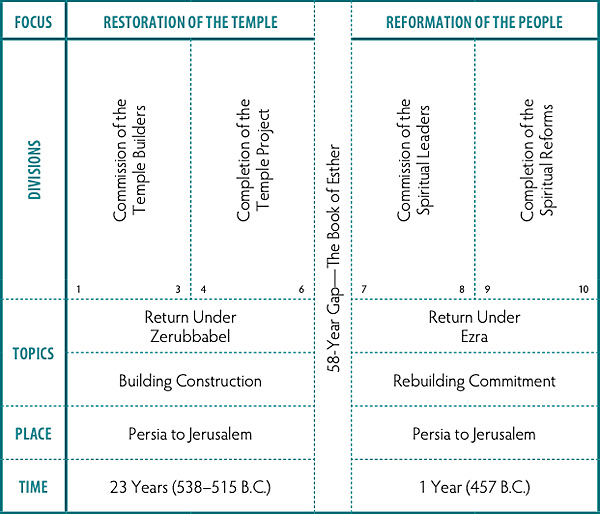
May 1
Ezra 1, 3

Overview
At last, the wearisome Babylonian captivity is at an end. With King Cyrus's declaration permitting the people to leave Persia and return to their homeland, the hard work of rebuilding the nation can begin. Nearly 50,000 pilgrims journey with Zerubbabel back to Jerusalem to rebuild the temple. But laying the temple foundation brings tears of remembrance as the builders recall the splendor that was once Solomon's temple-a splendor they could not regain.
Your Daily Walk
How long have you lived at your present location? Statistically, if you are an American and have lived in the place you call home for seven years or longer, you are a vanishing breed.
Pulling up stakes is never easy. Anticipation and anxiety can make the ordeal as difficult emotionally as it is physically. Consider the caravan of pioneers listed in Ezra 2. The walk ahead of them was long, nearly a thousand miles. There was the constant danger of ambush from robbers, especially since the people were transporting a wealth of temple treasures (1:9-11). Notwithstanding, God had stirred people's hearts to respond to the invitation of a pagan monarch. With such internal compulsion and external confirmation, how could they help but move out for God?
Is God calling you to pull up stakes-to move to a new home, a new school, a new job, a new level of commitment to Him? Then here is a motto to copy and display in your home or office: Even a dangerous journey of a thousand miles can be faced confidently when God is leading the expedition.
Insight - Cyrus, God's Pagan Messiah
About 150 years before the dramatic proclamation of Ezra 1:1-4, the prophet Isaiah delivered a detailed prophecy concerning King Cyrus (Isaiah 44:28-45:7). Because the Lord would prompt Cyrus to do all these things for the Jews, he is called "my shepherd" (44:28) and "[My] anointed" (literally, "messiah"; 45:1).
____________________
May 2/3
Ezra 4:1-5, 24; 6:13-22

Overview
The task of rebuilding the temple involves more than simply organizing men and materials. Antagonism from local citizens soon arises, threatening the project. Deceitful offers of help, open attack, false accusations-each must be handled by Zerubbabel with conviction and courage. Although construction has been temporarily halted, the prophets Haggai and Zechariah emerge to exhort the people not to give up. Darius, a new and sympathetic Persian king, at last ends the 15-year construction delay by reconfirming the decree of Cyrus: God's temple must be completed!
Your Daily Walk
Ours is an instant society in which immediate results have almost become the rule. Fast, quick, and easy are the buzzwords of our busy lives. Yet, many endeavors for God will only be accomplished if the long-range perspective is maintained. Parenting a child, developing a spiritual gift, discipling a new Christian, acquiring an education, teaching a Sunday school class, all these take the investment of years of practice, patience, and perseverance for the goal to be achieved.
If Zerubbabel had allowed the short-term discouragements to deter him from his long-range determination to rebuild the temple, he never would have finished the task. But with his goal clearly in view and his faith firmly fixed in God, Zerubbabel remained on target for more than 20 years.
Complete this prayer: "Though I may not experience instant success in my goal of ________________ with God's help I will commit myself to be faithful one day at a time, beginning today."
Insight - Ezra the Priest-Which Way Did He Go?
In a book titled "Ezra," you would expect the man to play a prominent role. With the help of a Bible concordance (or just by retracing your steps), see how many times Ezra's name appears in the first six chapters. The answer may surprise you.
____________________
May 4
Ezra 7:11-28; 8:31-36

Overview
Chapter 7 breaks a 58-year silence by introducing a priest and teacher named Ezra. Another kingly proclamation, this time by Artaxerxes, sets the stage for Ezra's return to Jerusalem, accompanied by 1,753 priests, Levites, and laymen. After praying and fasting, Ezra and his caravan begin the four-month journey, weighed down with treasures for the temple yet buoyed up by their confidence in God.
Your Daily Walk
Have you ever tried to help God by doing what He has already promised to do Himself?
Abraham tried it (Genesis 16) by fathering Ishmael, even though God had promised to give him a son by Sarah. Saul tried it (1 Samuel 17:38-39) by covering David with the king's bulky armor, though the young shepherd boy knew God wanted him to use a different method to kill the giant Goliath.
Ezra was tempted to try it too. When presented with the chance to enlist pagan soldiers and horsemen for protection against enemies along the way, Ezra went to his knees and received the assurance of something he had previously told pagan King Artaxerxes: "The gracious hand of our God is on everyone who looks to him, but his great anger is against all who forsake him" (8:22). Armed with that confidence, Ezra and the people set out on a four-month adventure in trusting God. God proved His faithfulness once more!
What human crutch are you tempted to turn to when things get tough? To your checkbook? Investments? Friends? Job security? Spouse? Or do you turn to the Lord? Turn to Him right now in confident prayer, and watch Him guide your pilgrimage.
Insight - Three Leaders, Three Backgrounds
God chose three very different men to lead the three Jerusalem "homecomings." Zerubbabel was a prince of Judah; Ezra was a priest and Levite; and Nehemiah was a politician from an unspecified tribe.
___________________
May 5
Ezra 9:1-10:17

Overview
Upon his arrival in Jerusalem, Ezra is greeted by reports of pollution in the city. Spiritually mixed marriages, expressly forbidden in the Law of God, are taking place among people and the priesthood alike. The news brings instant anguish to the "teacher well versed in the Law of Moses" (7:6). Identifying himself with his disobedient countrymen, Ezra intercedes with an emotional prayer of confession. The guilty parties, moved by Ezra's example, assemble to bring about change appropriate to repentance. Even though it's the rainy season, the difficult, time-consuming work of restoring purity in Israel's families begins.
Your Daily Walk
The statement, "Confession is good for the soul," is not a biblical quote, but it is a biblical concept. Look up the following verses to see what each says about the importance of confession:
Acts 19:18-20
James 5:16
1 John 1:9
Real confession involves two elements: (1) an acknowledgment of wrong committed, and (2) a forsaking of wrong conduct. Chapters 9-10 of Ezra describe a situation that demanded both acknowledging ("We have been unfaithful," 10:2) and forsaking ("Separate yourselves," 10:11). Though the cure was painful, God found pleasure in the nation's prompt and wholehearted confession.
Is confession overdue in your life today? There's no better time to complete this prayer: "God, I acknowledge that I have sinned against You, and beginning today with Your help I will forsake ________________."
Insight - Putting Yourself into Your Prayers
More than 30 occurrences of the plural pronouns us, we, and our in Ezra's prayer of intercession (9:5-15) show that Ezra, though innocent of the charges, identified himself with the condition of his countrymen. Do you pray that way for your family, church, and nation?
____________________
Nehemiah
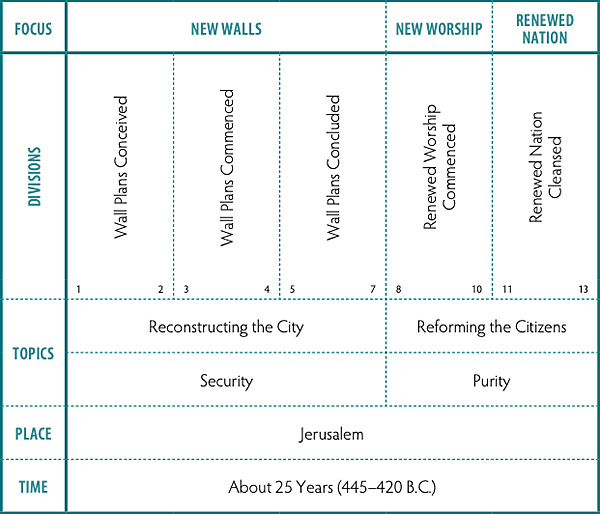
May 6
Nehemiah 1:1-2:8

Overview
Nearly a century has passed since Zerubbabel led the first group of Jewish hostages from Babylon back to their homeland. But though the temple stands erect, inviting worshipers from near and far, the walls lie in rubble, inviting enemy attacks. Nehemiah, cupbearer to King Artaxerxes of Persia, hears this heartbreaking news. With a carefully and prayerfully conceived plan, he is ready when the king inquires: "What is it you want?" (2:4). Accompanied by army and cavalry units, Nehemiah returns to Jerusalem to inspect the damage and infuse his countrymen with the will to raise the walls.
Your Daily Walk
What would you think of a person who, upon plugging in an iron and finding that it didn't work, responded, "Well, I guess it just wasn't God's will for it to get hot"? Irons are supposed to get hot! Appliances are supposed to work. And when they don't, you need to check the connections, because something is obviously wrong. You expect a hot iron-and rightly so.
Now consider your prayer life. Does it "get hot"? That is, does God answer your prayers in regular, discernible ways? Or are you surprised when an answer to prayer comes? Your expectation should be answered prayer, for God has staked His reputation on it. Nehemiah learned that exciting truth, and you can, too.
Spend a few extra minutes basking in these biblical prayer promises: Jeremiah 33:3; Matthew 7:7-11; John 16:24; 1 John 5:14-15. Pick one and "plug it in" to your prayer life today. Watch for God's answer, and be thankful when it comes. That's what prayer is all about.
Insight - Persian Cupbearer: Servant or Something Else?
Nehemiah was more than a royal waiter. He was also a confidante, advisor, administrator, bodyguard, and food taster (to protect the king from poisoning)-a position of high trust and authority. Today, we would call him a prime minister.
____________________
May 7
Nehemiah 4

Overview
Nehemiah's dream of rebuilding the walls now becomes contagious! The people rise up in unison, trowels in hand, to begin repairing the eight gates and more than two miles of wall surrounding the city. Nehemiah's strategy is simple: give each person a vested interest in the work. To ensure both speed and the quality of workmanship, he assigns each worker the portion of the wall closest to their own house. It's difficult to do a sloppy job when you know that if enemies break through a defective portion of the wall, the first people jeopardized will be your own family. But soon, the entire project is threatened by outside opposition. Harmless ridicule gives way to threats of violence, and Nehemiah responds with a combination of prayer and preparation.
Your Daily Walk
"Pray like it's up to God; then act like it's up to you." Although those words are not scriptural, they contain more than a germ of truth. Over and over, God has told you to take your problems and anxieties to Him. "Do not be anxious about anything, but in everything, by prayer and petition, with thanksgiving, present your requests to God" (Philippians 4:6). Take a lesson from Nehemiah. When troubles come, turn your problems into prayers-pronto.
But once you have prayed through your problems, don't expect angels to finish building your walls. Pick up your trowel and finish the job God has given you. "So that the LORD your God may bless you in all the work of your hands" (Deuteronomy 14:29).
Pick a situation in your life that needs prayer coupled with preparation. Pray it through, work it out, and watch the results.
Insight - The Special Gate for God
The East Gate (3:29), through which the Shechinah glory (a visible manifestation of God's presence) left, is also the gate by which Ezekiel sees God's glory return (Ezekiel 43:1-17) to reside in the temple's Holy of Holies during the Kingdom Age, as he had seen its departure during the fall of Jerusalem.
____________________
May 8
Nehemiah 5; 6:15-19

Overview
Internal strife in the Israelite camp causes as much unrest as the battle thrusts from outside the camp. The people are suffering under financial stress imposed by their Persian masters. Worse yet, the Israelites are exacting interest from their own brothers who have borrowed to pay their debts. After correcting this abuse, Nehemiah again turns his attention toward the threats from neighboring enemies. He is not ensnared by an assassination plot on his life, nor will he be intimidated by the threats of a slanderous letter. After 52 days of building and battling, the walls stand completed. At last, the holy city of Jerusalem can be resettled.
Your Daily Walk
How do you react when you see the poor exploited? Does your heart beat a little faster? Now imagine it is a member of your family being exploited. How would you respond to that?
Lack of grain and oppressive Persian rule had forced some of the Hebrews in Jerusalem to mortgage their homes and sell themselves into slavery in order to pay their debts. When Nehemiah heard that the rich were extorting money from their own countrymen, his reaction was immediate and unmistakable.
You may never have exacted interest from someone suffering hardships, but have you been guilty of taking advantage of another Christian by ignoring his difficult circumstances? Leave your money at home today and let your empty wallet remind you of the usury tactics of Nehemiah's day. Then look for a way to assist, rather than simply avoid, a Christian brother or sister who is in difficult financial straits.
Insight - Doing Wrong to Do Right Is Wrong, Right?
Shemaiah's offer of safety in the temple to Nehemiah (6:10-14) was a direct violation of God's Law, which forbade anyone other than priests from entering the sanctuary. Even if Shemaiah had been telling the truth (which he wasn't), for Nehemiah to enter the temple would have been a fatal mistake.
____________________
May 9/10
Nehemiah 8:1-12

Overview
The first half of Nehemiah's account describes the construction of the city walls; the second half contains instructions for the city worshipers. Beginning with chapter 8, the account becomes biographical rather than autobiographical, as Nehemiah addresses the spiritual rather than the physical well-being of the inhabitants of Jerusalem. Revival breaks out when the Word of God is translated, broadcast, and explained for the common people. Ezra's preaching produces heartfelt confession, wholehearted worship, and a refreshing resolve to bring the nation's wayward conduct in line with its covenant relationship with God.
Your Daily Walk
This evening, as a family, with a friend, or just by yourself, go through your house and gather up every trace of Scripture you can find: every Bible, Bible motto or poster, every hymnbook or gospel recording, every gospel tract or Christian biography. Pile them all together. Then strike a match as you ponder this sobering thought: Someday you may lose the priceless freedom you enjoy today of surrounding yourself with God's Word. (Now, blow out the match.)
If that ever happened, how much of God's Word would you have hidden away in your heart, where no tyrant can invade (Psalm 119:11)? Ezra's reading of the long-neglected Book of the Law produced tears of gladness and grief-gladness over the return of God's Word to its proper place in the nation, and grief that the nation had drifted so far from God's will and way. It could never happen in your country-or could it? And isn't it worth five minutes of daily prayer to help see that it won't?
Insight - Ezra, the Elusive Priest
Just as Ezra did not appear until chapter 7 of the book that bears his name, he also does not appear until chapter 8 of the Book of Nehemiah, a natural dividing point for the book. Chapters 1-7 center on God's work in building the wall; chapters 8-13 focus on God's worship in obedience to the Law.
____________________
May 11
Nehemiah 13

Overview
With his time in Jerusalem nearly at an end, Nehemiah busies himself with the final duties of his mission. He oversees the redistribution of the population in the cities: one-tenth in Jerusalem and the rest in the surrounding suburbs. A joyous celebration is held in which two processions of praising people march along the walls to dedicate them to God. Nine years after returning to Persia, Nehemiah hears disturbing news from his homeland once more. He returns to correct abuses in the temple and deal with the stubborn problem of mixed marriages.
Your Daily Walk
It is sad but true that those who do not learn from history are destined to repeat it. The closing chapters of Nehemiah provide a sobering warning and an opportunity to learn from the past.
The people under Nehemiah had made several vows in chapter 10. They agreed to obey God's Word, abstain from intermarriage with pagan people, keep the Sabbath, and support temple worship. Less than a decade later, they had broken every promise.
Today would be a great time to renew old promises and vows before the Lord. Are you married? If so, spend some quiet time with your spouse, reminding each other of the vows you made on your wedding day. Confess your areas of failure, and praise your spouse for faithfully keeping your vows.
If you are a single, never-married Christian, you have an extra privilege (and responsibility) to serve God with undivided attention during your single years (1 Corinthians 7:32-33). Use that privilege today.
Insight - Nehemiah's Prophetic Partner
Malachi, who lived and ministered during the same time as Nehemiah, spoke to the moral condition of the Jews who returned to Jerusalem. You might want to read his short four-chapter book alongside Nehemiah. Malachi paints a bleak picture of cold-hearted indifference toward God-a condition that persisted for 400 years until the appearance of the Promised One (John 1:29).
____________________
Esther
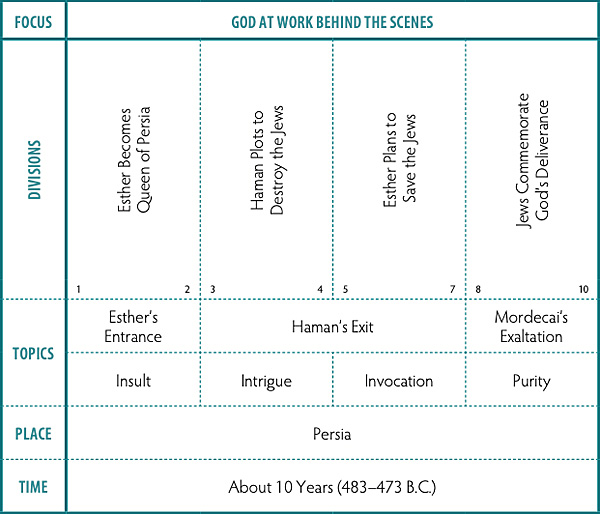
May 12
Esther 1:1-12; 2:8-23

Overview
Xerxes, the Persian king, hosts a sumptuous banquet for his court officials. After a week of partying, the king calls for Queen Vashti to entertain the guests. When she denies his request, he banishes her from the palace in a fit of anger and embarrassment and begins the search for a new queen. Esther, a beautiful Jewish orphan raised by her cousin Mordecai (2:7) and living in exile under Nebuchadnezzar, rises above the competition and wins the king's heart. Through Mordecai, Esther learns of a plot against the king and tells him in time to save his life. The heroism of Mordecai is duly recorded in the official records and promptly forgotten.
Your Daily Walk
If anyone ever had reason to have vengeful thoughts, it was Mordecai. When he was first deported under Nebuchadnezzar's army in 597 B.C., Mordecai's family was transported hundreds of miles from their homeland. Life in exile was the only life Mordecai had ever known.
If anyone ever had occasion to translate vengeful thoughts into action, it was Mordecai. Unknown to the king (but well known to Mordecai), an assassination plot was afoot. It would have been easy for Mordecai to remain silent, reasoning that the Lord's vengeance was at work at last. But instead, Mordecai risked his life to save the king.
What would you have done in a similar situation? Look up the following verses and see what each has to say about the way God wants you to respond to those in authority over you: Romans 13:1-7; 1 Timothy 2:1-2; 1 Peter 2:17. Now complete this sentence: "Instead of getting even, with God's help I will respond to someone who deserves my vengeance by ________________."
Insight - The Girl Who Went from Rags to Riches
Esther changed overnight from an obscure Jewish girl to the queen who had at her disposal up to "half the kingdom" of Persia (5:3). That kingdom extended from modern-day Greece (west) to India (east) and from southern Russia (north) to Saudi Arabia (south), an area of more than 600,000 square miles!
____________________
May 13
Esther 3:1-6; 4:13-17

Overview
After Mordecai's heroic deed, the villain Haman enters the drama. Enraged by Mordecai's refusal to bow down to him in reverence, Haman devises a sinister plot to exterminate Mordecai along with every Jew in Persia. The superstitious throw of the dice determines the date of his proposed massacre, and the 11-month countdown begins. When Mordecai confronts Esther with the danger of Haman's plan, she is left with a painful choice: either approach the king (and possibly lose her life) or remain silent (and allow the annihilation of her people and herself).
Your Daily Walk
Make a mental list of things you know about yourself that no one else knows: details that could be used against you if they were public knowledge. Now consider that Esther's secret ancestry went from an asset to a liability overnight. The same Jewish ancestry that provided her incredible beauty now put her life in jeopardy. She could have turned her back on her "roots" and her countrymen, enjoying the protection of the palace. Instead, she identified herself with the people of God and made herself available for God's service.
Are you tempted to disqualify yourself from God's service because of something in your background? Perhaps God has raised you up "for such a time as this" (4:14). But before God can use you, He must possess you, assets, liabilities, and all.
Insight - Moses, Esther, and Who?
Esther could have turned her back on the plight of the Jews and relied on the privilege of her rank and the protection of the palace. This was also true of Moses. He abandoned all the privileges of the Egyptian palace and "chose to be mistreated along with the people of God rather than to enjoy the pleasures of sin for a short time" (Hebrews 11:25). Can you think of anyone else who abandoned kingly privileges to rescue His people?
____________________
May 14
Esther 5, 7

Overview
Fortified by faith, Esther courageously enters the king's court to present her request. Wisely, she invites the king and Haman to a special banquet in their honor and uses the occasion to invite them to a second banquet. Before the second banquet takes place, however, three events happen in rapid sequence: Haman builds an enormous gallows for hanging Mordecai; King Xerxes discovers Mordecai's previously overlooked act of bravery in saving his life; and Haman is forced to endure the humiliation of bestowing on Mordecai the very honor that he himself so greedily craved. At the second banquet, Esther uncovers the plot against the Jews, and then Haman is hanged on his own gallows.
Your Daily Walk
Toss a coin in the air, and see how many times in a row you can correctly guess which way it will land. Statistically, if you succeed five times in a row, you have done what only one person in 32 might be expected to do.
In the first seven chapters of Esther, at least a dozen events show the fingerprints of God's sovereign control, including Esther's coronation, Mordecai's forgotten act of bravery, Haman's lots, Esther's uninvited audience with the king, the timing of Esther's two banquets, and the king's insomnia. (Can you suggest six more?) The odds of 12 events happening in consecutive order by chance are one in 479 million! Incidentally, the "odds" of this happening in God's sovereign plan are one in one. Both the what and the when of life are under His loving control. Take a minute to acknowledge that fact before Him right now in a prayer of praise for His providence in your life.
Insight - The Fickle, Forgetful Monarch (6:1-11)
During his sleepless night following Esther's first banquet, King Xerxes learned that Mordecai's act of heroism had been duly recorded in the court chronicles. The king instructed Haman to give Mordecai the equivalent of a modern-day ticker-tape parade, completely forgetting he had just signed an edict to exterminate the Jews.
____________________
May 15
Esther 8:1-9:19

Overview
Haman is dead, but his murderous decree against the Jews lives on. Though a "law of the Medes and the Persians" could never be reversed, its effects could be counteracted by a subsequent decree. The king issues a new edict permitting the Jews to defend themselves throughout the empire on the day Haman had selected to annihilate them. The Feast of Purim is inaugurated as an annual celebration to commemorate this historic deliverance of the Jewish people.
Your Daily Walk
What do the following words have in common: Tishri, Chislev, Nisan, Adar, and Sivan?
Answer: They are all months in the Jewish calendar. For the devout Jew, the calendar was more than a way of marking time. It provided a ready-made way to annually recall God's dealings in the life of the nation. Nisan marked Passover, the time of Israel's deliverance from Egyptian bondage. Sivan brought the Feast of Pentecost, the celebration of yet another bountiful harvest from God. Tishri took the people back to their wilderness wanderings through the Festival of Booths. Each holiday became a holy day-a time of recalling, repenting, and renewing commitments to follow the God of Israel.
Why not establish your own annual "Feast of Purim," a time when you and your family rehearse God's special provisions over the past year? Begin tonight.
Insight - Present-Day Purim
Devout Jews observe Purim as follows: The day before (the 13th of Adar) is kept as a day of fasting in accordance with the command of Queen Esther (4:15-16). As soon as the stars appear, candles are lit, and the Book of Esther is read in the synagogue. Every time the name of Haman is mentioned in the reading, the congregation stamps on the floor exclaiming, "Let his name be blotted out. The name of the wicked shall rot!" The rest of the festival involves feasting, games, and gift-giving.
____________________
April 16
1 Chronicles 11, 13, 15

Overview
Think of 1 Chronicles as a sort of "divine commentary" on the Book of 2 Samuel, a second volume covering the action-packed life of King David. With the passing of Saul, the new shepherd-king assumes the throne and promptly establishes his new capital at Jerusalem, the place around which virtually the entire history of the nation will revolve. Along with his new capital, David selects a corps of mighty men who will support him during his reign. David next attempts to return the ark of God to its proper place-a task that proves more difficult than anticipated. But when at last the ark safely resides in Jerusalem, David leads the nation in a celebration of praise.
Your Daily Walk
No man is an island... and very few are peninsulas! It is difficult and often dangerous to attempt to stand alone without the support of others who share your convictions and commitments.
Today's reading devotes 78 verses to the naming of David's mighty men: his trusted friends, confidants, bodyguards, and counselors-in short, the backbone of his kingly court. Without them, David might never have risen to the greatness that he would ultimately achieve. Even though his role as king was unique in the nation, God never intended David to function as a solo performer in the palace.
Perhaps you will never rise to the place of power and prominence of King David. But everyone can be a mighty man or woman in the life of another person. Think about those who exercise leadership over you, such as your pastor or boss. First Chronicles 11:10 says David's mighty men gave him strong support in his kingdom. Can that be said of you in your support of your pastor? Your boss? What are one or two ways you can do something "mighty" for them this week?
Insight - A Thoroughly Anointed King
David's anointing as king over all Israel (11:3) was, in fact, his third anointing. The first was done privately by Samuel (1 Samuel 16:13), the second publicly as king over Judah (2 Samuel 2:4).
____________________
April 17
1 Chronicles 17-18

Overview
While David enjoys a palace of cedar, the ark of God resides in a mere tent-a fact that prompts David to contemplate a monumental building project. Even the prophet Nathan encourages David in his God-honoring ambition. But then, through the prophet, God delivers a ringing "You are not the one" (17:4) along with a heartwarming promise of an ongoing dynasty and an eternal kingdom for David's descendants. However, David, the mighty man of war, must leave the fulfillment of his dream to his son Solomon and concentrate instead on the business of enlarging the kingdom God has entrusted to him.
Your Daily Walk
Consider the following contrasts taken from the lives of a father and son: David and Solomon.
David was a man of war; Solomon was a man of peace. David dreamed of building the temple; Solomon erected and dedicated the temple.
David was told by God, "I will not give you what you asked for." Solomon was told, "I will give you what you did not ask for." Yet, despite the differences in their lives, there is one resounding similarity: both men glorified God in their lifetimes.
There is something far more painful than being denied a cherished dream or ambition, and that is undertaking the ambition anyway, only to find that God is not in it. Has God set up a red light in your path? And are you ignoring the signal or looking for alternate routes to His glory? Each time you stop for a red light today, commit one of your dreams or goals to God. Where He has put a period, don't put a question mark.
Insight - No Cover-Up Intended!
David's sin with Bathsheba and his subsequent murder of Uriah took place between 20:1 and 20:2. In his intention to focus on themes of true worship and true kingship in the nation's history, the Chronicler was selective in his choice of material. He omitted details of David's private life, not because he wanted to whitewash the past, but because he knew those incidents were already known and recorded.
____________________
April 18/19
1 Chronicles 22-23

Overview
Though David's desire to build a house for God must wait, nothing keeps him from preparing for it. He chooses the most appropriate site (the threshing floor of Ornan), gathers the building materials, charges his son Solomon with the duty of finishing the task, and enlists the support of all the key men in Israel. Then he outlines the 24 orders of priests, 24 divisions of singers and musicians, gatekeepers, treasurers, and other officeholders who will oversee the nation's military and civil affairs in its new place of corporate worship.
Your Daily Walk
What are you doing today to help your children accomplish great things for God tomorrow?
David is a marvelous example of a farsighted father. The greatness that Solomon would later achieve was, in large measure, due to the careful planning and provision that David made before his own death. Though Solomon receives the acclaim for building the temple, which bears his name, it was David who drew the blueprints, gathered the materials, hired the workers, and instituted a vigorous public relations program to secure support for the project. In his heart, David envisioned a greatness for Solomon that he himself would never achieve, and he did his best to pave the way for it.
What sort of heritage will you leave for your children and even your grandchildren to build upon? Will they someday be able to thank God for your foresight in building a library, providing for their education, or instilling a vision for ministry that they can carry on after you are gone? Plan a "Project for Future Greatness" and begin it this week.
Insight - An Ironic Twist to the Priestly Office
In chapter 24, the priests were divided into 24 orders or "divisions" for service in the temple. They were called "officials of God" (v. 5) and had charge of the sacrifices. Their work was to cease with the coming of Christ, but ironically, it was the priests themselves who engineered the crucifixion of Christ (Matthew 27:1, 6, 20, 41).
____________________
April 20
1 Chronicles 29:22-30

Overview
Today's reading forms a fitting conclusion to David's life, for here he is portrayed in all his wisdom and humility as David the counselor, encourager, exhorter, and worshiper. In sharp contrast to the bitter infighting and civil unrest that characterized David's ascension to the throne, Solomon's ascension is attended by national worship and rejoicing. Even David's death cannot dampen the nation's optimism and thanksgiving for the godly leadership they enjoy. The crowning epitaph of David's life is that "he died at a good old age, having enjoyed long life, wealth and honor" (29:28).
Your Daily Walk
The saddest contradiction to the Christian life is all too often the average Christian funeral. While grief is a necessary part of any loved one's passing, the Christian has cause for rejoicing when a brother or sister in Christ is finally "away from the body and at home with the Lord" (2 Corinthians 5:8). There is hope and comfort in those words that the world knows nothing about.
The one sermon you can be sure everyone important to you will hear is the one preached over your casket. Have you given any thought to the words you want spoken on that occasion? Will those in attendance hear a clear presentation of the good news of Jesus Christ? Will they find out why you could face death fearlessly, knowing it would bring you face to face with your Lord?
Jesus Christ turned every funeral He ever attended into a cause for celebration. The morbid wailing of the mourners would be cut short by the miraculous life-giving touch of the Savior, and the dead would live again. What plans are you making today to ensure that your funeral speaks as eloquently as your life, that "to live is Christ and to die is gain" (Philippians 1:21)?
Insight - David's Building and Loan Association (29:1-9)
Before David's death, he had diligently gathered a temple-building fund of gold and silver from personal and national contributions that, by modern standards, would be valued at several billion dollars.
____________________
2 Chronicles
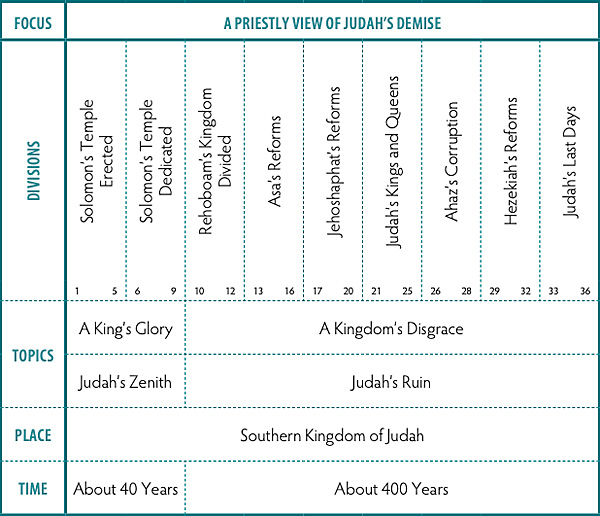
April 21
2 Chronicles 1, 5

Overview
A father's dream becomes a son's delight as Solomon undertakes the greatest architectural feat of his lifetime: building the temple in Jerusalem. Large numbers of men and great quantities of materials, plus seven years of Solomon's life, are invested in the task of completing the house of the Lord. When at last the temple stands finished with the ark of the covenant in place, Solomon leads the people and musicians in heartfelt praise to God. "They raised their voices in praise to the LORD and sang.... The glory of the LORD filled the temple of God" (5:13-14).
Your Daily Walk
When commissioned by God to do a job, Solomon allowed nothing to stand in the way of completing his God-given assignment. With breathtaking speed, he organized more than 150,000 workers and tons of materials.
Solomon's zeal and enthusiasm for God left scant time for coffee breaks as long as there was still work to be done. If you were to evaluate the degree of your own enthusiasm for God's service, where would it fall on the following scale?
30 - Sorry, not available.
70 - Do I have to?
100 - It's my duty. / It's my delight!
By the time you get your shoulder to the wheel, your nose to the grindstone, and your ear to the ground, it's usually time for lunch.
This month, you learned to do everything "as working for the Lord" (Colossians 3:23). Now add this thought from 1 Corinthians 10:31: " Do everything honorably for the glory of God."
Insight - Gold, Gold, Everywhere
Nearly every feature of the temple, including the walls, doors, nails, and furnishings adorned with gold or gold overlay, was made possible by King David (1 Chronicles 22:14), who set aside 3,750 tons of pure gold from his personal treasury. In 1 Chronicles 29:4, David gave an additional 100 tons of gold.
____________________
April 22
2 Chronicles 6, 9

Overview
In a setting fit for a king's inauguration, Solomon now leads the nation in dedicating the newly completed temple to the glory and worship of the God of Israel. Kneeling on a specially constructed bronze scaffold, Solomon prays one of the most majestic and moving invocations found anywhere in the Bible. He overflows with praise to God, thanking Him for His unchanging character and unfailing promises on behalf of the nation. When Solomon finishes, the glory of God fills the temple, prompting the people to respond, "He is good; his love endures forever" (7:3). But even amid worship and rejoicing, there is cause for concern. By night, God appears to Solomon to warn him that if the nation fails to remain true to Him, He will uproot them from their beloved homeland and will destroy the magnificent temple which they have labored so long to complete.
Your Daily Walk
What do these three words have in common: salt, magnet, light? Answer: They are all descriptions of your task as a Christian.
Each day that God leaves you here on earth, you are to be like salt (making others thirsty for God), a magnet (drawing others to God), and light (showing the way to God). The queen of Sheba came hundreds of miles to learn of the wisdom and wealth of Israel's king (9:1). Notice her conclusion: "Praise be to the LORD... who has delighted in you and placed you on his throne as king to rule for the LORD" (9:8). After looking at Solomon's life, the queen gave glory to Solomon's God. Is that what happens from day to day when others rub shoulders with you? Today, remember your God-given role, salt, magnet, light, and practice it.
Insight - Great Achievements of a Great Monarch
Chapter 8 describes more than a dozen of the major accomplishments of Solomon's reign militarily, architecturally, religiously, and commercially. How many can you find?
____________________
April 23
2 Chronicles 10

Overview
Solomon is barely cold in his grave when the nation turns from worship to waywardness in its commitment to God. Solomon's son Rehoboam imposes a foolish tax increase, sparking bitter division in his kingdom. On the verge of civil war with Jeroboam (the newly established king of the northern 10 tribes), Rehoboam heeds the prophet's word and ends the conflict. But once his kingdom is established, he forsakes the Law of the Lord yet again. God sends a stinging rebuke in the person of Shishak, king of Egypt, who defeats Rehoboam's army and plunders the wealth of the Lord's house.
Your Daily Walk
Is your religion
... like a spare tire? (You only use it in an emergency.) like a wheelbarrow? (Easily upset and must be pushed.)... like a bus? (You ride it only when it goes your way.)... like a pacemaker? (You rely on it constantly.)
Rehoboam's up-and-down spiritual life could be likened to a spare tire. When times were tough, he turned to God; when things were running smoothly, he forsook the Lord. It may remind you of God's words through the prophet Hosea: "They were satisfied, they became proud; then they forgot me" (Hosea 13:6).
Take stock of your own life. Are things going smoothly? All bills paid? Enjoying good health? No major conflicts in your family, church, or neighborhood? Job secure? Refrigerator full? Watch out. Satan would love to trip you up by turning your eyes away from the Source of your supply. On the memo line of each check you write today, add the words "Don't forget!" This might even provide an opportunity to witness for your Lord.
Insight - "Dear Diary, Today I Plundered a Temple..."
Inscriptions found on Egyptian temple walls show Shishak's military success in plundering the Jerusalem temple during Rehoboam's reign (12:9). One picture shows Shishak holding a group of Israelites by the hair and hitting them with a club-a painfully accurate rendering.
____________________
April 24
2 Chronicles 15-16

Overview
Abijah, king of Judah, is used by God to discipline and defeat Jeroboam, king of Israel. During their battle, 500,000 Israelites fall, a shattering defeat from which Jeroboam will never fully recover. What Abijah accomplishes in the military sphere, Asa attempts to duplicate in the spiritual realm. He removes all traces of foreign religion from the land and commands the people to return to the careful observance of God's statutes. But toward the end of his reign, Asa faces a threat from Baasha (king of Israel) and seeks an alliance of protection with the king of Syria. Even on his deathbed, he puts his trust in earthly physicians alone, rather than in the Great Physician.
Your Daily Walk
Have you ever found yourself in a seemingly hopeless situation, one in which you looked at your circumstances and felt fear? Or despair? Or discouraged? What did you do? Did you try to fix the situation yourself? Or did you ask God to step in? Things were looking bad for King Asa. Baasha, the king of Israel, had sealed off all escape routes, and the situation looked hopeless. So Asa, instead of asking God to help, turned to the king of Syria, Ben-hadad, and bribed him to come to his rescue. On the surface, the strategy worked.
But God saw it differently. Earlier, Asa had trusted in the Lord, not in foreign powers. Now he was turning from trust in God to trust in himself, and God disciplined him.
What is the pattern of your life: belief in God, belief in yourself, or belief in others? Faith or sight? God or self? Each time you are tempted to rely on yourself, remember that it's always safe to trust the Lord.
Insight - A Dubious Distinction (16:7-10)
Hanani the seer, who condemned Asa for his reliance on foreign armies rather than on the Lord, becomes the earliest "persecuted prophet" in the pages of the Bible. (Check Luke 11:47-51 for the name of one other man who, though seldom thought of as a prophet, might also lay claim to this rather dubious distinction.)
____________________
April 25/26
2 Chronicles 17, 20

Overview
Only 10 verses are given to godly King Jehoshaphat in 1 Kings, but the chronicler devotes a full four chapters to his life, and with good reason. Jehoshaphat knows that the key to spiritual revival in the nation is a renewed interest in and commitment to the Law of the Lord. He institutes a nationwide "Bible study program," using the princes, Levites, and priests as teachers, an effort that God richly blesses with peace and prosperity. In contrast to his predecessors, Jehoshaphat manages to make peace with the king of Israel. But a friendly visit nearly costs him his life as he becomes entangled in a war between Israel and Syria. His reaction to divine rebuke, his appointment of judges to rule not "for man but for the LORD" (19:6), and his Godward response in the face of crisis all point to the day-by-day reality of his faith.
Your Daily Walk
Chapter 20 describes perhaps the most curious battle scene found anywhere in Scripture. Jehoshaphat leads his army out to confront the combined forces of Moab and Ammon. His battle plan is simple: "Take up your positions; stand firm and see the deliverance the LORD will give you" (20:17). Then, as if to add insult to injury, Jehoshaphat selects singers to go before the army and chant choruses of praise. While the singers sing and the soldiers stand at attention, God produces a mighty victory for Judah as the enemy forces "helped to destroy one another" (20:23).
Have you yet learned the lesson Jehoshaphat and the people of God learned? When the battle seems overwhelming, when the enemy is large and imposing, don't turn and run. Instead, stand still, sing out, and watch God work.
Insight - A Big Mistake
Jehoshaphat's alliance with Ahab (18:1-19:11) was a serious blunder, fully deserving the rebuke of the prophet Jehu (not to be confused with Jehu, grandson of Nimshi, who later wiped out the line of Ahab). The prophet's question, "Should you help the wicked and love those who hate the LORD?" (19:2) rebuked Jehoshaphat and prompted him to restore justice and priestly order in Judah.
____________________
April 27
2 Chronicles 21-22

Overview
Jehoram's life is living proof that a bad marriage can undo even the best of upbringings. Raised by a godly father and grandfather, Jehoram marries the wicked daughter of Ahab and Jezebel, embraces her pagan deities, and leads the nation into idol worship once again. The atmosphere of trust and affection that characterized his father's administration is replaced by a mood of suspicion and jealousy. As Jehoram's first public act, he slays all his brothers and many key rulers in the nation-a move designed to secure his position as king, but which in fact leads to an excruciating and premature death. In rapid succession, his son, wife, and grandson come to the throne in a tale of family intrigue that must be read to be believed. Joash and Amaziah both became long-reigning kings with halfhearted commitments.
Your Daily Walk
No matter how many good apples you pack around a rotten one, you can't make the rotten one good. But you can ruin an awful lot of good apples.
The same is true in the relationships people have with each other. One corrupting friendship is enough to drive a person away from God, even in the presence of countless righteous lives, provided that friendship is close enough and lasts long enough to exert its corrupting influence.
That's why your close friends will mark you for life. That's why your choice of a life mate is critically important. God states very clearly in His Word: "Do not be yoked together with unbelievers. For what do righteousness and wickedness have in common? Or what fellowship can light have with darkness?" (2 Corinthians 6:14). Examine your relationships. If you're courting disaster, make the necessary changes now-before the "rotten apple" becomes you.
Insight - The Unenviable Life of a Ruler in Judah
All five rulers discussed in today's reading met violent deaths. Four were murdered, and one was stricken by God with an incurable disease. Of the 20 rulers in Judah's history, half died from unnatural causes.
____________________
April 28
2 Chronicles 28

Overview
King Uzziah does mighty things for the nation of Judah, both militarily and architecturally. But spiritually, his life resembles a roller coaster. "As long as he sought the LORD, God gave him success.... But after Uzziah became powerful, his pride led to his downfall" (26:5, 16). Uzziah dies a leper's death for his half-hearted devotion to God. By contrast, his grandson Ahaz is wholehearted in his zeal for false gods and pagan practices. Ahaz introduces images of Baal, worship on the heathen high places, and infant sacrifice. Though God repeatedly warns Ahaz of the danger of his ways and to turn the king's heart back to Him, there is no response. Only one question remains: How long will God's patience continue with His rebellious people?
Your Daily Walk
In the carpentry business, a 2x4 can come in many different lengths. But every 2x4 has one thing in common: It is about 2 inches thick and 4 inches wide.
When God disciplines an individual, a family, a church, or a nation, He often does so through painful circumstances. And though it would be easy to liken such an experience to being "hit over the head with a 2x4," there is a fundamental difference: 2x4s used like that are for punitive reasons; God's discipline is therapeutic.
Think back over the life of Ahaz as you have seen it unfold in 2 Chronicles 28 and 2 Kings 16. How did God try to get his attention and change his course of action through defeat in battle? The word of the prophet? Enemy occupation?
Before you are too hard on Ahaz, is there a lesson God has been waiting patiently for you to learn as well?
Insight - A Pagan Practice Punishable by Death
Infant sacrifice by fire was a brutal Canaanite ritual introduced into Judah by Ahaz. Not only was it abhorrent for human reasons, it was also a capital offense under the Mosaic Law, punishable by stoning (Leviticus 20:1-5).
____________________
April 29
2 Chronicles 29, 32

Overview
The Assyrian assault and the dispersion of Israel are completely omitted at this point in the Chronicles account, even though they have a profound impact on Hezekiah's life and rule in Judah. Inheriting a disorganized country and a heavy tribute burden to Assyria, Hezekiah nevertheless puts first things first. In the very first month of his administration, he reopens and repairs the house of the Lord, restores the long-neglected temple worship and Passover celebration, and declares war on idol worship and pagan practices. When the Assyrian King Sennacherib besieges Jerusalem, and the situation looks hopeless, Hezekiah puts his faith to work once again in earnest prayer for deliverance. God answers his plea and crowns his life with prestige and power.
Your Daily Walk
Wouldn't it be wonderful to know that someone like Hezekiah was praying for you every day? Here was a man whose every recorded prayer was answered.
Wouldn't you like to have that kind of "clout" working for you? Then read and ponder the margin's sermon-in-a-sentence by Robert Murray McCheyne, Scottish missionary and preacher who never lived to see his 30th birthday. See Hebrews 7:25.
("If I could hear Christ praying for me in the next room, I would not fear a million enemies. Yet distance makes no difference; He is praying for me.")
Insight - "Dear Diary, It Was a Bad Day in Jerusalem..."
Sennacherib's own account of this invasion has been found on a clay prism he himself made. It is now in the Oriental Institute Museum in Chicago, and reads in part: "As for Hezekiah, king of Judah, who had not submitted to my yoke, 46 of his fortified cities ... I besieged and captured... 200,150 people... I took it as booty. Hezekiah himself was shut up like a caged bird in Jerusalem, his royal city. I built a line of forts against him, and turned back everyone who came forth out of his city gate."
No Assyrian king would ever record a defeat, especially one as devastating as the Jerusalem debacle, but it is significant that Sennacherib did not claim to have taken Jerusalem, a most remarkable confirmation of biblical history.
____________________
April 30
2 Chronicles 34; 36:17-23

Overview
The final century of Judah's national history reads like a bad dream. After Manasseh's 55-year reign of terror and apostasy, even a godly reformer like Josiah is powerless to prick the hearts of the people, though for a time he is able to stem the external appearances of evil. But after his death, the nation swiftly returns to its abominable ways. Oppressed and eventually overthrown by the Babylonians, the people of Judah are slaughtered, their homes and temple destroyed, their city walls leveled. The survivors are dragged off to Babylon, there to ponder their fate for 70 long years. But in the midst of this doom and destruction shines a ray of hope. Cyrus, king of Persia, issues a decree: The house of the Lord must be rebuilt in Jerusalem. Who among His people is willing to return?
Your Daily Walk
For the Jews, Jerusalem represented their place of greatest failure. To stare at the rubble of what was once mighty Jerusalem, with its shattered temple and broken-down walls, must have broken the heart of even the most callous of God's people. They had failed Him. They had gone their own sinful ways. And they had been punished.
Now, through Cyrus, God was calling His people back to "the scene of the crime" for a second chance.
Have you failed God in recent days, only to go into your own personal exile? Take heart, you are in good company. Abraham, Moses, and Jonah (to name a few) suffered similar setbacks. But they emerged from failure to accomplish great things for God. And you can too.
Is God calling you back to repentance, back to your family, school, job, or ministry? Will you answer that call right now?
Insight - Judah's Final Kings-Brothers in the Business
For more than three centuries, the kingdom of Judah had passed in an orderly fashion from father to son, interrupted only briefly by the reign of Queen Athaliah. But now, in Judah's final, frantic years, like a top winding down and toppling over, the kingdom passes quickly between three sons and a grandson of Josiah.
1 Kings
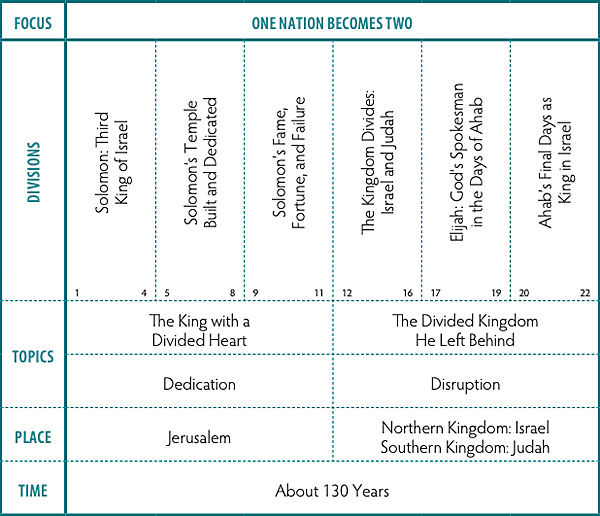
April 1
1 Kings 2:1-4, 3:3-15

Overview
King David's advanced years and restricted activity create a leadership vacuum that Adonijah seeks to exploit by proclaiming himself king. Though he enjoys the support of Joab, the general, and Abiathar, the priest, Adonijah is opposed by Nathan, Zadok, and others in David's administration. God had previously made it clear (and David had privately acknowledged) that Solomon was His choice to succeed David. Now is the time to make that declaration public and official. Solomon's anointing as the third king in Israel spells the beginning of the end for Adonijah's conspiracy. But while Solomon's position is secure, his need is great for godly wisdom to rule the kingdom-a request that God willingly grants. And God also provides the blessings Solomon could have requested but didn't: riches, victory, and honor.
Your Daily Walk
How would you respond if God appeared to you as He did to Solomon and extended a blank check invitation: "Ask for whatever you want me to give you" (3:5)? Be honest! Could you resist the urge to ask for riches, power, or fame? Is there anything in this world more lasting and important than financial success? Do you place wisdom over wealth in your priorities?
Solomon's response to God's offer is exemplary. First, he recognizes his need, saying, "I am only a little child" (3:7). Next, he recognizes his responsibility as king. And finally, he recognizes his resource, the wisdom of God. If you need wisdom, you can ask God. Turn to James 1:5 and pray that verse back to Him as the expression of your need for wisdom and as your desire to put His wisdom to work in one of your responsibilities today.
Insight - Following in His Father's Footsteps
David became known as "the sweet singer of Israel" for his skill in composing many of the psalms in Israel's hymnbook. But Solomon was not far behind. According to 1 Kings 4:32, he composed more than a thousand songs himself, of which Psalm 127 is an outstanding example.
____________________
April 2
1 Kings 6:1-14; 8:12-61

Overview
Today's reading features the realization of David's dream to build a house for God, a plan God said would be carried out by David's son (5:5; 2 Samuel 7:12-13). Solomon enlists the help of his father's friend Hiram, king of Tyre, to provide the cedar and fir lumber for the temple and royal palace. With keen organizational skills, Solomon assigns the conscripted laborers to work and seeks out a master craftsman to execute the intricate decorations. Though David's planning was inspired by the Spirit of God (1 Chronicles 28:11-12), the exact dimensions and details of the temple are not recorded in Scripture. However, the general pattern of the tabernacle and its court is followed. In his address to the people at the dedication of the temple, Solomon offers a majestic prayer to God with the oft-repeated refrain, "Hear from heaven... and forgive" (8:30, 34, 36, 39, 49-50).
Your Daily Walk
English clergyman J. B. Phillips wrote a book titled Your God Is Too Small, in which he accused Christians of cutting the infinite God revealed in Scripture down to puny human dimensions. While giving mental assent to an "infinite" God, we often live as if (and pray as if) He is weak, finite, and fickle in keeping His promises. Solomon could hardly be accused of doing that. In speaking to God, Solomon said, "The heavens, even the highest heaven, cannot contain you" (8:27). "The Lord is God and... there is no other" (8:60). "Not one word has failed of all the good promises he gave through his servant Moses" (8:56).
Does your God match the infinite dimensions of the God of the Bible? Make a list of all the evidence of God's bigness described in chapter 8. In light of this, can any of your problems be too big for Him?
Insight - The Missing Wonder of the Ancient World
The temple of God built by Solomon in Jerusalem is not listed among the seven wonders of the ancient world, most likely because it was destroyed before Antipater drew up his famous list of architectural marvels in about 140 B.C.
____________________
April 3
1 Kings 9:1-9; 11:1-13

Overview
A fitting epitaph over Solomon's life might read, "The wise king who acted foolishly." Solomon's spreading fame and mushrooming wealth begin to fill his heart with pride. His wholehearted devotion to God is replaced by a growing love for foreign wives (of whom he will eventually take more than a thousand). At first, Solomon only tolerates the presence of pagan deities; later, he accepts them; finally, he worships them, and the one true God is forsaken and forgotten. But while Solomon ignores God, God is still very much interested in Solomon. He reminds the wayward king of His covenant with David and declares that, because of Solomon's idolatry, the kingdom will be torn apart, leaving only two tribes for his son.
Your Daily Walk
Fellowship with God is a lot like electricity. It is a moment-by-moment phenomenon. And when you are enjoying it, you and others around you will know it!
Fellowship depends on constant contact with the Source of power. If something interrupts the connection, the flow of power ceases because the power is not in the receptor but in the Source. Spiritually, the severing of fellowship might not be immediately obvious, but the vitality soon wanes because the power flow has stopped. That is why Scripture warns, "If you think you are standing firm, be careful that you don't fall" (1 Corinthians 10:12).
Check up on your own personal fellowship with God. Are you giving God a chance to speak to you daily through His Word? Are you regularly responding to Him in prayer? Are you dealing promptly with sin in your life? Are you filling your thought life with meditation upon His actions and attributes? Why not fellowship with your Heavenly Father right now?
Insight - Taking to the Sea
Solomon was the first of Israel's kings to create a merchant navy, a refinery fleet that brought smelted copper from the colonial mines of the Phoenicians in Sardinia and Spain. The copper was used to make bronze and to build Solomon's temple and other structures.
____________________
April 4/5
1 Kings 12

Overview
Supporting Solomon in the manner to which he is accustomed puts a heavy burden of taxation on the nation of Israel. After Solomon's death, the people demanded relief from their crushing taxes. Rehoboam, Solomon's headstrong son and successor, rejects his father's wise counsel and follows the foolish advice of his younger associates. Rather than lessening the burden, he multiplies it by 10. The result is predictable: rebellion, civil war, and a divided kingdom. Only 2 of the 12 tribes remain true to Rehoboam. The rest form a new nation under the leadership of Jeroboam, who sets up his own system of worship in the north, and in the process sets the pattern for the wicked rule that will characterize all his successors.
Your Daily Walk
"Like father, like son" is a familiar and sometimes painfully accurate adage. Do you want to see how a son will turn out? Carefully study the life of his father, and more often than not, you'll have your answer. Similarly, if you are curious to know what a girl will be like in 20 years, look at her mother now.
The influence of parents on their children is hard to overestimate. Children are born mimics and will imitate those around them (especially their parents) almost from birth. Proper exhortation in the lives of children is important, but have you overlooked the importance of proper example? Hold up a spiritual mirror and examine your life right now. Make a list of some of the things you like and don't like about what you see. Now ask yourself this penetrating question: "If my children grow up to follow in my footsteps, will I be pleased where those footsteps lead?" If you're not satisfied with the answer, the time for a mid-course correction is now.
Insight - The Long and Short of It
During the 41-year reign of Asa, the first good king in the southern kingdom of Judah, no fewer than seven different men occupied the throne of Israel in the north. One of them, Zimri, had the dubious distinction of being a king for a total of only seven days.
1 Kings–2 Chronicles
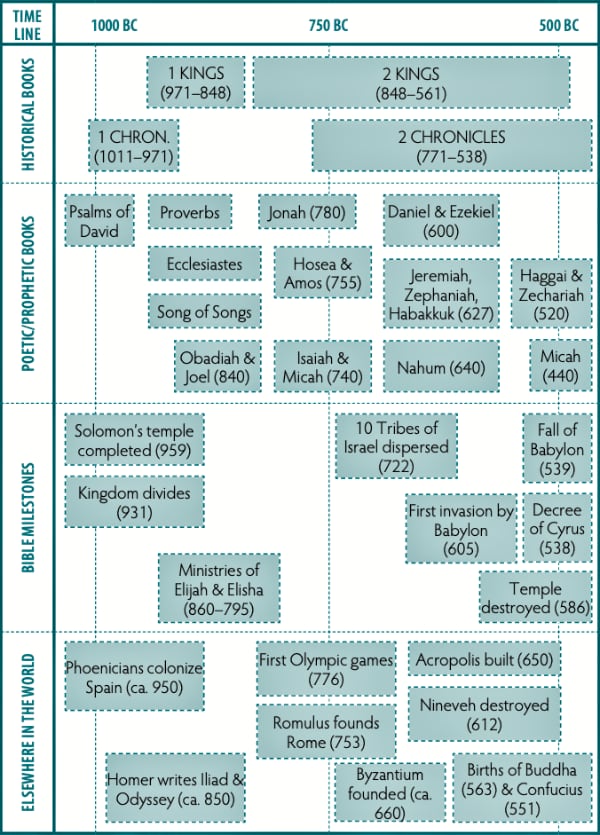
April 6
1 Kings 18:20-19:21

Overview
Elijah appears on the center stage of Israel's history without an introduction. Acting as God's prophetic mouthpiece, he announces to wicked Ahab that Israel will have no more rain except by the prophet's word. Then Elijah leaves Israel for three years, moving at God's direction first east to the Kerith Ravine, then north to the city of Zarephath. In every location, God provides for his needs. As the drought intensifies, Elijah returns to challenge Ahab, and the prophets of Baal lose both their jobs and their lives. But when an enraged Queen Jezebel seeks his life, Elijah retreats to the wilderness exhausted, discouraged, and full of self-pity. There God strengthens him, restores him, and sends him out to minister anew.
Your Daily Walk
Elijah was a fearless man of faith. He stood toe-to-toe with the most powerful man in Israel and boldly announced God's judgment of drought. Three years later, he delivered God's challenge to all those who worshiped Baal, called down fire from heaven, and personally "dispatched" the prophets of Baal!
Then suddenly, after the dramatic and exhilarating moment of his greatest achievement for God, Elijah fell victim to the "Lone Ranger" mentality: "I am the only one left" (19:10, 14). Strength gave way to self-pity, doubt replaced determination, and the fearless man of faith began to falter. Have you faced a similar temptation in your own life, thinking you are the only servant of God in your neighborhood, office, or school (you may be) and feeling sorry for yourself because of it? Then write out this thought and carry it with you today: "God is never without a witness, and with God I am never alone."
Insight - Divine Therapy for Human Depression
It should not be surprising that God, who created humans, knows best how to treat their emotional distress and spiritual anguish. For the distraught Elijah, God prescribed rest, food, exercise, solitude, and a job to do in that order. That's a pretty good prescription for tackling depression in our age as well.
____________________
April 7
1 Kings 21

Overview
Today you finish reading the Book of 1 Kings. But the division between 1 and 2 Kings is only literary, not historical. Tomorrow the story will continue as smoothly as if there had been no book division at all (which, in fact, was the case in the original Hebrew). Although God's mercy and patience are great toward Ahab, the rebellious king of Israel simply refuses to follow God. Yet, Ahab's disobedience pales by comparison with the wickedness of his wife, Jezebel. In cruel treachery, she engineers the murder of Naboth so that Ahab can seize his vineyard. At last, Ahab reaps what he has sown for so long.
Your Daily Walk
You can outsmart your friends; you can outsmart your family; you can outsmart your enemies; and sometimes you can even outsmart yourself. But you can never outsmart God.
Consider Ahab. Warned by a prophet of God not to go into battle, Ahab gambled with his life and lost. He concluded that a clever disguise on the battlefield would make it impossible for anyone to recognize him, even God. The result? "Someone drew his bow at random and hit the king of Israel between the sections of his armor" (22:34). Lucky shot-or a divine bull's-eye?
Trying to outsmart God has never been a wise move. Even the psalmist David learned that, in the game of hide-and-seek, God always comes out the winner (Psalm 139:7-12). But if you find yourself playing the game, the choice is yours: Remove the disguise you've been hiding behind and come to God in humble repentance, or wait for God Himself to unmask you. To his sorrow, Ahab selected the second course. Choose now your own path.
Insight - An Unjust Act of Justice (21:1-16)
Naboth's cruel and unjust murder, masterminded by Queen Jezebel, was nonetheless carried out "justly." Cursing the king was forbidden (Exodus 22:28), and crimes had to be confirmed by at least two witnesses (Deuteronomy 17:6; 19:15). So even in her wicked deed, Jezebel followed the letter of the Law.
___________________
2 Kings
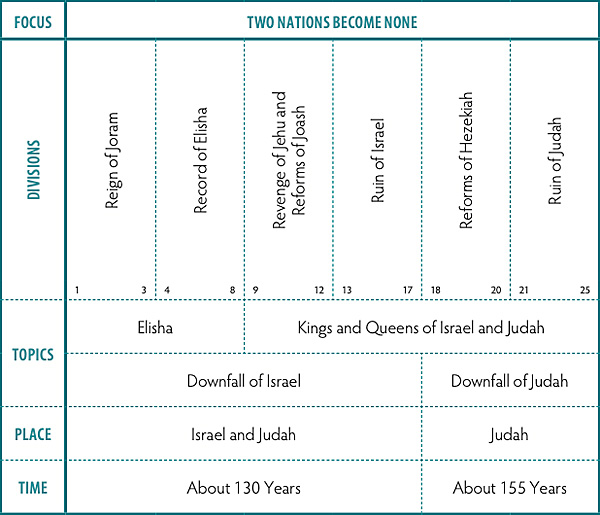
April 8
2 Kings 2

Overview
While 1 Kings centers on the ministry of Elijah, 2 Kings focuses on the ministry of Elisha. After Elijah makes his last prophetic utterance the prediction of Ahaziah's death for turning to lifeless idols rather than to the living God he is taken up to heaven in a whirlwind, leaving his understudy Elisha to continue the prophetic work of calling the nation back to God. With the mantle of Elijah on his shoulders and a double portion of Elijah's spirit to fortify him, Elisha wastes no time beginning his prophetic and miraculous ministry. He predicts that God will fill the valleys of Edom with water, enabling King Joram to defeat the forces of Moab and turn back the enemy threat.
Your Daily Walk
If a miracle is something so difficult that only God can do it, what area of your life most needs a miracle? And how does it compare with these "miracle stories"?
The Lord said to Abraham: "Is anything too hard for the LORD?" (Genesis 18:14). And Abraham fathered Isaac at age 100.
Jeremiah affirmed: "Nothing is too hard for you" (Jeremiah 32:17). And God delivered His people from exile.
The angel told Mary: "For nothing is impossible with God" (Luke 1:37). And a virgin gave birth to the Savior.
When Elisha instructed Joram to dig trenches in the valley because God was going to fill them with water in spite of a drought, Elisha assured the king, "This is an easy thing in the eyes of the LORD" (2 Kings 3:18). The next morning, the waters came.
What challenge in your life seems too big for anyone but God? Write your name by one of the stories above as your testimony of confidence in God's ability to do the impossible.
Insight - Going to School with the Prophets
The "company of the prophets" (2 Kings 2:3, 5, 7, 15; 4:1, 38; 5:22; 6:1) were probably young men studying the Law and the history of Israel in order to teach the people.
____________________
April 9
2 Kings 4-6

Overview
Elisha, the great miracle worker of God, performs no fewer than nine miracles in the space of today's section: providing an "oil well" for a destitute widow, giving new life to a dead boy, making poisoned stew harmless, multiplying bread for a hungry crowd, curing a leprous army captain, making an ax head defy the law of gravity, reading the mind of an enemy king, opening the eyes of a servant to see the angels of God, and closing the eyes of the enemy to the same spectacle. In each case, God's power at work in the individual shows His readiness to do the same in the nation He has called His own.
Your Daily Walk
Myopia, simply defined, is improper focus. Images appear fuzzy or blurred because the eye cannot focus light to a sharp point. Physical myopia can be detected and corrected quite easily.
There is a similar visual problem in the spiritual realm. Let's call it spiritual myopia. The symptoms: clear focus when identifying problems, obstacles, and difficulties in everyday life, but great difficulty focusing on the reservoir of power and protection that God has provided to meet those problems head-on. Spiritual myopia was the condition of Elisha's servant when he focused on the problem (6:15) but not the provision (6:17). He saw only a horde of Syrians, while Elisha saw the host of angels.
On an index card, draw a small eye chart (similar to what you would find in an ophthalmologist's office), using the words of 2 Kings 6:16, and place it on your mirror or near your computer screen. Let it remind you often of the importance of proper spiritual focus in your walk with God.
Insight - How to Fly Off the Handle
In biblical times, the iron head of an ax was attached to the handle by leather thongs. Thus, it was common for the head to fly off the handle whenever the thongs broke or slipped. Accidents with axes were so common that a special provision was included in the Law of Moses to handle such cases (Deuteronomy 19:1-6).
____________________
April 10
2 Kings 9-10

Overview
Anointed king over Israel at Elisha's direction, Jehu wastes no time carrying out his mission. He heads straight for the city of Jezreel, where Joram is recuperating from his battle wounds. There he slays the ruling heir of Ahab's house in the vineyard of Naboth, for which Ahab's wife had committed murder a generation before. But Jehu is far from finished. In addition, he kills Ahaziah, king of Judah (who was making an untimely visit to Joram), Jezebel (Joram's wicked mother-in-law), and finally the entire surviving family of Ahab, thus fulfilling God's sentence of death. But while Jehu is executing judgment in Israel, a different and potentially more dangerous execution is taking place in Judah. Athaliah, the mother of Ahaziah, seizes the throne and seeks to remove the rest of the royal line. The sole surviving heir, Joash, grows up to be Judah's youngest monarch and one of its greatest reformers.
Your Daily Walk
Whatever else you can say about Jehu (and you can say plenty), his single-minded attention to the task God gave him is exemplary. Jehu was a man with a divine calling, a man with a mission, who lost no time in carrying it out. He brought to fulfillment the prophecy of Elijah against the house of Ahab (1 Kings 21:19-24) and, for a time, completely rid Israel of the heathen worship of Baal. God approved of Jehu's faithfulness to his calling and rewarded him for it.
How do you tackle the assignment God has set before you? Carelessly? Halfheartedly? Or with the zeal of a Jehu? Whether you are a student or a parent, a minister or an office worker, you can put your heart into your work if the God of Jehu is in your heart.
Insight - Judgment Can Be Murder
Jehu was anointed as God's instrument for the task of exterminating the house of Ahab, and along with it, the worship of Baal. Baalism was so viciously cruel that only a person of Jehu's relentlessness could have done the job. By the end, Jehu had indeed wiped out the entire house of Ahab and had thoroughly purged the nation of Baal worshipers.
____________________
April 11/12
2 Kings 13, 17

Overview
On his deathbed, Elisha offers King Joash of Israel the opportunity to utterly rout his Syrian enemy. But the king's lack of faith results in something far short of complete victory, and presents a picture of the problem that has plagued Israel's kings for centuries. The alliance between Israel and Judah, secured under Jehoshaphat, now gives way to constant warfare. Anarchy and apostasy rip the land of Israel as the first king is assassinated, and then another is assassinated. When Israel and Syria form an alliance against Judah, Ahaz (king of Judah) buys the help of Assyria. But the downward spiral continues, and soon the 10 tribes in the north are deported to the remotest corners of the Assyrian empire, while other conquered peoples are imported to fill the vacuum.
Your Daily Walk
Historians and political scientists have developed elaborate explanations for the conquest of Israel, and later of Judah. "These were small countries," they say, "in the buffer zone between large, powerful neighbors to the south (Egypt) and north (Assyria and Babylon)." But the Bible states that the conquest and exile were God's judgment because of the sin of His people. Israel had turned her back on the Lord, turned to idols, and ignored the repeated message of God's prophets to "shape up or ship out." They had no one to blame but themselves.
That biblical principle remains in force today for nations as well as individuals, Christians as well as unbelievers. God will deal with an individual, with a family, or with a nation according to the unchanging principle that "a man reaps what he sows" (Galatians 6:7). When was the last time you "sowed" a word for God by means of a brief phone call or email to one of your elected officials? If an issue is crucial, we can't afford to remain silent.
Insight - It's a Long Way to Captivity
In the Assyrian dispersion, many Israelites were resettled in northern Mesopotamia (more than 400 miles away) and others in the area of the Medes (a full 1,000 miles from Samaria).
____________________
April 13
2 Kings 18, 20

Overview
With the captivity and deportation of Israel, the curtain drops on the northern 10 tribes. But what of their countrymen in the south? Will they learn from Israel's calamity and turn back to God? At this crucial juncture, God raises up Hezekiah, who does "what was right in the eyes of the LORD, just as his father David had done" (18:3). Spiritually, Hezekiah institutes sweeping reforms to bring the nation back to a wholehearted worship of God. Politically, he refuses to pay tribute any longer to Assyria, choosing instead to trust God for protection from reprisal. In answer to his prayer, God decimates the Assyrian army, breaking the back of that once mighty nation. However, by the time of his death, Hezekiah's pride and family negligence ensured that Judah's days were numbered.
Your Daily Walk
If you're looking for some help in your prayer life, spend some time studying an Old Testament character whose every recorded prayer was answered.
Hezekiah was a man of faith (18:5) and prayer. His first reaction when confronted with a problem was to bring it before the Lord. Whether the problem was 185,000 uninvited Assyrians (19:35) or a painful illness (20:7), Hezekiah took it to God in prayer. And when he prayed, things happened.
Prayer is not a magic formula, but verbal communication with the sovereign God of creation. Examine your own prayer habits. Are they built on a personal relationship with God? Are you strengthening your prayer life with daily exercise? Are you more comfortable talking to God today than you were a year ago? Try this: Every time you get into or out of your car today, spend a few seconds in prayer. You'll find it habit-forming.
Insight - Smashing an Ancient Artifact
Hezekiah's zealous reform included even the destruction of the bronze serpent that Moses had made in the wilderness (Numbers 21:8-9), which the people were burning incense to.
____________________
April 14
2 Kings 22-23

Overview
Those who do not learn from history are destined to repeat it, and Judah is no exception. Though Israel has been swept away in judgment, the southern kingdom continues its pagan "business as usual." Good King Josiah makes a last desperate attempt to turn the nation back to God. He locates the long-lost Book of the Law and institutes sweeping reforms. But though he can impose changes in actions on the people, only wholehearted repentance can change the attitudes of godlessness and self-indulgence that are the root of the problem. As a result, when Josiah dies, his successors revert to pagan practices. At last, God brings down the curtain on the southern kingdom as Babylonian soldiers topple the walls, homes, and temple of once-mighty Jerusalem.
Your Daily Walk
What is the most important book in the world to you? Assuming your answer is "the Bible"..
THINK: How many days this month have you spent time in the Bible? Assuming your answer is "at least one"..
THINK: How did you respond to the truth you encountered there? Assuming your answer is an honest one...
THINK: Are you satisfied with your response to that truth? Assuming your answer is less than a resounding "yes"..
REREAD 2 Kings 23:2-3. The power of God's Word to change lives is perhaps nowhere more evident than in those two verses. The Word pierces where no manmade sword can reach: to the very heart of the king, priests, prophets, and people, turning their hearts collectively back to God. The result: a national spiritual awakening.
God's Word convicts, but only you can commit yourself to doing God's will. Is there an area of your life where a response is overdue?
Insight - The Short and Long and Short and Long of It
The lengths of the reigns of the last four kings of Judah are easy to remember once you see the pattern. The sequence is 3 months, 11 years, 3 months, 11 years.
____________________
1 Chronicles
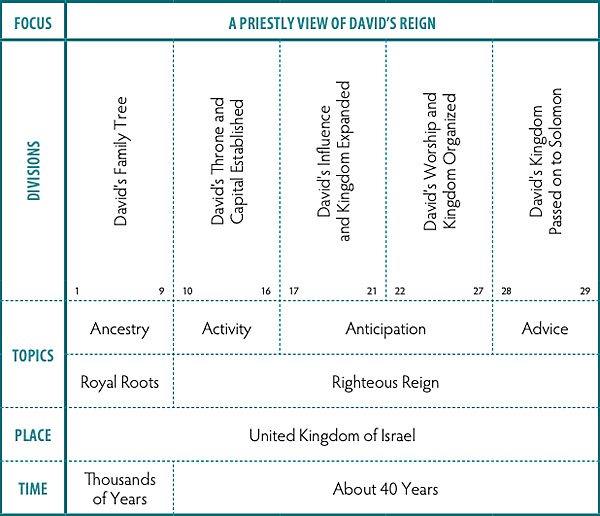
April 15
1 Chronicles 1

Overview
Chronicles is more than just a repetition of the books of 2 Samuel through 2 Kings. Though it covers the same period of history, Chronicles approaches the task from an entirely different perspective. It focuses on religious (not political) history, giving special attention to events surrounding the temple (not the palace) and the southern kingdom of Judah (the Davidic royal line). Down through the centuries, God has provided a witness for Himself and protected the people who were the ancestors of the coming Messiah of Israel-a fact clearly seen in the table of genealogies.
Your Daily Walk
Before you write off today's section as a lost cause in your pursuit of excitement in daily Bible reading, look beyond the monotonous repetition of "begat" and "the sons of" to see the personalities and events involved. For example:
• How many of the names do you recognize?
• For how many of the characters can you recall at least one fact or story from the Old Testament?
• Who would you say are the five most important people mentioned in these lists? Why did you select those five?
• How many reasons can you think of that God might want to include these chapters in His Word?
The opening chapters of 1 Chronicles give not only the historical roots of God's people, but also the spiritual roots. Can you trace yours? Who are the important people in your spiritual heritage? Which of them are still alive today? Is there a tangible way you could say thank you for their role in your spiritual development? You might want to begin a page of spiritual roots in the back of your Bible and add to it as your research continues.
Insight - Curious Omissions in a Copious List
Chapters 1-9 may seem like an exhaustive genealogy, but they are not. Careful study reveals several significant omissions, including the family of Eli and the tribes of Zebulun and Dan.
____________________
March 16
1 Samuel 4, 6, 8

Overview
In fulfillment of Samuel's prophetic word, judgment falls upon the family of Eli. Hophni and Phinehas die at the hands of the Philistines, along with 34,000 of their countrymen. Worse yet, the ark of God falls into enemy hands. Struck by the twin blows of national and family catastrophe, Eli falls over and dies a broken man. Upon the shoulders of young Samuel is placed the responsibility of rebuilding the shattered nation, both spiritually and politically. The Philistines return the ark (with a little divine encouragement), and the Israelites return to the worship of the one true God. But as Samuel grows older and his sons pervert their priestly office, the elders request a king to rule over them, as the other nations do.
Your Daily Walk
Be careful how you pray. God may give you what you ask for! Israel requested a king, a seemingly harmless request. After all, wouldn't a monarch be preferable to the corrupt priests who were making a sham of national worship? But God knew the people's motives were wrong (the desire to be like all the other nations), and the consequences would be devastating. Their sons and daughters would be inducted into the king's service, their lands confiscated, their possessions taxed and seized. In effect, they would become slaves to the king. Yet they insisted: "Give us a king!"
Examine your prayer life. Is it characterized by demands or requests? "God, heal me... bring my husband back... make me successful... give me what I ask for." Check your motives. Are you making requests with your comfort and convenience in mind, or with His glory in mind? And have you considered what might happen if God did answer your prayer? Could it be that God has something even better in store for you than the answer you would supply to your own prayer? Talk to Him about it right now.
Insight - The First Circuit-Riding Preacher
In his role as judge, Samuel made a yearly circuit from his home in Ramah to Bethel, Gilgal, Mizpeh, and back-a journey of 210 miles.
____________________
March 17
1 Samuel 10, 12

Overview
In response to the Israelites' persistent request for a king, God grants their wish. Saul, a handsome man from the tribe of Benjamin, goes searching for a lost donkey, but instead finds Samuel, who anoints him king over Israel. Saul promptly leads the nation in battle against the Ammonites, wins a decisive victory, and humbly refuses to punish those who would not acknowledge him as king. Although Saul honors God early in his reign, Samuel warns the people of the danger in not allowing God to be King of their hearts: "If you persist in doing evil, both you and your king will be swept away" (12:25).
Your Daily Walk
A rambunctious little boy was told by his mother to sit quietly in a chair. He grudgingly obliged, but after taking his seat, he announced, "I may be sitting still on the outside, but on the inside I'm still running around!" His mother's authority was enough to control her son's body, but not his heart.
Such was the case with Israel. Like a little child, the nation was admonished by Samuel to continue in the ways of God, even though the people now had a human king of their own. Outwardly, they agreed to serve and obey God. But despite external compliance, their hearts remained unchanged.
God wants people who have bodies (actions) and hearts (attitudes) that are pleasing to Him. Take a sheet of paper and divide it into two columns. Over the left column, write: "Things I do for God." Over the right: "Why I do what I do for God." Now begin to fill in the columns. And if you find you're doing some of the right things for the wrong reasons, ask God for a "heart transplant" today. That's His specialty (Jeremiah 17:9-10).
Insight - God Doesn't Act Out of Character
God's promise that "for the sake of his great name the Lord will not reject his people" (12:22) meant that to abandon Israel would have been a violation of His covenant and a contradiction of His character. God is always true to His Word and His name.
____________________
March 18
1 Samuel 13:1-14; 15:1-23

Overview
Saul's promising beginning as king over Israel is all too brief. In today's reading, he reveals attitudes and actions that ultimately lead to his rejection by God. Presumption, rationalization, pride, stubbornness, and outright disobedience mark the latter years of his reign, until finally Samuel delivers a make-or-break assignment: "Completely destroy the Amalekites." Electing to do only part of God's will, Saul saves the best of the livestock to "sacrifice to the Lord" (15:15), and spares Agag, the Amalekite king. When confronted with his disobedience, Saul passes the blame to the people, causing Samuel to deliver the verdict: "Because you have rejected the word of the Lord, he has rejected you as king" (1 Samuel 15:23).
Your Daily Walk
The tragedy of Saul's life is the sharp contrast between what could have been and what actually happened. Twice the Bible says that "the Spirit of God came upon [Saul]" (10:10; 11:6). After Saul's anointing by Samuel, "God changed Saul's heart" (10:9). After his rejection as king, "the Spirit of the LORD had departed from Saul" (16:14). These verses would indicate that Saul was a true child of God who was self-willed, proud, and rebellious against God (15:17, 22-23). He represents the Christian who has been equipped by God for a task, but whose willful sin disqualifies him from further service (1 Corinthians 9:27).
You cannot hope to lead others effectively until you are first willing to be led by God. Is pride, stubbornness, or rebellion clouding your relationship with God today? Ask God where you need to change in order for you to be the instrument of godly leadership that He desires you to be. Then write your name and today's date in the margin of your Bible next to 1 Samuel 15:22.
Insight - Saul in the Old, Saul in the New
Both Saul of Tarsus (Acts 9:11) and Saul of Gibeah (1 Samuel 10:26) were from the tribe of Benjamin. But what a contrast! Saul (later called Paul) was a physically weak "giant" of the faith; King Saul was a tall, imposing giant of a man who ended his life by suicide.
____________________
March 19
1 Samuel 16:1-18:4

Overview
Samuel, still grieving over Saul's sin, is instructed by God to anoint a new king, an unlikely young candidate from the family of Jesse. David's obscurity is short-lived, however. After he is enlisted by Saul to play the harp in the king's court, David meets and defeats the Philistine giant, Goliath. But the more David seeks to serve the king, the more his reputation enrages Saul, leaving his very life in jeopardy. Not even David's close friendship with Saul's son Jonathan can bring him immunity from Saul's attacks.
Your Daily Walk
How many close friends do you have? Not simply acquaintances or fellow workers or neighbors, but the kind of friend "who sticks closer than a brother" (Proverbs 18:24), and with whom you can share joy and heartache?
David found that having a true friend can be more than valuable-it can be lifesaving. When Saul conspired to kill Israel's future king, Jonathan put his life on the line by informing David of his father's murderous intent. Ignoring his own welfare, Jonathan put God's program first.
What kind of friend are you? Do you establish relationships with other people for what you can gain from them, or for what you can give to them? If you're having trouble developing close friendships, spend some extra minutes today reading John 15:13-15. There you'll find some characteristics of a growing friendship: sacrifice (v. 13) and communication (v. 15).
Pick someone who is only an acquaintance to you now and begin a "Project Jonathan" in that person's life today. Use the above principles to help you map out a friendship-building activity or two for the week.
Insight - A Working Definition of a Friend
A friend is someone who knows you fully and still accepts you unconditionally. Your true best friend is one who is honest and tells you the "truth in love." The wise words of Solomon remind us: "Wounds from a friend can be trusted" (Proverbs 27:6). Do you have a friend like that? Are you willing to be one?
____________________
March 20
1 Samuel 20

Overview
Jonathan promises to help David by discovering whether Saul's anger is simply a passing mood or a firm resolve. Jonathan finds the latter true, but in the process, he incurs his father's wrath. There can be only one course of action if David is to live to take the throne: He must flee for his life. David's path of escape takes him first to Nob, where he secures food and weapons for his journey. From there, he flees to Gath and then to the cave of Adullam, where a band of relatives and outcasts joins him. Driven to the Desert of Ziph by Saul's advancing search party, David finds his life in constant jeopardy.
Your Daily Walk
Can you rejoice when others are preferred over you? Can you remain a loyal and sincere friend when someone else gets the promotion that by rights should have been yours? Are you willing to be content with God's place for you when it is less than your ambition desires, or even less than what should rightfully be yours?
If you have trouble answering with a hearty "yes!" then consider the remarkable character of Jonathan. Humanly speaking, he was heir apparent to the throne of Israel, set to succeed his father Saul. Humanly speaking, he had every reason to hate David and to join his father in seeking David's death. Instead, he loved David, befriended him, protected him, and accepted God's will for him, even though it meant taking a back seat to his own personal ambitions.
"Godliness with contentment is great gain" (1 Timothy 6:6). Are you content today with your possessions, status, and situation? Read Philippians 4:11-13 out loud several times until God gives you the strength to make it a sincere prayer of your heart.
Insight - Jonathan-An Unsung Hero
Perhaps the truest test of a man's greatness is his willingness to submit to God's plans. As heir to the throne, Jonathan was a war hero (chapter 14) who possessed a kingly character. Yet he loved David as himself (18:1), sided with him against his own father, and bowed humbly to God's choice of David as king.
____________________
March 21-22
1 Samuel 24, 26

Overview
After a brief delay to deal with the Philistine problem, Saul returns to take up the pursuit of David. His renewed zeal nearly pays off as (unknowingly) he traps David and his men in a cave. Then miraculously the tables are turned as David stands poised over the sleeping form of Saul with the power of life and death in his hand. Though vengeance is within his reach, David refuses to lift his hand against the Lord's anointed king. Again in chapter 26 the scene is repeated, this time in the Desert of Ziph. Once again David must make a choice. Once again the source of David's anxiety is only a sword's thrust away. And once again David resists the temptation to play the role of God by snuffing out Saul's life.
Your Daily Walk
If circumstances alone formed the basis for determining the will of God, then Saul's life would have ended in chapter 24 and Nabal's in chapter 25. If counsel alone revealed God's will in a particular situation, then Abishai would have convinced David to rid himself of Saul once and for all in chapter 26.
Opportunity alone does not constitute the will of God. The counsel of others taken by itself is insufficient to determine God's will. These things must be balanced with what we know of the character and commands of God as revealed in His Word. David knew that God had said, "It is mine to avenge; I will repay" (Deuteronomy 32:35; see also Romans 12:19).
Have others wronged you and then placed themselves in a vulnerable position where it would be easy for you to get even? Try this instead. Look for a way to repay evil with good (Romans 12:21), and by an act of the will leave the settling of accounts with God. He will set things right in ways you never dreamed.
Insight - En-gedi (24:1-2)
En-gedi, from the Hebrew meaning "spring of the wild goat," was a desert oasis that served as a refuge for David in his flight from Saul. Located halfway down the western coast of the Dead Sea, En-gedi is a nature preserve and tourist attraction today.
____________________
March 23
1 Samuel 27, 29, 31

Overview
The Book of 1 Samuel closes with a climactic series of events leading to the death of Saul and his sons, and clearing the way for David's ascent to the throne. Disheartened and no doubt weary, David defects to the Philistines for his own protection and settles in Gath, the very city from which Goliath came. He finds himself using deception to avoid siding with the Philistines in the growing hostilities against Israel. Saul, unable to find direction from God, consults a spiritist, through whom God sovereignly delivers a chilling judgment and death prediction.
Your Daily Walk
In modern English, the word tragedy is used to describe any adversity, no matter its cause. But more specifically, a tragedy is "a calamity that results from a wrong decision based upon a flawed character." Using this definition, Saul's life was a true tragedy. It held so much promise of success both for him and the nation, yet it ended in defeat and disgrace, all because of pride and self-will.
Becoming a Christian doesn't mark the end of your battle with sin and temptation; in many ways, it marks the beginning. As a Christian, you still have a sin nature that seeks to express itself in your daily actions. You also have a personal will that desires to direct your life. And both need to come under the control of Jesus Christ.
From a hymnal or the Internet, use the familiar words of Frances Havergal's hymn "Take My Life, and Let It Be" to renew your commitment to the lordship of Christ, from head to toe.
Take my life, and let it be / Consecrated, Lord, to Thee.
Take my hands, and let them move / At the impulse of Thy love.
Insight - A Dubious Distinction
Saul, the first king of Israel, ended his life by becoming the second recorded suicide in the Bible (31:4). Can you recall the first? (Hint: You read his life story earlier this month. His name also begins with the letter S, and he "brought down the house.")
____________________
2 Samuel
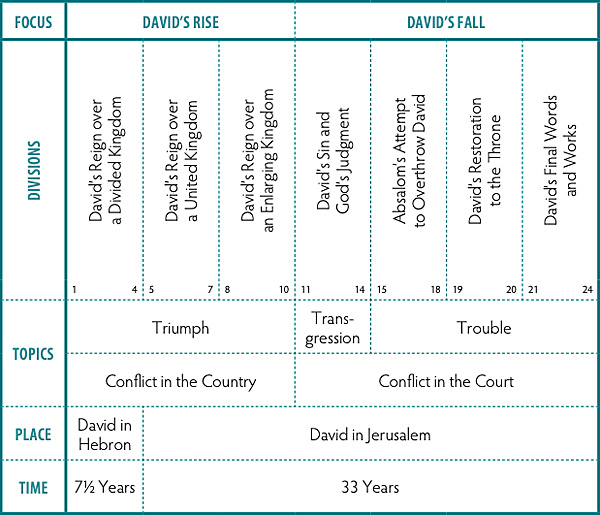
March 24
2 Samuel 1:1-2:7

Overview
The Book of 2 Samuel opens where 1 Samuel closed, with the deaths of Saul and Jonathan. David's lament over the loss of his closest personal friend and of God's anointed leader is captured in a moving song with the repeated refrain, "How the mighty have fallen!" (1:19, 25, 27). Assured by the Lord that the time for his ascension to the throne has come at last, David is installed as king over Judah. But his acceptance as Israel's new national leader will be slow and painful. Ish-bosheth, Saul's surviving son, usurps power in the north, sparking a civil war between Israel (led by Abner) and Judah (led by Joab). Intrigue, assassination, and defection result in the deaths of Asahel, Abner, and finally Ish-bosheth. With the opposition to David's rule removed, the way is cleared for David to reign over a united kingdom at last, more than seven years after Saul's death.
Your Daily Walk
Have you learned to separate personality from authority? God's commands are often based on a line of authority. Within the chain of command, he has instructed children to obey their parents, young people to respect their elders, and citizens to submit to the ruling authorities, whether or not they like the personality of the one in authority over them. In the same way, David honored Saul as God's anointed king throughout his life. Refusing to carry a personal vendetta or to retaliate against Saul's family, David sincerely mourned Saul's passing and showed kindness to Saul's house, though Saul was no doubt his "favorite person."
Whether or not you agree with the personality and philosophy of your civic leaders, you have a spiritual responsibility to submit to them, honor them, and above all, pray for them (1 Timothy 2:1-3). Have you done that yet today? It will help them and you.
Insight - Family Feud, Old Testament Style
In 3:1-5, six of David's sons are named, each born to a different wife. David's moral laxity, so evident in these verses, would ultimately contribute to his downfall.
____________________
March 25
2 Samuel 5:1-5; 7:1-29

Overview
The internal strife has finally ended, and David is firmly established as king over a united kingdom. Now, in his first official act as monarch, he relocates the nation's capital from Hebron to Jerusalem. In addition to Jerusalem's becoming the political center of Israel, David now makes it the religious center as well by transporting the ark from Gibeah. At last, David is ready to see the fulfillment of a lifelong dream: the construction of a house for God. But through the prophet Nathan, God redirects those plans. Because David has been a man of war, it must be left to his son, Solomon (whose name means "peace"), to build God's temple. But while David will not be permitted to build a house for God, God will build a house for David: a throne, a family, and a kingdom that will stand forever.
Your Daily Walk
How do you respond to the death of a dream? When your most cherished ambition is shattered by a financial reversal, a physical injury, or an unexpected change of plans, what is your reaction?
After God curtailed David's plans to build a permanent house for the ark, David responded with gratitude (not grumbling) and praise (not pouting). He thanked God for all the good things He had done in the history of the nation, and reaffirmed God's sovereign right to veto David's plans: "Now, LORD God, keep forever the promise you have made concerning your servant and his house. Do as you promised" (7:25). Personal ambition yielded to sovereign direction.
Have you committed your dreams and ambitions to God? He may want to approve and confirm them, or He may want to change and refashion them into something you've never dreamed. That's His right as Creator. So give Him that right-right now!
Insight - Learning a Life-and-Death Lesson (6:3-7)
For perhaps 50 years, the ark had been considered little more than a piece of furniture. God's stern judgment upon Uzzah for touching it marked the beginning of a new era in which the people recognized the sanctity of God's presence again.
____________________
March 26
2 Samuel 9

Overview
Once David has consolidated his nation politically and religiously, he turns to the task of being God's man of war. By subduing the neighboring nations, David extends Israel's borders: Philistia to the southwest; Amalek to the south; Edom, Moab, and Ammon to the east; Syria to the northeast; Zobah to the north. Each succumbs to David's withering assault. But though he is a man of war, David maintains a tender heart. He seeks out and befriends the sole surviving heir of Saul's dynasty, a lame grandson named Mephibosheth, by making him part of the king's family.
Your Daily Walk
Insurance companies today have a name for those who apply for insurance while suffering from heart disease or who have a family history of premature death. Such individuals are "bad risks."
When a new king came to the throne in the ancient Near East, you might say the remaining family members of the preceding dynasty were bad risks. According to the custom of the day, they had two chances for survival: slim and none. The usual practice was for the new king to pursue and slaughter any possible claimants to the throne. That's why David's gesture of mercy and clemency to Mephibosheth was so amazing.
God's grace to us, which is illustrated by this story, is even greater. "God demonstrates his own love for us in this: While we were still sinners, Christ died for us" (Romans 5:8). If you have not received God's grace, do so right now (see Ephesians 2:8-9). If you have, thank God anew for it. Then look for a Mephibosheth in your life who needs to learn about God's love and forgiveness.
Insight - Just Call Me "Mephibosheth"
A helpless cripple, heir of King Saul, and a self-proclaimed "dead dog," Mephibosheth was nonetheless welcomed with open arms into David's own royal family. What a beautiful illustration of God's grace to us crippled as sinners, yet lifted from our shame and given an inheritance by the King Himself.
____________________
March 27
2 Samuel 11-12

Overview
A person's life can pivot on one small event. Such is the case with David. Idling around the palace when he should have been leading his troops on the battlefield, David sets himself up for disaster. A chance look leads to lust, which gives birth to sin, which in turn results in death. But even in his darkest moment, the "man after [God's] own heart" (Acts 13:22) shows his true character. When confronted by Nathan the prophet about his sin, David responds with wholehearted repentance. Though he experiences God's forgiveness, the seeds of sin have been planted. All too soon, David will reap the harvest of that sin.
Your Daily Walk
The crash of the giant redwood could be heard for miles. But the question on everyone's mind lingered long after the sound had died away. There was no chainsaw, no forest fire, no dynamite. How had such a mammoth tree come toppling down?
Silently, secretly, thousands of tiny beetles ate away at the very heart of the tree. The signs of decay went unnoticed until the crash, and then it was too late.
David's sin with Bathsheba was no sudden collapse of his moral values, but rather the outgrowth of an undisciplined life given to passion, polygamy, and idle pleasure. When the temptation came, David had no willpower to resist. He saw, he inquired, he yielded. And the crash could be heard for generations to come in the form of treachery, immorality, jealousy, and murder.
Where are subtle sins eating away at your spiritual vitality? If it is true that disaster in the Christian life more often results from a slow leak than a blowout, take time today to examine your life for any "slow leaks." You can't afford to ignore them.
Insight - Solomon, the Peace Child (12:24)
As part of the judgment upon David's sin, the child born of adultery died in infancy. But later God gave to David and Bathsheba another son, whom they appropriately named Solomon-"peace." Despite his past failure, David was now at peace with his God.
____________________
March 28-29
2 Samuel 15, 18

Overview
Incest, murder, intrigue, rebellion-the story of David's family from chapter 12 on reads like a horror story. But the worst is yet to come. Absalom, David's favorite (and most undisciplined) son, seizes the opportunity to usurp his father's throne. After sowing discontent among the people, Absalom launches a dramatic, unexpected invasion of Jerusalem, forcing David to flee for his life. In his flight, David is deceived by Ziba, maligned by Shimei, and befriended by Barzillai. But he owes his life largely to Hushai, who remains behind in Jerusalem and counsels Absalom to mount a careful (and delayed) attack, rather than to pursue immediately. When the battle is joined in the forest of Ephraim, Absalom's dreams of power come to a "hair-raising" conclusion.
Your Daily Walk
What do Monday morning quarterbacks and many politicians' speeches have in common? They are always right because they are always based on 20/20 hindsight.
Absalom would have made a good Monday morning quarterback. Certainly, he was an outstanding politician, for he won the hearts of the people by second-guessing the decisions of the king and promising the people what they wanted, though he had no authority to grant it.
When a bad decision has been made, do not hesitate to give open, honest criticism to the person who's responsible. Wrong decisions cannot be ignored. But watch the human tendency to become an armchair general.
All statements beginning, "If I had been there..." are dangerous. Pick a church or civic leader and focus your efforts this week on positive support, rather than negative second-guessing.
Insight - Hair Today, a "Goner" Tomorrow
Absalom's luxuriant head of hair was the crowning glory of a vain egomaniac. How ironic that it became the instrument of his death, suspending him from the low-hanging branches of a tree.
____________________
March 30
2 Samuel 19

Overview
David's unceasing grief for Absalom (at the expense of those who risked their lives for the king) prompts an abrupt but effective confrontation with General Joab. A king's personal feelings must give way to the good of the nation. So, accompanied by his faithful followers, David begins his triumphal return to Jerusalem. His reestablishment as king in Israel marks the return of discontent to the nation. Jealousy between the tribes, an attempted coup by Sheba, murder in the palace guard- the violence is a continual reminder that "uneasy lies the head that wears the crown."
Your Daily Walk
Think back over the chapters you have read in 2 Samuel, and make a list of your impressions of Joab, David's general.
Every leader needs a man like Joab. For all his bad points (and there were plenty-he was brutal, bloodthirsty, vengeful), Joab had a side that was commendable. His devotion to David and to the nation was exemplary. He was a man who saw what had to be done and did it, regardless of how unpopular the action or how unwanted the rebuke. Though David often questioned Joab's actions, he never questioned Joab's motives and rightly so.
Do you have the fortitude to do the unpopular thing when it is right and needs to be done? Do you have the courage to speak up when a voice needs to be heard? No one enjoys such roles, but they are a vital part of godly exhortation. Select an admirable trait from Joab's life (such as commitment, fortitude, or selflessness) and use it as a pattern for your activities today. God will give you the strength and wisdom to be a Joab when the job calls for one.
Insight - David's Shrouded Grief
After learning of Absalom's death, David "covered his face" (19:4), the customary way of expressing grief. The covered head symbolized the agony that shut David off from the world and also pictured the shroud of Absalom's burial.
____________________
March 31
2 Samuel 21-24
2 Samuel 23-24

Overview
Years of ruling the nation (and getting into and out of trouble) have taken their toll on David, leaving him faint in battle and feeble in old age. But though David can no longer pursue the enemy, problems continue to pursue him to the end of his reign. A broken treaty with the Gibeonites results in three years of famine; a sinful census leads to the deaths of 70,000 Israelites. But in each case, David repents of his sinful ways and assumes the familiar posture of a worshiper of God, the hallmark of his life. To the end of his days, David remains a man after God's own heart.
Your Daily Walk
When called upon to support the work of God with your money, do you "give till it hurts" or "hurt when you give"?
David provides a valuable model for giving. When God punished the Israelites for David's proud census, the prophet Gad told David to build an altar on Araunah's threshing floor. It would have been an easy matter for David to confiscate Araunah's property, or at least to accept Araunah's offer of free animals and wood for the sacrifice. But David refused, knowing that such an offering would not be pleasing to God. "I insist on paying you for it. I will not sacrifice to the LORD my God burnt offerings that cost me nothing" (24:24).
Examine your own offerings to the Lord your God. Do you tend to give superficially or sacrificially? Are your gifts the overflow of a grateful heart? As you look forward to your next paycheck, think about increasing the amount you give to your church or a Christian organization you support. And remember, "God loves a cheerful giver" (2 Corinthians 9:7).
Insight - A Mighty Man in a Curious Place
In David's list of 37 mighty warriors (23:8-39) is one curious inclusion: Uriah the Hittite! Though David masterminded his death, he never forgot Uriah's exemplary conduct.
____________________
Joshua
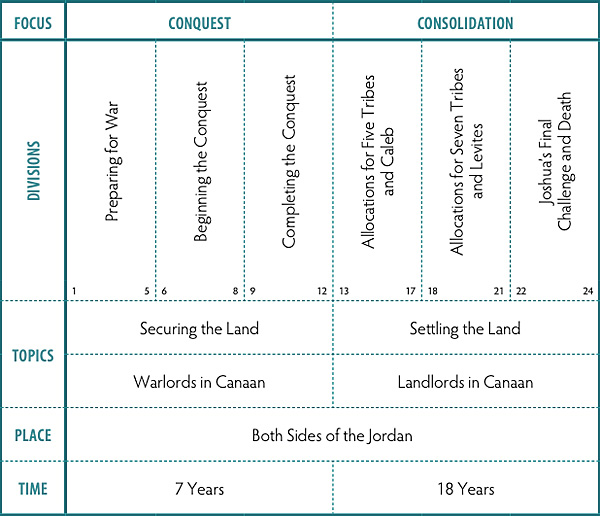
March 1
Joshua 1:1-8; 3

Overview
Moses has died, and Joshua is appointed by God to take the reins of leadership. The people are poised within view of the land promised to their ancestors and denied to their unbelieving parents. The time has come to cross over, conquer, and possess. But will they succeed where their fathers failed? The task seems impossible: a swollen, turbulent river to ford; foreign terrain to cross; mighty, walled cities to conquer. So God begins to prepare His people for the days of warfare just ahead. He reminds Joshua that careful attention to His Word brings blessing and success. Spies are sent to survey Jericho, the first obstacle in the land. The priests, bearing the ark of the covenant, lead the people across the raging Jordan without even getting their sandals wet! The stage is set for conquest.
Your Daily Walk
God specializes in dry sandals. He loves to start with an impossible situation in your life, then do the impossible. When the nation of Israel approached the Jordan River, God demanded a step of obedience before they could cross. The priests, like drum majors leading a marching band numbering in the million-plus range, had to hike to the brink of the flood-swollen Jordan and take that first step into the water. Then—and only then—would God perform a miracle, roll back the waters, dry up the puddles, and send the people across, kicking up dust at every step. Dry sandals followed trusting obedience.
Where is God waiting for you to take that first step of faith? Think about the obstacle you are facing (your Jordan) and the step of obedience God is asking you to take (your dry-sandals experience). Trust Him for the unexpected, and let Him surprise and delight you by doing the unexplainable.
Insight - A Mighty Little River
The Jordan, a winding, muddy river more than 200 miles long (and only waist-deep in some places), carries biblical significance far beyond its size. It is mentioned more than 50 times in Joshua and more than 160 times in the Old Testament.
____________________
March 2
Joshua 6:1-7, 13; 8:1, 25

Overview
Joshua employs a textbook strategy for military victory: "Divide and conquer!" He attacks the middle of the country first, dividing the enemy forces in half, before mopping up resistance among the isolated troops in the south and north. His stunning victory at Jericho shows the importance of following God's directions down to the smallest detail, no matter how trivial they may seem. The lesson is painfully reinforced at Ai, where disobedience leads to defeat and death. But after disciplining His overconfident people, God patiently encourages them and leads them to victory in the rematch with Ai.
Your Daily Walk
The true test of an obedient child comes not when the parent's orders make good sense ("Don't touch the stove or you'll burn yourself"), but when there seems to be no good reason for the command ("Be home by 11:00," or "Eat your spinach"). A parent's wishes may be changeable or based on a whim, but God's will is never that way (Hebrews 13:8; James 1:17).
God's command to Israel at Jericho to destroy what was not consecrated to Him contradicted "good human judgment." It seemed wasteful to the people and unnecessarily cruel. Joshua did the "sensible" and "prudent" (but disobedient) thing by sending only a small army against Ai. And the result was a rout for Israel and the needless death of 36 soldiers.
Pick a command from God's Word that you have been tempted to label impractical, unnecessary, or irrelevant (you might try Ephesians 5:22, 25; 6:1, 5). Write it down, along with these words: "Where I understand the will of God, I will do it; where I do not understand the will of God, I will trust Him... and do it anyway!"
Insight - The High Cost of Covetousness
The gold and silver pieces Achan took (7:21) were worth only a few thousand dollars. In exchange, they cost the lives of 36 soldiers, a humiliating defeat for the nation of Israel, and death by stoning for Achan and his entire family.
____________________
March 3
Joshua 9, 12

Overview
In many ways, Joshua's military is guided more by his enemies' actions than by his own plans. First, the king of Jerusalem forms an alliance of kings in the south and attacks Gibeon (the nation that had tricked Israel into a treaty of protection). True to her pact, Israel comes to Gibeon's defense, smashing the southern coalition. A similar alliance now forms in the north, led by Jabin, king of Hazor. And once again, "The Lord gave them into the hand of Israel" (11:8). Finally, Joshua squelches resistance throughout the entire land until the hills, valleys, plains, and mountains (see 11:16) are secure, ready to be allotted to the waiting tribes.
Your Daily Walk
Nothing is as exasperating to a parent as a 3-year-old's newfound independence. "Let me do it... don't help... I can do it myself" are all expressions of a dependent child exercising his awakening sense of independence. The parents' help may no longer be wanted, but that doesn't mean it isn't needed.
When faced with the unexpected problem of Gibeon (chapter 9), the leaders of Israel responded in immature independence. "We can handle this one on our own. No need to consult God about such an elementary matter. After all, we've made tougher decisions than this before!" The foolish peace pact with Gibeon, made without consulting God, was based on false appearances and deceiving words. In the years ahead, it would be a source of heartache to Israel.
What decision are you tempted to make without giving God a single thought? Talk to Him first. God delights in guiding those who acknowledge their need of Him (Proverbs 3:5-6). And the consequences of ignoring Him can't be overlooked.
Insight - A Hungry Homeland
Earlier, the spies described Canaan as a land that "devours those living in it" (Numbers 13:32). During the seven-year conquest, Joshua's army destroyed 31 kings and most of the Canaanites, making the spies' statement ironically prophetic.
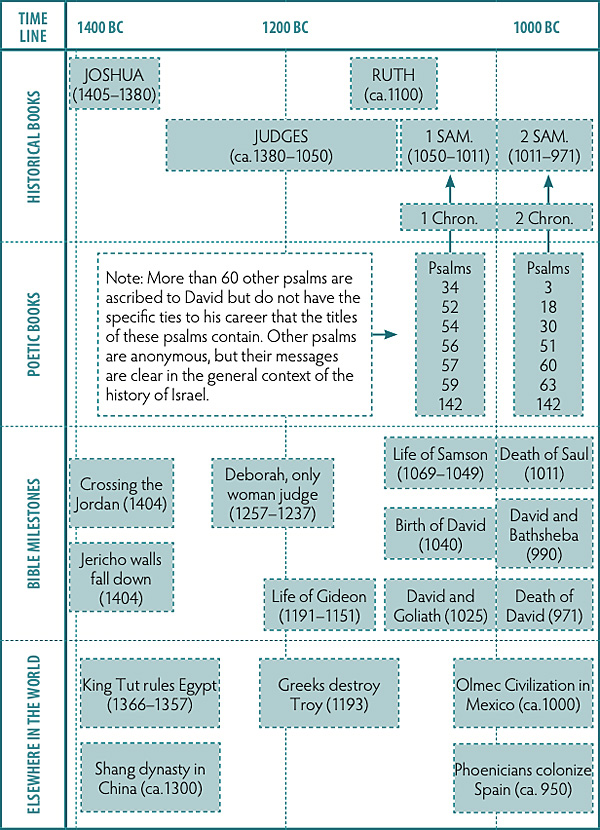
March 4
Joshua 14

Overview
Although Israel, under Joshua's leadership, had conquered Canaan by destroying key cities and their kings, "there are still very large areas of land to be taken over" (13:1). To complete the task, Joshua assigns territories to each individual tribe with instructions to clear out the remaining pagan influence and to possess the land completely. Territories have already been assigned to Reuben, Gad, and half the tribe of Manasseh on the east side of the Jordan. But before any allotments are made on the west side, Caleb asks for and receives the area promised him by Moses: Mount Hebron, a known Canaanite stronghold.
Your Daily Walk
Probably as a child, you either played with model planes, boats, and trucks or knew someone who did. List as many characteristics of a model as you can. Now think about some outstanding characters who emerge from the pages of Scripture, and ask yourself: "Apart from the Lord Jesus Himself, after whom would I most like to model my life?"
Did the name Caleb cross your mind? Three times in seven verses we read that he "followed the LORD... wholeheartedly" (14:8-9, 14). Caleb knew what it meant to claim the promises of God, then move out by faith to possess what God had promised.
As you read chapter 14 today, did you notice what was said about Caleb—his age, physical condition, godly ambitions, steps of obedience? Select one way that Caleb's life can become a model for your life today, and put it to work.
Insight - God's People and Long Waits
Caleb was 40 years old when he, Joshua, and the other spies checked out Canaan. Afterward, he waited 45 years for God to fulfill His promise of giving him Mount Hebron. So, at 85, as long as God was with him, he wasn't afraid to go into the hill country, drive out the Canaanites, and take possession of the land. Can you think of other biblical characters who waited a long time for God to fulfill His promise to them?
____________________
March 5
Joshua 18:1-10; 21:43-45

Overview
With the moving of the tabernacle to the territory of Ephraim, Shiloh becomes the new center of Israel's worship. The remaining seven tribes now receive their inheritance by lot. But for the tribe of Levi there will be no territorial allotment, for their inheritance is the priestly service of God (13:14; 18:7). Instead, 48 cities are assigned to the three families of Levites (Kohath, Gershon, Merari), and six cities are reserved as places of refuge for accidental manslayers. At last, the task of dividing and distributing the land is complete.
Your Daily Walk
Try to envision 22 godly men (Joshua plus three men from each of the seven remaining tribes) gathered together in a tent with 8,000 square miles of real estate at stake (18:4, 10). And how are they making the weighty decision as to which tribe receives which parcel of land? They are "casting lots"—the Old Testament equivalent of throwing dice!
Does it bother you that Joshua would leave such an important matter as the partitioning of the land to the "chance" roll of the dice? Then remember that in biblical times God often made His will known in the casting of lots (Leviticus 16:8; Jonah 1:7; Acts 1:15-26). Notice the repeated phrase "in the presence of the LORD" in 18:6, 8, 10. This was no accidental division of the land, but a public acknowledgment that God's will extended even to the parceling of the land.
God's will for your life today can be known with just as much certainty as Joshua enjoyed thousands of years ago. Only now God has specified other ways of finding it besides the roll of the dice. Make a study of the following verses to learn how He wants to reveal His will to you today: Psalm 119:105; Romans 12:2. If God cares enough about a piece of real estate to guide Joshua's lots, then how much more must He care about you?
Insight - The End of a Six-Century Wait (21:43-45)
In these three verses, at least three of God's promised blessings are fulfilled for the nation of Israel. How many can you find?
____________________
March 6
Joshua 22:10-34; 24:29-33

Overview
After being commended for their faithful service in conquering the land of Canaan, the warriors of the tribes east of the Jordan are sent home. They recognize that the Jordan River (which forms a natural barrier between the tribes) may one day form a spiritual barrier as well. To prevent this, a memorial altar is built on the riverbank—an act misunderstood and viewed with horror by the tribes west of the Jordan. Civil war nearly breaks out before the real motives behind the altar are revealed. The book closes with Joshua's farewell address in which he gives the people an ultimatum: "Choose for yourselves this day whom you will serve.... As for me and my household, we will serve the LORD" (24:15).
Your Daily Walk
Analyze the following situation, then select the correct response: A woman running breathlessly down the road is being pursued by an equally breathless man who is gaining on her at every step. The man is: (a) a criminal, (b) a bill collector, (c) a sports enthusiast. Correct answer: (c) The fellow is a runner, and so is his wife. They are out for their morning run, and he is just about to pass her. If you had been an onlooker, would you have assessed the situation correctly?
Motives are hard to read, but easy to misread. How can you avoid the kind of mistake made by the tribes west of the Jordan? When tempted to think the worst about another's actions or attitudes, stop and ask yourself these two questions: (1) What would I want others to believe about me if I were in the same situation? (2) What damage might result if I don't get all the facts and jump too quickly to the wrong conclusion?
Insight - "Just Look at His Track Record!"
Joshua wanted to ensure that his people would continue following the Lord wholeheartedly after his death. So he wove an incontrovertible argument for his God by recalling numerous instances of His goodness to Israel in the past, ending it with a personal exhortation to "choose for yourselves this day whom you will serve." Did his plea bring results? Reread 24:31.
____________________
Judges
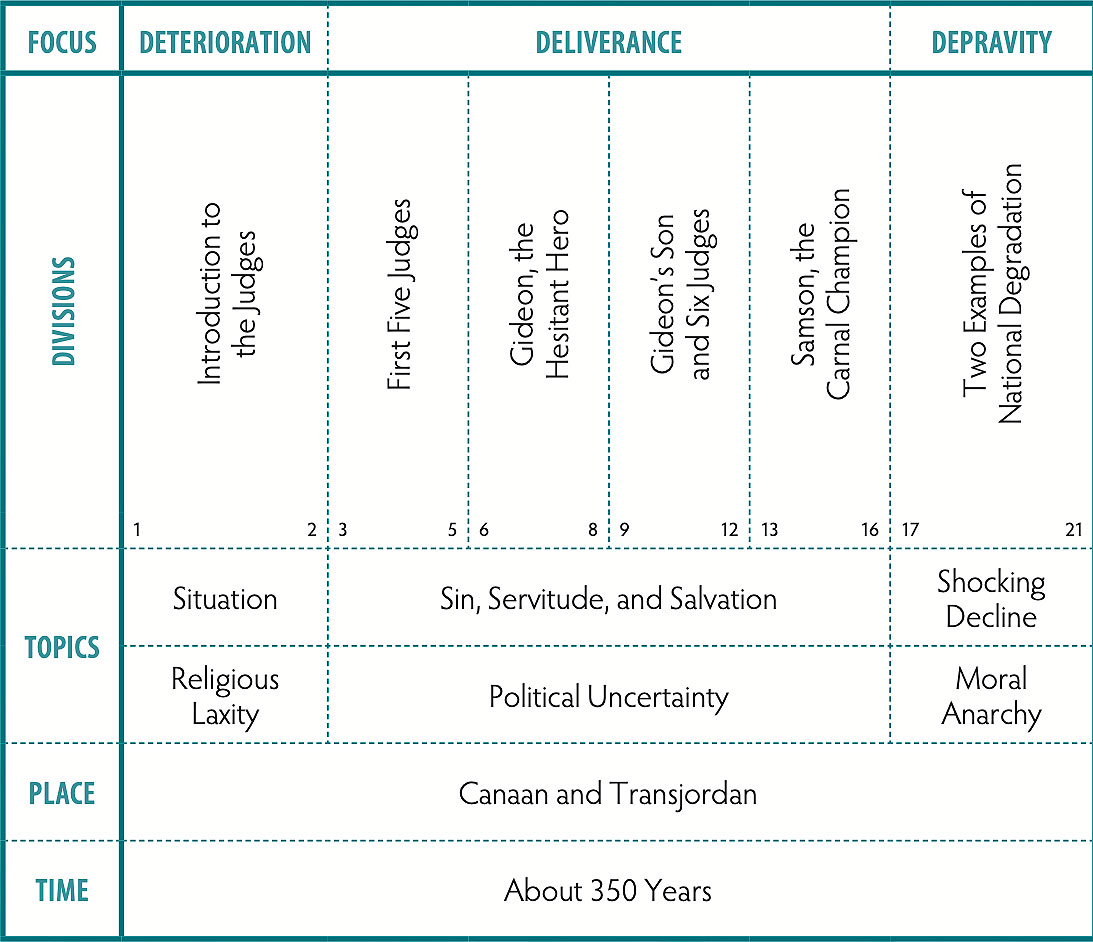
March 7-8
Judges 2:6-23

Overview
Efforts by Judah, Simeon, and the other tribes to purge the land of its pagan inhabitants are not completely successful. Pockets of godless influence remain, always a source of spiritual stumbling to Israel. Over and over, the cycle repeats itself. Israel falls into national immorality and idolatry, causing God to allow powerful neighboring countries to oppress and enslave her. When the people cry out in repentance, God responds to their renewed commitment by raising up yet another judge to deliver them. But the cycle soon begins again as the nation's spiritual temperature grows steadily colder.
Your Daily Walk
Look up Romans 12:1-2 and read it several times. Now write your own paraphrase of what it means to be conformed "to the pattern of this world."
You will spend nearly every day of your earthly life surrounded by unbelievers. And when you stop to think about it, you really have no choice in the matter. To eliminate all contact with non-Christians, as Paul writes, would require leaving the world (1 Corinthians 5:9-10). Besides, how can you witness to unbelievers and lead them to the Savior if you spend no time with them?
But while you must have contact with the world, you are commanded not to be conformed to the world. That was Israel's problem. Her people not only had contact with sinners (as a result of their failure to obey God and destroy them completely), but they also embraced the sinner's sin. They became indistinguishable from the heathen.
Complete this sentence: "One way in which my commitment to Christ causes my lifestyle to differ from the world around me is ... " Consult 1 Peter 2:9-17 for suggestions.
Insight - Reconstructing the Colorful Period of Judges
An excellent way to trace the judges' cyclical period is to color-code your Bible. Select five colored pencils, and use one color to highlight each part of the "sin cycle": sin, servitude, supplication, salvation, silence (you'll use each color seven times).
____________________
March 9
Judges 6:11-7:23

Overview
Israel's oppression under Midian is brief but severe, as Midian forcibly takes Israel's harvest. Gideon, called by a divine messenger to deliver God's people, is a reluctant savior and doubtful candidate for greatness. It takes a pair of confirming signs (first a soggy fleece, then a dry one) to convince Gideon that God can use him. But once his faith is sparked, Gideon watches as God removes all the props upon which he might have trusted: his army (reduced 99 percent); his weapons (reduced to pitchers, torches, and trumpets); and his military strategy (reduced to a single command: "Stand still!").
When a miracle of deliverance occurs, there can be only one explanation—God did it.
Your Daily Walk
Are you a skeptic—the kind of person who never takes anything at face value, who asks a lot of questions, and who always requires confirmation of the facts? Then you will appreciate the life of Gideon.
In 1 Corinthians 1:22, Paul comments that "Jews demand miraculous signs," and such was the case with Gideon. Faced with an overwhelming assignment and equipped with rather dubious human qualifications, Gideon needed a bolstered faith. Nowhere in the passage did God chide Gideon for his request for a confirming sign. He gladly and patiently provided what Gideon needed.
When the will of God is clear, to demand a sign is evidence of unwillingness to obey. When God's will is uncertain, but you are earnestly seeking it (like Gideon), God will make it clear to you. Take a decision you are wrestling with today and ask God to confirm His will through the Bible, Christian counsel, circumstances, or inner assurance. Remember, delayed obedience is really disobedience.
Insight - God's Unbeatable Team (7:22)
In Leviticus 26:8, God had promised Israel that "five of you will chase a hundred, and a hundred of you will chase ten thousand." With Gideon's band of 300 men, God fulfilled that promise, proving He isn't concerned about the odds.
____________________
March 10
Judges 11-12

Overview
Abimelech, Gideon's son by a concubine, is never called a judge in Israel, though he sets himself up as king and murders 69 of his 70 brothers. As Jotham (the only surviving son) predicted, Abimelech dies as violently as he lived. The brief records of two minor judges, Tola and Jair, are followed by a lengthy treatment of Jephthah in the days of oppression by the Philistines and Ammonites. In contrast to Gideon, who sought to appease the tribe of Ephraim, Jephthah ends up going to war against Ephraim. His action-filled reign as judge is best remembered for his presumptuous vow, which seals the fate of his virgin daughter forever. The section closes with a brief look at three other minor judges who are most noteworthy for their enormous families.
Your Daily Walk
Should Christians take oaths or make vows today? Those who respond "No!" will find ample support in the tragic result of Jephthah's presumptuous vow (11:30-31, 34-40).
Vows are not to be taken lightly. But the real tragedy of Jephthah was his unwillingness to admit he had acted foolishly and had made a mistake. A willingness to admit errors and seek help is evidence of maturity and strength, not weakness.
Is there a family member or friend you have wronged through a mistake? Admitting you were wrong, asking for forgiveness, and making restitution for any damage can open new opportunities for fellowship and service with that person. God wants you to be an open, honest person with a realistic view of yourself—one who (unlike Jephthah) is quick to admit mistakes and knows when to seek wise counsel.
Insight - A Deadly Slip of the Tongue
The 42,000 Ephraimites Jephthah slew were identified by the fact that they said "Sibboleth" instead of "Shibboleth" (12:6). But they aren't the only ones in Scripture who were betrayed by an accent. When Peter was in the high priest's courtyard the night Jesus was arrested, he was accused of being a follower of Jesus because of his Galilean speech (see Matthew 26:73).
____________________
March 11
Judges 13, 16

Overview
The life of Samson is a study in unfulfilled potential. The only child of an elderly couple, designated by God a Nazirite from birth, blessed with superhuman strength, and commissioned to "begin the deliverance of Israel from the hands of the Philistines" (13:5), Samson instead spends most of his life fulfilling his own passions and desires. His lack of self-control eventually results in blindness and bondage. But God gives him one last portion of power, and in his death, Samson destroys more Philistines than during his entire life of compromise.
Your Daily Walk
Here are some of the wisest words ever penned by Benjamin Franklin: "Doing an injury puts you below your enemy; avenging one makes you but even with him; forgiving one sets you above him."
Revenge is one of the most natural—and destructive of all human responses. Rather than trying to right a wrong by forgiving it, the most common reaction is to try to right a wrong by committing another wrong—namely, lashing out at the other person. Such was the problem with Samson. He spent much of his time burning with anger (14:19) and doing harm to those who had wronged him (15:3). But his temper only complicated the problem, never corrected it.
What is your response when someone has wronged you? Do you count to 10 before "blasting off"? Or do you "go into orbit" immediately? To help you cultivate a proper response to others, put this verse to work today: "A gentle answer turns away wrath, but a harsh word stirs up anger" (Proverbs 15:1). You'll find it hard to express anger—or harbor it—when you whisper.
Insight - Nazirite or Nazarene—What's the Difference?
Many confuse the two terms Nazirite and Nazarene. Jesus, a Nazarene, was so called because He lived in Nazareth. Samson, a Nazirite, was so called because he did not drink wine, touch dead bodies, or cut his hair—all prohibitions of a Nazirite vow. (For added details concerning this vow, see Numbers 6:1-21.)
____________________
March 12
Judges 17; 19; 21:25

Overview
The closing chapters of Judges provide graphic snapshots of the spiritual and moral degeneration of a nation in which "everyone did as he saw fit" (17:6; 21:25). Chronologically these events belong with chapter 3, but thematically they form a fitting conclusion to the book. The spiritual decline is illustrated by Micah, who carves his own idol, consecrates his own son as priest, and hires a traveling Levite to minister on his behalf. The tribe of Dan confiscates both the idol and the priest to serve their own interests instead. The story of the Levite and his concubine is a grisly flashback to the days of Sodom and Gomorrah. In the ensuing civil war, the tribe of Benjamin is decimated, and efforts to repopulate it result in little more than anarchy.
Your Daily Walk
Is it possible one of the reasons the forces of evil and wickedness are so successful is that the children of God are simply naive?
When you read chapters in the Bible like Judges 17-21, your immediate reaction may be, "It can't happen here." No one wants to believe the veneer of civilization is really that thin and fragile. But until you recognize the problem, there is little hope of finding a solution.
Check up on your own I.Q. (Information Quotient). Do you know what the crime rate is in your area? What percent of your community is unchurched? How many unwanted babies were aborted last year? How many incidents of divorce, child abuse, and substance abuse were recorded? Knowing some of those statistics can help you pray more intelligently.
Insight - My, How Times Have Changed!
The Book of Joshua records the history of the nation of Israel in days of victory with faith in God, spiritual vision, strength, and unity. But as you read in Judges of Israel's defeats, apostasy, worldliness, weakness, and anarchy, you may have thought you were reading about an entirely different nation.
____________________
March 13
Ruth 1, 4

Overview
The Book of Ruth provides a beautiful interlude of love in the period of the judges in Israel—an era marked by immorality, idolatry, and war. This heartwarming account of devotion and faithfulness tells the story of Ruth, a Moabite widow who leaves her homeland to live with her widowed, Israelite mother-in-law in Bethlehem. God honors her commitment by guiding her to the field of Boaz (a near kinsman), where she gathers grain and eventually finds a husband. The book closes with a brief genealogy in which Boaz's name is prominent as the great-grandfather of King David, and an ancestor of Jesus.
Your Daily Walk
Love is more readily demonstrated than described. Ruth demonstrated the true character of love when she willingly and steadfastly pledged her allegiance and devotion to her mother-in-law Naomi. Clearly, by traveling to a foreign country she had more to lose than gain. She was still young and easily could have remarried someone of her own nationality. But her primary concern was not for her own well-being, but rather for the well-being of Naomi. Ruth exemplifies sacrificial love the kind that Jesus portrayed when He gave His "life for the sheep" (John 10:11).
How can you give of yourself sacrificially to someone around you your spouse, roommate, employer, neighbor, or friend? Jot down a name in the margin, a specific act of selfless love you can do for that person, and the date when you will do it. Don't let your love be "Ruthless," or it will soon become useless (1 Corinthians 13:1-3).
Insight - Ruth and Esther—Alike and Yet So Different
Ruth and Esther are the only two books in the Bible named after women. Ruth, a Gentile, lived among Hebrews and married a Hebrew. Esther, a Hebrew, lived among Gentiles and married a Gentile. Both women were greatly used by God to bring glory to Himself.
____________________
1 Samuel
March 14/15
1 Samuel 1:1-20; 3:1-21
Overview
Like a ray of sunshine in the gloomy period of the judges stands the godly family of Elkanah and his barren wife, Hannah. God hears Hannah's fervent prayer for a son, who would be dedicated to the service of God, and graciously provides Samuel (along with three more sons and daughters). In fulfillment of her vow, Hannah brings Samuel to Shiloh, where he begins his life of godly service under the tutelage of Eli the priest. But when Eli fails to discipline his own sons, bringing reproach upon both God and the tabernacle, Samuel is commissioned by God to declare judgment upon Eli's house.
Your Daily Walk
Analyze the following statement: Being a good businessperson does not guarantee that you will be a good parent. Now, substitute for the word "businessperson" each of the following groups of words, and then reread the statement thoughtfully: Bible study leader, Sunday school teacher, volunteer worker, civic leader, student, church leader.
In today's passage, you were confronted by a sobering scene. Eli, a man who knew his job well as a priest and functioned adequately in his service before the Lord, was nevertheless a failure in his role as a father. Success in one sphere did not guarantee success in the other. And because of his failure as a father, he lost his influence in the spiritual realm as well.
Parents, take an objective look at how well you're doing in raising your children to glorify God. Are there some pressing areas of need? Your church library or local Christian bookstore offers a gold mine of resources to help you teach God's truths creatively and practically to your children. But only you can make parenting the priority it needs to be.
Insight - Samuel, the Tabernacle Toddler
In the ancient Near East, it was common to nurse children until the age of four or five. Thus, since Samuel was brought to the tabernacle after he was weaned (1:22), he was already old enough to learn much from Eli about the Law and priestly duties.
____________________
February 16
Numbers 21

Overview
The wanderings are drawing to a close, and the movement of the people becomes more purposeful. They are heading for the plains of Moab, east of the Jordan River, and poised just opposite the promised land. Along the way, they face both physical and spiritual conflict. Militarily, they enjoy victory over the Canaanites, Amorites, and Bashanites. But constant grumbling about the food and water results in God sending fiery serpents in judgment. The advance of the Israelites causes the king of Moab to hire a diviner, Balaam, to foretell the future and to curse the nation of Israel. Instead, Balaam blesses Israel and predicts her prosperity.
Your Daily Walk
Are you a roller-coaster Christian, up one day and down the next? It’s a frustrating feeling, but what is the secret to consistency in the Christian life?
In the space of a single chapter (21), the nation of Israel conquered three national powers. Smashing victories! Stunning triumphs! But for some of the people, it wasn’t enough. To their way of thinking, God wasn’t working fast enough. After all, they were still on the wrong side of the Jordan and didn’t possess a single spadeful of the land they had been promised. Their impatience led to criticism about the living conditions, the length of the journey, and God’s timetable.
One key to consistency in the Christian life is simply giving God time to work. Rough edges take time to smooth. Growth to maturity never occurs overnight. But each day can represent a significant step in the right direction. Tuck a note in one of your shoes tonight to remind you when you awaken tomorrow of the step toward maturity the next 24 hours can bring with God’s help. (You might want to read Colossians 2:6-7 as you start the day.)
Insight - The Far-Reaching Influence of Balaam
Balaam’s idea was simple: “If you can’t curse a people, corrupt them so God will have to chasten them.” Notice in Revelation 2:14 how his teaching was still being felt 1,500 years later.
____________________
February 17
Numbers 26–30
Numbers 27

Overview
A final census of the people, ordered by Moses prior to entering the promised land, reveals that the old generation has died off—a fact that signals an end to the 40 years of wandering. Following the census, God designates a new leader to replace Moses. Although Moses survived the judgment of his generation, he would not lead the people into Canaan. Next, he reviews for the new generation the various sacrifices of worship—as well as the daily, weekly, monthly, and yearly celebrations —to ensure that the nation does not overlook any of its holy obligations or divinely assigned remembrances.
Your Daily Walk
Would you rather be known for your good reputation or your outstanding character?
Though reputation and character are often used interchangeably, their meanings are vastly different. Your reputation is what others think you are; your character is what God knows you are.
For all his humanness, Israel’s great leader revealed a striking depth of character when God told him that he would soon die. Instead of complaining, Moses expressed concern for the people's welfare. Forty years of wilderness travel, during which time his ability and reputation as a leader were frequently under fire, served not to shatter his character, but rather to shape it.
What circumstance has God brought into your life to build your character: A difficult relationship? A conflict at work? A physical or financial problem? Complete this sentence by writing in the char- acter-shaping experience you face today: “God, build my character today as I face the challenge of _______________.”
Insight - “All Right, Everybody, Count Off!”
The census taken in chapter 26 served at least three purposes besides merely “counting heads”: (1) It measured Israel’s military strength; (2) it provided the records necessary to divide the land properly; and (3) it supplied accurate genealogical records, which would be needed by future generations.
____________________
February 18
Numbers 31-33
Numbers 32

Overview
Moses’ final acts of leadership before his death involve conquest and consolidation. Midian, which had led Israel into idolatry, is judged as 12,000 Israelite troops annihilate this powerful people and collect a wealth of spoils. Next, the tribes of Reuben and Gad ask to settle on the east side of the Jordan. Moses grants their request on the condition that they help the remaining 10 tribes complete the conquest of the promised land first. The section closes with a review of the geographic movement during the 40 years of wandering.
Your Daily Walk
If you have ever watched a quiz show where contestants are faced with the difficult choice of (1) keeping what they have already won, or (2) risking it all on the possibility of winning an even bigger prize, then you’ll understand the situation in today’s section.
With the lands of Jazer and Gilead conquered, Reuben and Gad wanted to settle there. They were willing to help conquer the rest of the land, but they liked what they saw east of the Jordan River and weren’t willing to take a chance on what they hadn’t seen. This was contrary to God’s intention for His people. He had already promised the entire nation victory over the Canaanites if they would just trust Him. By settling for God’s second best, Reuben and Gad set the stage for future strife.
How is God asking you to step out in faith into unknown territory? The temptation will be there to settle for the security of the status quo—and miss the blessing God has for you. Instead of being controlled by a fear of the unknown, let your actions be guided by a confidence in the Known—the God of Israel who never slumbers or sleeps (Psalm 121:4)
Insight - The End of Balaam
The census taken in chapter 26 served at least three purposes besides merely “counting heads”: (1) It measured Israel’s military strength; (2) it provided the records necessary to divide the land properly; and (3) it supplied accurate genealogical records, which would be needed by future generations.
____________________
February 19
Numbers 34–36
Numbers 34:1-15; 35:9-34

Overview
Now God specifies the boundaries of the land and appoints the men who will oversee the division of the land among the remaining tribes. The cities in which the Levites will live are designated, as well as the cities of refuge for those guilty of unintentional murder. Since the land is apportioned through the male side of the family, the case of a family in which there is no male heir is clarified by Moses, who specifies that all land must stay within the tribe to which it was originally given.
Your Daily Walk
Why do some people seem to enjoy the blessing of God more than others?
God’s best for Israel was complete possession and enjoyment of the land of Canaan. The equitable division of the land among the tribes and families showed that God’s blessing was designed to touch every person in the nation. The only prerequisite for the enjoyment of that blessing was a believing faith, demonstrated by obedience to God.
As you look at the people whose lives seem to overflow with God’s blessing, you may be tempted to think they have a special key to His storehouses which you don’t possess. Turn to the New Testament and read the first 14 verses of Paul’s letter to the Ephesians. There you’ll find a reminder of just how rich you are as a Christian. Itemize the parts of your spiritual inheritance that you own but are not presently enjoying: forgiveness (unshackled from your past), acceptance (seeing yourself as God sees you), redemption (set free from sin’s bondage to serve God), etc. Now, what do you need to do in order to enjoy what you already possess?
Insight - The Old Testament Right to a Fair Trial
Because the nearest relative of a victim of murder had the right to avenge the death, cities of refuge were necessary to provide protective custody for an accused manslayer until the legal process could be carried out (35:10-15, 22-28).
____________________
Deuteronomy
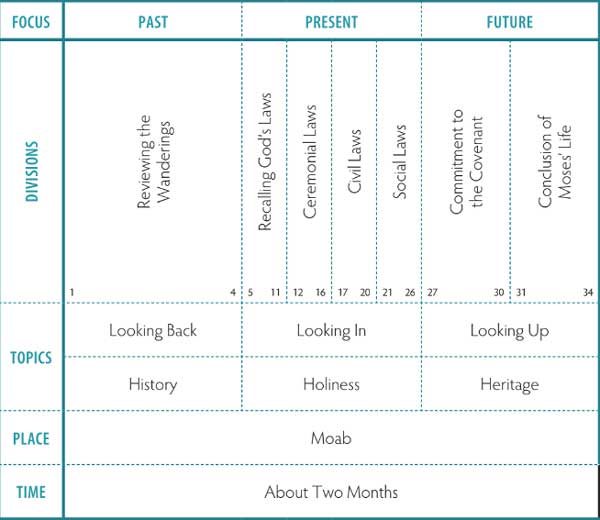
February 20
Deuteronomy 1, 4

Overview
The first of Moses’ three sermons in the Book of Deuteronomy reviewsthe history of the nation and traces God’s dealings with His people. Because of unbelief, the Israelites failed to possess the land God had promised them. But even their disobedience could not annul God's promise. Israel would one day dwell in the land, though an entire generation had died in the wilderness for failing to believe God. True to His word, God overthrew nation after nation during Israel’s relentless march to the Jordan River. The lesson from the past is painfully transparent: Blessing and victory follow obedience, but disobedience brings only defeat and heartache.
Your Daily Walk
What have you learned during the months or years you’ve been walking with the Lord?
The story is told of a high school teacher who spoke with excessive pride of her 38 years of (mediocre) teaching experience. Her principal responded with a chuckle, “Well, that’s not quite correct. Actually, she’s a first-year teacher—38 times over.” Do you see the difference? Each year, that teacher was making the same mistakes she had made during her first year—mistakes that should have been corrected long ago. She never profited from her past errors, so she was destined to repeat them again and again.
Moses tried to shake the nation of Israel from its complacency by pointing out the deadly consequences of past disobedience. As you read today’s section, you could almost hear him plead with the people to open their eyes and learn from their sordid history.
Are you wiser in the ways of God today for having seen Him work in the past?
Insight - Words Worth Repeating
How much practical application do Moses’ sermons to his people in the Book of Deuteronomy carry? Just ask Jesus, who quoted this book three times to fend off Satan in the wilderness, one for each offer Satan made (Matthew 4:1-11).
____________________
February 21/22
Deuteronomy 6

Overview
The second (and longest) of Moses’ three sermons starts in chapter 5 and ends in chapter 26. He begins by reviewing the Ten Commandments, the foundational expression of God’s moral and spiritual requirements for humanity. He then stresses the importance of loving God and passing on His Law to succeeding generations. Moses realizes the need for Israel to keep the Law and to teach future generations God’s commands if they are to be what God desires: an obedient people, conquering their foes in God’s strength.
Your Daily Walk
If a “god” is defined as “anything that has the potential to replace God as the focus of your life,” what will be the most dangerous god you encounter today at work? At home? On your campus? In your leisure-time activities?
As Moses repeated God’s Law to the people, he emphasized one command: “You shall have no other gods before me” (5:7). Why that command? Because he had indelible memories of the golden calf incident at Mount Sinai. He knew the ever-present danger of substituting something for the all-important Someone. In addition, Moses had keen foresight. He knew the religious “climate” into which the people were about to move: a land filled with idolatry and unabashed immorality which, if permitted, would turn the Israelites away from God.
Go back over your list of potential gods. Have you allowed one or more to take a “controlling interest” in your life? If so, circle the ones that need to be rooted out. Then invite the one true God to return to His desired (and proper) place in your life.
Insight - Listen Up, People
Deuteronomy 6:4 begins the celebrated Hebrew Shema (“Listen”), which consists of vv. 6:4-9, 11:13-21, and Numbers 15:37-41, and is recited twice daily by devout Jews. The command “Listen, Israel” is repeated in some form seven times in Deuteronomy (4:1; 5:1; 6:3-4; 9:1; 20:3; 27:9) to emphasize Moses’ appeal for the nation's obedience.
____________________
February 23
Deuteronomy 9
Overview
Moses continues his second sermon by calling upon Israel to remember God’s miraculous care throughout the wilderness experience. As He provided abundantly in the past, so He will provide in the future. But Israel must not forget her sinful past—especially the golden calf incident and its tragic consequences. The choice is Israel’s to make. If she loves and obeys, God will shower her with blessings; if she rebels, God’s judgment must surely follow.
Your Daily Walk
Who or what are the “Anakim” in your life? If you’re not sure, spend a few extra minutes in chapter 9.
The sons of Anak were a race of giants greatly feared by the Israelites. When the spies made their report about the promised land (Numbers 13:26-33), it included two specific references to the Anakim: first, an observation that was true (“We even saw descendants of Anak there,” 13:28); second, an interpretation that was false (“We can’t attack those people; they are stronger than we are,” 13:31). For 40 years these towering giants stood as a taunting symbol of the nation’s unbelief. So tall and formidable were they that the nation had coined a saying: “Who can stand up against the Anakites?” (Deuteronomy 9:2). But Moses assured the people that God specializes in dealing with Anakim. God would go before His people to destroy the giants and to give them the land as He had promised.
What impossible situation seems to stand in the way of your spiritual progress? God’s word to Israel is also aimed at you: “The Lord your God is the one who goes across ahead of you” (9:3). He can handle your “giant-size” situation.
Insight - Phylacteries—A “Binding” Practice
The Pharisees of Jesus’ day (and orthodox Jews of today) practiced Deuteronomy 11:18 by tying small boxes containing Scripture verses to their foreheads and arms when they prayed.
___________________
February 24
Deuteronomy 12:1-16; 14:22–15:11

Overview
From the general principles of the Law and exhortations to obedience, Moses now moves to more specific regulations governing life in the promised land. God Himself would specify the place and manner of worship, and Israel must reject all idolatrous practices. Purity, tithing, release from debt, and servanthood are all ways in which Israel can demonstrate her unique relationship with God. And the nation must be careful to observe all the feast days that mark important events in her miraculous history.
Your Daily Walk
Today, pierced ears are considered fashionable. But in Israel, ears were pierced for a vastly different reason.
In today’s reading Moses gives instructions concerning the release of servants after a six-year period. Once in a while there arose a situation in which a servant so loved his master that he did not wish to be set free. He would prefer to remain under his master’s protection, devoted to his work, rather than to set out on his own. As a perpetual sign of this new relationship, the master would pierce the servant’s ear, thereby proclaiming to the world, “This is my beloved servant; I am perpetually his beloved master.”
In Psalm 40, David picks up this image: “Sacrifice and offering you did not desire, but my ears you have pierced…I desire to do your will, O my God” (40:6, 8 niv).
What about your ears? Have they been pierced for the Lord? Are you the property of the Father, ready to do His will as a loving servant? If not, give God your ears—and life—right now.
Insight - “You are not to do as we do here today” (12:8)
The disruption of life caused by the conquest of the land east of the Jordan may have made orderly worship impossible. This verse may have been intended to prohibit the use of private altars for worship or sacrifice. Once in the land, only one central place of worship would be sanctioned.
____________________
February 25
Deuteronomy 17–18

Overview
Because Israel was a civil society as well as a religious community, laws governing national affairs were as vital as religious statutes. In today’s reading Moses delivers a set of regulations providing for justice and impartiality in the settling of a wide variety of situations that might arise in the life of the nation. Included are laws governing kings, priests, and prophets; peacetime and war; national and international affairs; the guilty and the innocent.
Your Daily Walk
“Now, I don’t know if this is true or not, but did you hear about…?”
If you’ve ever been the subject of such talk, you know the pain and destructiveness of hearsay. God hates rumors, hearsay, and gossip. That’s why He designated a system of justice in Israel whereby no action could be taken against an accused person until two or three witnesses had testified to the truthfulness of the accusation (17:6-7). This law required a thorough investigation and gave the accused the right to be confronted by his accusers. The system was so effective that it became standard practice in the New Testament for handling church discipline (2 Corinthians 13:1). Jesus reaffirmed the Old Testament law when He said: “If your brother sins against you, go and show him his fault…But if he will not listen, take one or two others along, so that ‘every matter may be established by the testimony of two or three witnesses’ ” (Matthew 18:15-16).
God’s principle is clear: You are responsible to investigate a charge of wrongdoing against a fellow Christian before acting on it or telling someone else about it. Remember to squelch rumors and hearsay before they hurt someone else.
Insight - The Motive Behind the Monarch (17:14-15)
Although Israel’s request for a king would seem harmless enough, 1 Samuel 8:4-9 reveals that this desire for a human monarch was indicative of Israel’s refusal to retain God as her true King.
____________________
February 26
Deuteronomy 23:1-8; 26:16-19

Overview
The concluding portion of Moses’ second sermon contains a variety of wise guidelines for life in the promised land. Moses anticipates (and resolves) situations that could arise to disrupt the smooth functioning of Israel’s society. In areas as diverse as marriage, capital punishment, purity, and tithing, Moses provides God’s view of what should and should not be done.
Your Daily Walk
Can you identify with this humorous sign? Then you might get a chuckle out of this tidbit: A man whose life was notoriously cluttered and confused asked that this epitaph be etched on his tombstone: “Organized at last!”
If you are one of those impeccably organized people who plans everything well ahead of time, then you may skip today’s devotional reading. But if you’re like the majority of the human race, you may find Moses’ example in today’s reading very helpful. He greatly served Israel by giving the people clear directions in anticipation of a number of difficult situations. What can you learn from him?
Take the matter of potentially sinful situations. You have a child causing you disciplinary problems. You have a boss or fellow employee who irritates you. Why not plan right now the biblical, God-honoring response you will make the next time that situation arises? Make three columns on a sheet of paper and write down (1) the anticipated situation; (2) your natural response; and (3) your prayerful, planned response. Keep that sheet handy and with God’s help, plan ahead to glorify Him in the midst of a difficult situation.
Insight - The Motive Behind the Monarch (17:14-15)
Although Israel’s request for a king would seem harmless enough, 1 Samuel 8:4-9 reveals that this desire for a human monarch was indicative of Israel’s refusal to retain God as her true King.
____________________
February 27
Deuteronomy 29–30

Overview
In today’s reading Moses concludes his presentation of the new Law for the new generation. First, he sets forth the consequences of obeying and of violating the covenant. Complete surrender to God’s will as revealed in the Law will bring blessing upon the nation, the family, and the individual. Crops will flourish, cattle will multiply, and daily needs will be met. On the other hand, disobedience will result in disaster: pestilence, plagues, and ultimately removal from the land. The responsibility is left squarely on the shoulders of the people. They are free to choose the path they will take, but they are not free to escape the consequences of their choice.
Your Daily Walk
Do you ever find the will of God elusive or unclear? You have an important decision to make, and you want to do the right thing. You want to honor God. But which direction should you take? First, turn to the Word of God. God has something to say to you, and it’s contained in the Bible. All that remains is for you to read and obey it.
God is not in the business of hiding His will or making it difficult to understand. To the Israelites Moses wrote: “What I am commanding you today is not too difficult or beyond your reach. It is not up in heaven, so that you have to ask, ‘Who will ascend into heaven to get it and proclaim it to us so we may obey it?’ ” (30:11-12). God’s will for you is not in a heavenly fog; it is a down-to-earth reality you can understand.
Read 30:11-20 twice. Then list three things that characterize God’s will for you today. Don’t worry about the things in the Bible you don’t understand; think about the things you do. And “do whatever he tells you” (John 2:5).
Insight - The Day the Slave Markets Were Glutted
The horrible curse of 28:68 literally came true. After the fall of Jerusalem in A.D. 70, the slave markets of Egypt became so glutted with captive Israelites that there were not enough buyers for them all. God always keeps His promises.
____________________
February 28
Deuteronomy 31, 34

Overview
Moses’ long and illustrious life is drawing to a close. During his final days as Israel’s leader, he delivers some significant words of counsel to the priests, the Levites, his successor Joshua, and the entire nation. He has learned much during his 120-year walk with God, and his final words of warning and encouragement deserve careful attention. To make his last utterances easily remembered, Moses writes them down in the form of a song. After blessing each of the 12 tribes, Moses climbs Mount Nebo for a final look at the promised land, and there he dies a strong and vigorous man.
Your Daily Walk
Do you have trouble identifying with a great Old Testament saint such as Moses? Moses was a unique historical figure. He stood in the very presence of God, performed miracles before Pharaoh, parted the Red Sea, turned rocks into drinking fountains, and died at the age of 120, still full of youthful vigor.
The Bible paints Moses in very human shades, though. He spent the first two-thirds of his life wrestling with his calling before he finally yielded to God’s will. Being a man of action, he found it frustrating to administer the affairs of a large, rebellious group of people. In a moment of impatience and anger, he struck a rock instead of speaking to it, thus denying himself the opportunity to set foot in the promised land. Yet, God’s commentary on Moses is this: “No prophet has arisen…like Moses, whom the Lord knew face to face” (34:10).
Let the words of Deuteronomy 29:29 provide a fresh motivation for you to know and do God’s will next month as you follow in the footsteps of Moses.
Insight - The Promised Land at Last
Moses, deliverer of his people, never set foot in the promised land. Or did he? Though he climbs Mount Nebo for one last faraway look at Canaan before his death, he is seen inside the promised land years later on the Mount of Transfiguration, along with Jesus and Elijah (Matthew 17:3; Luke 9:30-31).
Now think about God’s promises to His people. This month you saw Him guarantee a lush, fruitful home to the Israelites who fled Egypt. Yet they sadly and unnecessarily postponed the blessings of this promised land because of their lack of faith.
Throughout the Bible God makes many promises: assurances of provision (Matthew 6:31-34); of an abundant life (John 10:10); of freedom from fear and worry (Deuteronomy 31:8; Philippians 4:6-7); of love, joy, and peace (Galatians 5:22-23); and much, much more.
But every promise has two aspects: the promise itself and the claiming of that promise by the person to whom it is given. Like a free trip pledged to us, we must take hold of God’s promises by faith so we can benefit fully from them.
Perhaps the most important gift from God that we can claim is the promise of eternal life. Jesus says: “My sheep listen to my voice; I know them and they follow me. I give them eternal life, and they shall never perish” (John 10:27-28). Now that’s a prize worth claiming!
Won’t you claim eternal life through Jesus Christ? All you have to do is confess your sins, accept the living Christ as Savior and Master of your life, and believe in—lay claim to—your gift of salvation.
Leviticus
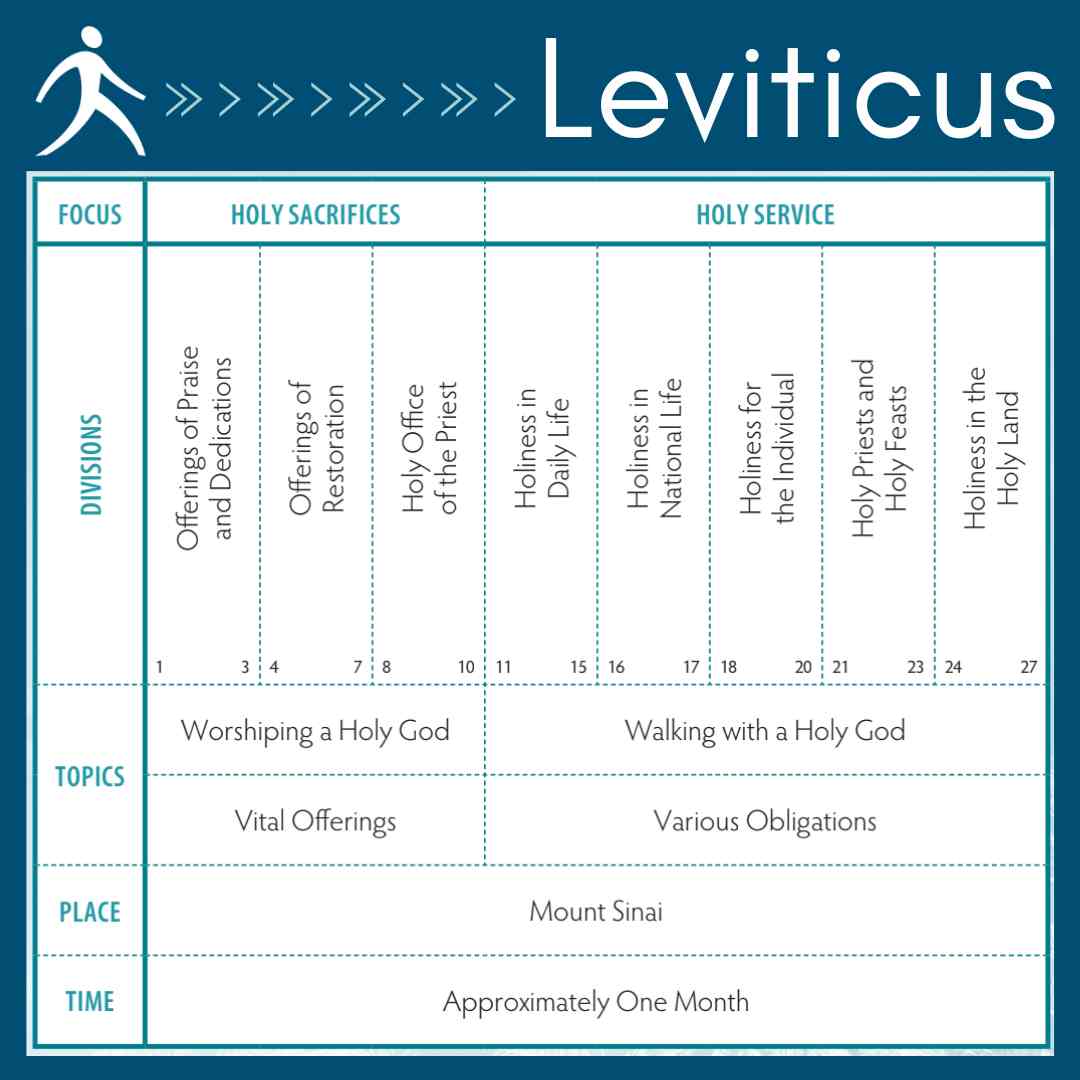
February 1
Leviticus 1

Overview
With the tabernacle completed, God now gives Moses instructions on the five types of sacrifices to be offered in the tabernacle. Three of them—the offerings of an aroma pleasing to the Lord—were voluntary expressions of worship tailored to the person’s ability to give. In the burnt offering, the worshiper declared his total commitment to God. Through the meal offering, he acknowledged that his material possessions belonged wholly to the Lord. By means of the peace offering, the worshiper publicly expressed his thanks or made a vow of spiritual service to God.
Your Daily Walk
Today, you will read about three Old Testament sacrifices prescribed for each Israelite. But did you know that the New Testament describes at least three “sacrifices” prescribed for each believer—three ways for you to offer a sacrifice to God today? Instead of a whole burnt offering, you can offer your body as a pleasing sacrifice to God (Romans 12:1). In place of a grain offering, you might offer from your material possessions a pleasing sacrifice by helping someone in financial need (like the Philippians did for Paul; see Philippians 4:18).
Instead of the peace offering, you could offer the “sacrifice of praise” to God (Hebrews 13:15), a verbal expression of thanksgiving for His care and provision in your life.
Today would be a good time to offer a pleasing aroma to God. Take one of the three sacrifices described above and put it to work by committing each part of your body to God’s service (living sacrifice), writing a check to someone in need (pleasing sacrifice), or sharing God’s goodness publicly in your life (sacrifice of praise).
Insight - Sacrifices for the 21st Century
Animal sacrifices, so essential to Old Testament worship, ceased with the Messiah’s once-for-all-time sacrifice on the cross. Yet Peter tells us that all believers are priests who should continually offer up “spiritual sacrifices acceptable to God” (1 Peter 2:5).
____________________
February 2
Leviticus 4–5

Overview
In addition to the three offerings of aroma pleasing to the Lord, God gives the Israelites two additional sacrifices. Both are required when sin has broken fellowship with God. The sin offering—covering sins of uncleanness, neglect, or thoughtlessness—provided restoration for the sinner while teaching the seriousness of sin and its consequences. The restitution offering—covering sins of injury to God and to others—provided not only for the restoration of the sinner, but for compensation to the injured party as well.
Your Daily Walk
In the margin, list five unpleasant but beneficial experiences from daily life—things you dislike doing (like going to the dentist), but know are good for you.
You probably don’t enjoy the whine of the dentist’s drill, but after all the poking and drilling and bitter taste, you find you enjoy a healthier mouth. Being corrected by a boss when you’ve made a mistake isn’t pleasant either, but afterward, you’re glad your boss cared enough to confront you with the truth.
In the Christian life, there are some equally painful but profitable exercises—such as obeying the biblical principle of restitution. When an Israelite caused injury to another, God’s command was clear: “Make it up to him.” Likewise, as a Christian, you have an obligation to repay those whom you have injured.
Think back over the past week. Is there someone whose character or possessions you have damaged? Have you asked for forgiveness? (That’s hard.) Have you repaid what you owe? (That’s harder still.) Take the initiative today to offer a restitution offering to God. You’ll find the peace of mind and restored relationship well worth the pain.
Insight - And If You Need a Model to Follow…
Zacchaeus, the tax collector who trusted Christ (Luke 19:1-10), beautifully illustrates restitution at work. The Law told a sinner to restore what he had taken or damaged, plus 20 percent. In his gratitude, Zacchaeus offered to restore fourfold what he had taken.
____________________
February 3
Leviticus 8–10
Leviticus 9:23–10:7

Overview
Israel’s tabernacle, the place of communion with God through sacrifice, is entrusted to the custody of Aaron and his sons. The priestly corps must undergo a 10-step consecration process and a 7-day dedication period before they can begin their ministry of mediation. God’s blessing—made visible by His fiery presence—suddenly turns into a curse as judgment falls on two of Aaron’s disobedient sons. Their deaths remind all Israel of the solemn responsibility of serving a holy God. Obedience, not expedience, should mark God’s people.
Your Daily Walk
Nothing is as hard to gain, and as easy to lose, as a good reputation. One philosopher has observed, “To have lost your reputation is to be dead among the living.” Perhaps as a child, you heard your parents say, “Remember, what you do and say reflects on us.” Your parents were telling you that the family’s reputation was either being tarnished or enhanced by your actions.
Perhaps that’s why God responded with such frightening judgment upon Nadab and Abihu. By their carelessness and disobedience, they threatened God’s reputation both inside and outside the nation of Israel—a grave sin indeed.
Our lives as Christians may be the only “Bible” some people will ever read. Do we reveal a holy God by our commitment to holiness, or do we smear His reputation with inconsistent lives? Write this thought on a card and carry it with you: “God’s reputation is at stake in my life. I want to maintain it, not stain it.”
Then, each time you are tempted to stray from God’s holiness, pull out that card. Read it; think about it; then let God strengthen you to be holy—and wholly His.
Insight - The Danger of Failing to Live Up to Your Name
Nadab and Abihu were in danger of damaging not just their own reputations. If allowed to continue in their sinful ways, they would have dishonored both their families and the godly names they carried.
____________________
February 4
Leviticus 11:44-47; 13:59; 14:54-57

Overview
Worshiping a holy God demands a holy people. For this reason, God gives Israel a series of regulations dealing with ceremonial uncleanness. Four areas are specified: dietary laws (describing edible and non-edible animals); childbirth matters; leprosy and other skin disorders; and bodily discharges. Each set of commands follows a general pattern. The worshiper’s defilement is first described, then the means for regaining his purity are prescribed. It’s a lengthy, detailed section—because holiness demands attention to detail.
Your Daily Walk
In Leviticus 11:44, God told Moses to tell the Israelites: “Be holy, because I am holy.” Isn’t God demanding something impossible and unattainable? Isn’t He being unreasonable when He says: “Be holy”? From a human viewpoint, the task seems impossible.
It is impossible by human efforts alone to live up to the righteous demands of a holy God. But the Law was designed to teach the Israelites to depend on God. Just as He provided sacrifices and rituals for cleansing His less-than-perfect people, so He wants to teach you that only through the supernatural provision of a sinless Savior, Jesus Christ, can you hope to achieve holiness.
Paul puts it this way: “Just as you received Christ Jesus as Lord [by faith, trusting in Him], continue to live in him [by faith, trusting in Him]” (Colossians 2:6). In Christ’s strength, you can live a holy and pure life. Complete this thought from Leviticus 11:44: “Be holy [how? when? where? with whom?] because I am holy.” Then work today on developing the habit of holiness in one area of your life.
Insight - Leprosy Then and Now
It is doubtful that modern-day leprosy (called Hansen’s Disease and caused by bacteria) is the same as Levitical leprosy (a variety of skin conditions) or New Testament leprosy (which apparently was a white, scaly disease, much like eczema or psoriasis).
____________________
February 5
Leviticus 16
Overview
The great Day of Atonement, observed each year, was Israel’s most significant act of worship. On that day, the nation gathered to watch in expectation as the high priest entered the Holy of Holies with the blood of atonement, which would cover the sins of the entire nation for another year. Because blood was the central element in Israel’s national and personal redemption, God prohibited the use of blood for any purpose other than sacrifice to Him.
Your Daily Walk
What would you do if God gave you the responsibility of atoning for your own sins? What would you offer as payment to satisfy His righteous demands: the deed to your house? Your savings account? Your awards and achievements? your spotless reputation? As sincere as these offerings might be, they would never be adequate to make amends for your sins.
Each year, as the nation of Israel stood before the tabernacle on the Day of Atonement and watched the high priest carry the blood of the sin offering into the Holy of Holies, the people were reminded once again that atonement was God’s idea. It was His provision for the forgiveness of sinful people. He took the initiative to establish a sacrifice of atonement, which provided a blood substitute for the guilty nation.
Just as God provided the way to cover Israel’s sins, so too He has sent His own Son as the once-for-all-time atonement for your sins (1 John 2:2). As you rejoice over that wonderful truth, make a list of three friends who need to experience Christ’s forgiveness of sins. Pray today for each of the three names and be ready to share the truth of the gospel with them when God opens the door.
Insight - No Private Sacrifices Allowed!
The restrictions against private sacrifices outside the tabernacle (17:3-4) were to prevent the people from copying their pagan neighbors, who often poured their blood sacrifices into the ground as food for their gods. Only properly ordained priests in the proper location (the tabernacle) could offer Israel’s sacrifices.
____________________
February 6
Leviticus 19

Overview
In addition to the regulations governing national holiness, God provides Israel with laws governing personal conduct and purity in relation to the family, the community, and society in general. Because obedience is His primary concern, God requires that violators of His laws be punished, and that the punishment be appropriate to the crime committed. God’s strict guidelines for living reflect His desire that His people “be holy… because I, the Lord, am holy, and I have set you apart from the nations to be my own” (20:26).
Your Daily Walk
“Love your neighbor as yourself” (19:18) rolls off the tongue with a familiar ease. But putting it into practice is another matter. Of all God’s commands, it may be one of the most difficult to keep. Why? Because loving your neighbor means being involved in your neighbor's life. That’s hard to do because a human being’s natural tendency is toward selfishness, not selflessness.
The Old Testament Law was difficult to keep because it made very specific demands on individuals. If an Israelite had questions about how to relate to his neighbor, the Law provided the answers (19:9-18). The New Testament is just as specific, and just as demanding—especially when it speaks of your relationship to your “neighbor.” Jesus’ story of the Good Samaritan (Luke 10:25-37) points out that your “neighbor” is anyone who needs your help and whose need God has equipped you to meet.
Put God’s command to love your neighbor into practice today by seeking out someone who needs help with yardwork, housework, or homework. Assist them in love and treat them as you would yourself.
Insight - “Do Like Me to Be Like Me”
More than 40 times in chapters 18–22, we read God’s words: “I am the Lord,” and “Be holy.” Without a doubt, the holiness of the Redeemer is the compelling reason for His insistence on practices of purity by the redeemed.
____________________
February 7/8
Leviticus 21

Overview
Privilege carries with it responsibility, and in the case of Israel’s priests, the responsibilities of serving a holy God become quite demanding. The priests must avoid defilement, which others might ordinarily experience. They must be free of physical defects to serve in the sanctuary. They must bear the responsibility for maintaining purity in Israel’s sacrificial worship. They must preside at Israel’s yearly feasts and sacred assemblies. It is a demanding assignment to lead a nation in corporate worship of a holy God—a privilege not to be taken lightly or entered into casually.
Your Daily Walk
If you discovered that your dining room had been “bugged,” would you have some embarrassing conversations to explain?
Unfortunately, in many Christian homes, the main course for Sunday dinner is often “roast preacher.” It’s an easy habit to slip into, but one that can produce harm and bitterness.
In Israel’s system of worship, the priests carried much of the responsibility for leading corporate worship. Today, the church no longer has a “priestly class,” but it does have those specially gifted, trained, and set apart for the work of the ministry (1 Timothy 3; Titus 1).
Like the priests of Old Testament times, these leaders have given of their time and energy in order to lead you in worship.
How often do you “remember your leaders, who spoke the word of God to you” (Hebrews 13:7)? Take a few minutes to write a thank-you note to your pastor or church leader, expressing gratitude for the consistent spiritual investment that person makes in your life.
Insight - Probing a Priestly Prohibition
Priests with physical defects were excluded from offering sacrifices (21:17-21), though they were entitled to the privileges of priesthoods such as eating the priestly portion (21:22). God was not relegating them to second-class status, but merely showing that the special service of sacrificing unblemished animals before a holy God required unblemished priests.
____________________
February 9
Leviticus 24–27
Leviticus 25

Overview
The closing chapters of Leviticus contain a variety of instructions for Israel when the people occupy the promised land. Oil and bread must be provided for the sanctuary. The death penalty must fall on those who blaspheme the name of God. The land must be given periodic rest during the sabbatical and jubilee years. God promises to honor obedience to His commands and reward disobedience with stern judgment. The work of the Lord must be faithfully supported by the tithes of God’s people, and vows must not be entered into lightly.
Your Daily Walk
People are born with an innate desire to possess. Children at play argue loudly, “That’s mine!” Though adults usually tend to be more civilized about it, you’ll find the same sentiment voiced repeatedly: “I want what’s mine!”
God recognized this tendency in His people and instituted ways to help teach them a crucial spiritual truth. Every seventh year, all land was to remain uncultivated in order to remind the nation that the land belonged not to them, but to God. And every 50th year, known as the Year of Jubilee, all land that had been sold was to be returned to its original owners. God would give the land a Sabbath of rest (25:2). They could enjoy it—not as permanent owners, but as foreigners and temporary residents (25:23).
How do you view your possessions? Do you hold on to them tightly, or have you recognized them as something graciously loaned to you by God? Remember, a steward is someone who owns nothing but is responsible for everything entrusted to his care. To reinforce that truth, choose one room of your house and list everything in it. Then across the list, write these words: “Mine by stewardship, His by ownership.” Get the picture?
Insight - Captivity Foretold
One of the earliest predictions of the Assyrian and Babylonian captivities occurs in today’s reading (26:33-35). Israel knew from the start what would happen if the people disobeyed God’s Word. Yet centuries later, it would come true.
____________________
Numbers
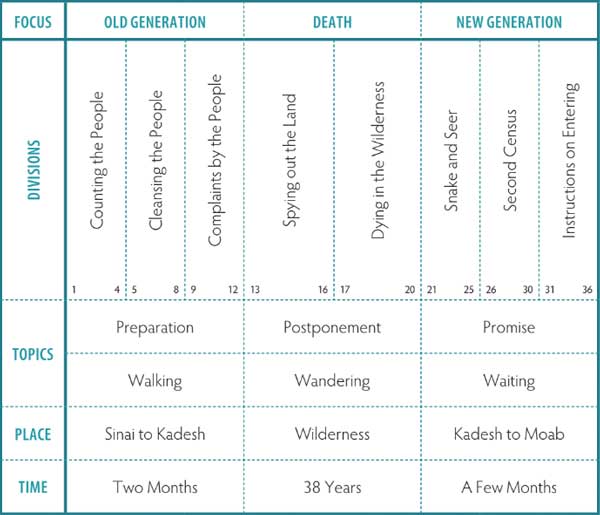
February 10
Numbers 3

Overview
With the laws given and the ceremonies specified, God now commands Moses to count the people and position them in a square formation around the tabernacle. The number of fighting men (603,550) suggests a total population of more than three million men, women, and children. The Levites are then positioned and numbered, and each priestly group is assigned a work detail related to the care and transport of the tabernacle.
Your Daily Walk
What is it that we all have the same amount of, but no one ever seems to have enough of? (Hint: The answer is not IQ, money, or credit card accounts.)
You probably guessed it. The one commodity shared equally by all members of the human race is time. Whether you are a peasant or a president, God’s gracious gift of time comes to you in bite-sized, 24-hour chunks—no more, no less. Perhaps you have been frustrated in your attempt to manage your time and accomplish everything you set out to do each day. If so, consider this: You have all the time you need to accomplish everything God intends for you to accomplish today. That means if you are too busy to do the things you know God wants you to do, then you are busier than God intends for you to be.
Analyze your time priorities. Across a sheet of paper, draw seven columns for Sunday through Saturday, and divide each day according to the way you normally spend it. Is there adequate time for sleep? Bible study? prayer? recreation? family activities? If not, what would need to change for God to be honored in your use of time?
Insight - The World’s Largest Campground
\If the population estimate of three million is accurate, and a minimum living space is allowed for each Israelite’s family and flocks, the camp of Israel must have been enormous—covering more than 100 square miles (about twice the size of San Francisco). Yet through a detailed, God-given plan for pitching, striking, and moving camp, Moses maintained order in the nation.
____________________
February 11
Numbers 5–8
Numbers 5:11-31; 6:1-21

Overview
With the Israelites numbered and positioned, God further prepares the nation for entering the promised land by giving Moses instructions for cleansing and worship. First, Israel must be free of defilement from immorality and suspicions. The people must sense the sanctity of binding commitments such as the Nazirite vow. They must provide for the material needs of the tabernacle. And they must have a purified group of Levites to minister effectively for them in the corporate worship and celebration of the nation.
Your Daily Walk
A jealous husband. A suspicious wife. The combination can eat like acid into the marriage relationship. For this reason, God provided the seemingly strange ritual of Numbers 5:11-31 in order to deal decisively with jealousy and suspicion in the home. The ordeal by “bitter water” was designed to dramatize the bitterness and heartache caused by festering jealousy.
Today, the problem of jealousy remains just as widespread and malignant. But God’s prescribed cure has changed somewhat. According to James 4:7-10, it involves three parts: (1) submission to God; (2) confession to one another; (3) restoration in forgiving love. As with Numbers 5, the process is painful, but necessary.
Examine your heart right now. Are you harboring suspicion or jealousy toward a spouse, Christian friend, or family member? The place to begin is by talking to God. Confess your wrong attitude and appropriate His forgiveness. Then confront the other party in love. It won’t be pleasant, but when the alternative is simmering bitterness and broken fellowship, wouldn’t you agree that God’s way is best?
Insight - No Wine, Corpses, or Haircuts Allowed
The requirements of the Nazirite vow might seem strange unless understood in their symbolic sense. Wine symbolized comfort and enjoyment. Death and corpses represented defilement. Long hair stood for God-given strength and dignity. By avoiding the former two and maintaining the latter, a Nazirite declared his or her total devotion to God.
____________________
February 12
Numbers 9-12
Numbers 9–10

Overview
Finally, the day has arrived for the nation to pull up stakes and set out for Canaan. As silver trumpets herald the journey’s commencement, the huge camp prepares to march. The long-awaited move has begun. But all too soon, gratitude turns to grouchiness: The people complain about their daily diet of manna and express jealousy over Moses’ leadership. In the midst of miraculous provision, there is persistent complaining, until at last the weary Israelites arrive at Kadesh-barnea, on the very border of Canaan.
Your Daily Walk
How many things can you think of that were truly “good” about the “good old days”?
When you experience adversity—even though you’re obeying God—you may catch yourself looking back on the “good old days” with a twinge of nostalgia. Memory is selective. Current difficulty often seems to bring to mind only the best of yesterday.
The Israelites had hardly broken camp when they began to complain about God’s daily provision of manna. To hear them tell it, you’d think they had left paradise in Egypt (11:5). But their foresight was even worse than their hindsight, for they forgot God’s promise of future blessing. God never intended for His children to spend the rest of their lives in the desert, eating manna.
Have difficult times caused you to look longingly at the way life used to be? To help you keep your eyes focused on God’s purpose for you, write these verses on an index card and carry it today:
“One thing I do: Forgetting what is behind and straining toward what is ahead, I press on toward the goal to win the prize for which God has called me heavenward in Christ Jesus” (Philippians 3:13-14). Keep looking up, and you’ll never want to look back.
Insight - Ark in the Middle, Ark in the Front
Compare Numbers 2 and 10, and note that the ark enjoyed a position of prominence both in the camp and on the march. Can you suggest a reason for each position?
____________________
February 13
Numbers 13–16
Numbers 13

Overview
At the Lord’s command, Moses selects one man from each tribe to form a spying party to survey the land of Canaan. They return 40 days later, all having seen the same thing but divided in their opinions as to what it meant. The majority opinion: “The people are stronger than we are.” The minority opinion: “We shall surely overcome.” Disheartened and faithless, the people threaten to stone Moses and return to Egypt rather than face what seems to them a certain massacre. God’s punishment for their unbelief is severe: one year of wilderness wandering for each day the spies were in the land—and death in the wilderness for that entire generation. Yet, God’s plans will not be ultimately thwarted, as seen in the laws that He gives them to practice in the land.
Your Daily Walk
Two bricklayers were asked what they were doing. The first replied, “I’m laying brick”; the second, “I’m building a great cathedral.” Same task, same bricks, two different perspectives.
On the verge of entering the promised land, the Israelites evaluated the spies’ report. The land flows with milk and honey, but it also overflows with fortified cities and giants. Obviously, there could be only one response—“Let’s go!” The question was, in which direction? Joshua and Caleb responded with faith: “Let’s go forward!” The other 10 spies responded with feelings: “Let’s go back to Egypt!” The majority opinion prevailed, and Israel traced circles in the desert for 40 years.
Where is God stretching your faith today? Spy out your situation and make a list of what you see. Then ask yourself two questions: “How could I respond to this without faith? How should I respond to this in faith?” Then do the thing that will please God.
Insight - “Hey, Moses, You Remind Me of Someone…”
He was a humble man. His own people wanted to stone him, but in turn, he asked God to spare their lives. He was innocent, but he had to share the same punishment as his followers. He eventually delivered them into a new life in the promised land. Does Moses remind you of Someone else you know?
____________________
February 14/15
Numbers 18, 20

Overview
As the grumbling generation marches through the wilderness outside the promised land, their discontent focuses on Moses and Aaron. Only a miraculous budding of Aaron’s rod can convince the people that Aaron represents God’s authority. In this context of rebellion, God again emphasizes the Levites’ role in the service of the tabernacle and provides the red cow as a means of cleansing the people from the ever-present defilement of death. Eventually, Moses is affected by the nation’s complaining attitude as well. In a moment of anger, he strikes the rock instead of speaking to it as God commanded, and so forfeits his privilege to set foot in the promised land.
Your Daily Walk
In the margin, write three things that you feel are essential for your future security. Now go back over your list and cross off any item that could easily be destroyed by a natural disaster or a financial reversal. Is there anything left?
God made it clear to Aaron and his family that their security lay in Him alone, even as they enjoyed their new homeland. God had faithfully supplied Aaron’s daily needs in the past (18:18-19), and He would do the same in the future. This was also true for the nation as a whole. God had been their great Sustainer, and would continue to provide even when they possessed wealth of their own.
Though owning property or having a bank account is not wrong, the danger is in allowing such things to crowd out your daily dependence on God. You may be in “good hands” financially, but you’re in better hands with God. Reread Numbers 18:20 to remind you that true security comes from God.
Insight - Don’t Touch That Grave!
Because a Jew was defiled by touching a human grave (19:16), tombs in Israel were often whitewashed so that unwary passersby could avoid contact with them. This helps explain why the Pharisees were offended when Jesus denounced them in Matthew 23:27 as “whitewashed tombs.”
____________________
January 16
Genesis 45–47
Genesis 47

Overview
Joseph, no longer able to maintain the masquerade, reveals his true identity to his terrified brothers. His explanation of recent events (45:5-8) reveals the spiritual perspective that sustained him through years of heartache and uncertainty. In keeping with the prophecy given to Abram (15:13), God assures Jacob that a sojourn in Egypt is divinely approved (46:3). So the entire family of 70 moves to Goshen, which will become home for the fledgling nation Israel for the next 400 years.
Your Daily Walk
The contrast must have been striking. Into the court of the most powerful king on earth hobbled an old man dressed in the rough garb of a Bedouin tent dweller. Pharaoh was granting an audience to Jacob out of respect for Joseph. And Jacob, the seemingly insignificant old man, blessed the king (47:7-10).
Pharaoh didn’t know it, but he was being blessed by none other than Israel. For all his immediate importance, Pharaoh would subsequently fade into oblivion. Even his name would disappear from historical records. Yet this old shepherd would continue to occupy a place of honor throughout the centuries. God’s people would be called the “children of Israel,” and God would now identify Himself as “the God of Jacob.” From Jacob’s line would come the King of kings, who “will reign over the house of Jacob forever” (Luke 1:33).
Appearances can be deceiving. You, like Jacob, may not look like a V.I.P. in the eyes of the world. But you are. Your importance, like Jacob’s, does not stem from what you have made of yourself, but from what Jesus has made of you. See if you can complete this sentence 10 ways: “Because I am a child of God, I am____________.” Then live out your identity today as a child of the King.
Insight - “You Did It…He Did It!”
“Do not be distressed…for selling me…God sent me” (45:5) is a classic statement of God’s providence. Looking back, Joseph could clearly see both elements—human and divine—at work in God’s plan.
____________________
January 17/18
Genesis 48–50
Genesis 50

Overview
Chapters 48–50 conclude the Book of Genesis by recording the final acts of Jacob and Joseph, along with their deaths and burials. Jacob’s blessing upon Joseph’s two sons, announcing that the younger would be more honored than the older, is in keeping with the pattern established in Genesis (Isaac instead of Ishmael, Jacob instead of Esau, Joseph instead of Reuben). As his final earthly act, Jacob blesses each of his 12 sons, giving a divinely guided pronouncement on their future. Jacob’s body is embalmed and taken back to Canaan for burial, while Joseph’s body remains in Egypt until the release of the newly born nation of Israel.
Your Daily Walk
Do you sometimes wish your life could count more for God—that you could have more of an impact for good in the lives of those around you? You plod along faithfully, but nothing much ever seems to come of it. In fact, you’re tempted to throw in the spiritual towel.
God’s plan is larger than any one person. Amazingly, He weaves together the lives of many different people to accomplish His will. Joseph is a good example. Torn from his family, ill-treated, and imprisoned, he later emerges as ruler in Egypt. And why? “God intended it for good to accomplish what is now being done, the saving of many lives” (50:20). Joseph’s family and the entire nation of Egypt soon owed their survival to Joseph’s leadership.
How many lives do you touch every day? The number might surprise you: your spouse, your parents, the kids, the boss, the teacher. Don’t forget your neighbors, your co-workers, the server, and the cashier. Select one name and one way God could use you to touch that life with a smile, a kind word, a thoughtful act. Then allow God to use you today for good.
Insight - Egyptian Mortuary Service
Embalming usually took 40 days and was available in three different price ranges. When completed, the coffin was left standing upright against the wall of the burial chamber.
____________________
Exodus
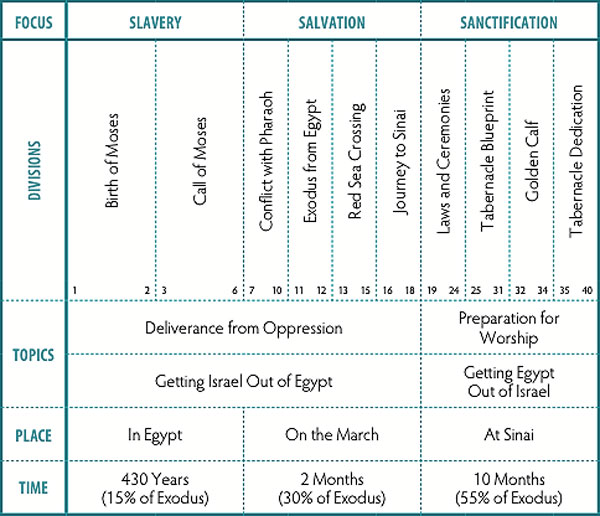
January 19
Exodus 1–2
Exodus 2:11-22

Overview
Exodus opens where Genesis leaves off: with Jacob’s descendants multiplying in Egypt. A new ruler emerges who respects neither Joseph’s memory nor the Israelites’ human rights. Though Pharaoh attempts to kill all newborn Hebrew males, the infant Moses is providentially spared and raised in the very palace of the one who sought his death. At the age of 40, Moses aims to do the right thing (deliverance) in the wrong way (murder) and spends the next four decades in exile, tending sheep in the Midian wilderness.
Your Daily Walk
The man sitting by the desert well was lost in his thoughts. With dejection on every line of his face, he felt much older than his 40 years. Moses was miserable—and with good reason.
He was the one man in all of Egypt who might have had a chance to bring relief to his people. He had position, training, natural ability, and the desire to help. But in one foolish act, he killed a man and forfeited all the advantages he had hoped to use.
Satan delights in convincing believers that they are of no use to God. And God delights in building cathedrals out of rubble. Moses’ life needed reconstruction, to be sure. But when that rebuilding process was complete, he was a monument to God’s grace.
Where in your life have you nearly given up hope that God could ever salvage the situation? First, walk a mile in Moses’ sandals. Study his failures. Learn about God’s patience in his life. Then find your own “desert well” to sit by and meditate on the encouraging words for discouraged disciples found in Exodus 3:10-14.
Insight - The Ark Revisited
The same Hebrew word for ark (as in Noah’s) describes the vessel used by Moses’ mother to hide him in the bulrushes. Once again, we see God deliver His chosen from destruction by water after an obedient act of the faithful (Noah and Moses’ mother, of Levi’s lineage; see Exodus 2:1).
____________________
January 20
Exodus 3–6
Exodus 3; 6:1-13

Overview
After 40 years of reflection, Moses concludes he is permanently disqualified from God’s service. In a remarkable debate with the living God, Moses offers four excuses and begs the Lord to send someone else as His spokesman. Finally, when God provides Aaron as a mouthpiece, Moses confronts Pharaoh with God’s message. As predicted, Pharaoh not only denies God’s demand but also increases the misery of the Hebrews. Moses’ popularity with his people plummets, but God assures Moses that He will keep His promise of deliverance.
Your Daily Walk
The church has been likened to a football game in which thousands of spectators, desperately in need of exercise, are watching a handful of players, desperately in need of rest. Are you a spectator or a player?
Before you pull out your list of reasons excusing you from active duty in your church, eavesdrop on an 80-year-old shepherd as he argues with a burning bush. With good reason, Moses anticipated resistance and rejection from his own people—to say nothing of Pharaoh. Besides, he had a speech impediment and an inferiority complex. Surely God was showing poor judgment (so Moses thought) in His choice of a deliverer for His people.
Patiently, thoroughly, God gave His rebuttal: “I can use this bush, that rod in your hand, or even your stammering lips—whatever is available—to accomplish My plan and fulfill My promises. For all that you lack, and everything you are not, I AM.”
God probably isn’t recruiting you to lead a nation out of bondage. But He definitely wants to show what He can accomplish through you. In response to His promise that “I AM all you need,” will you answer, “I am available”?
Insight - Speak Softly and Carry a Big Stick
God subsequently used Moses’s staff to turn water into blood, bring hail and lightning, summon locusts, divide the Red Sea, bring water out of rocks, and signal victory in battle.
_____________________
January 21
Exodus 7–10
Exodus 7; 8:25-32

Overview
Pharaoh’s stubborn refusal to release God’s people prompts Him to unleash nine devastating plagues against Egypt. Moved by this display of God’s power, Pharaoh repeatedly promises to release the nation. But when the time arrives, his heart is hardened and he breaks his word. To shatter Pharaoh’s unyielding will, God prepares one last plague—death in every unprepared home in the land.
Your Daily Walk
Have you ever yielded to the temptation to take what you thought was a shortcut, only to find yourself hopelessly lost? Maybe you’ve experienced the same thing in your spiritual life as you looked for a shortcut to accomplish God’s will.
Alternate routes may look attractive, but they can often have un- expected consequences. Pharaoh offered Moses four shortcuts to releasing the people from bondage (8:25, 28; 10:11, 24). None of the four conformed to God’s specific instructions. They were only attempts by Pharaoh to hide his refusal to obey God. Moses detected Pharaoh’s motives, for he knew that anything short of obedience is disobedience.
That principle is still true today. There is no safe alternate route when the Bible clearly states: “This is what the Lord says.” Nothing short of doing God’s will in God’s way will guarantee that you arrive at your intended destination. Look up the following verses to discover how God wants to guide you from the pages of His Word:
- The Bible is a ___________ and a __________ (Psalm 119:105).
- The revelation of God’s Word gives ___________ (Psalm 119:130).
- The best place to hide God’s Word is ___________ (Psalm 119:11).
Now map out God’s route to one of your destinations today.
Insight - Terror in the Sky
The locust, often a tool of divine judgment in the pages of Scripture, is one of nature’s most destructive creatures. A locust swarm may number more than 100,000 insects per square mile and has the capacity to eat thousands of acres of vegetation in a single day.
The religion of ancient Egypt is very difficult to analyze, for the Egyptians were one of the most polytheistic people of antiquity. The total number of their gods is uncertain, but most lists include at least 80. Most living creatures and many inanimate objects became the embodiment of some deity (Romans 1:23), and even Pharaoh himself was considered to be divine, on a level with other deities in the Egyptian pantheon (Exodus 5:2).
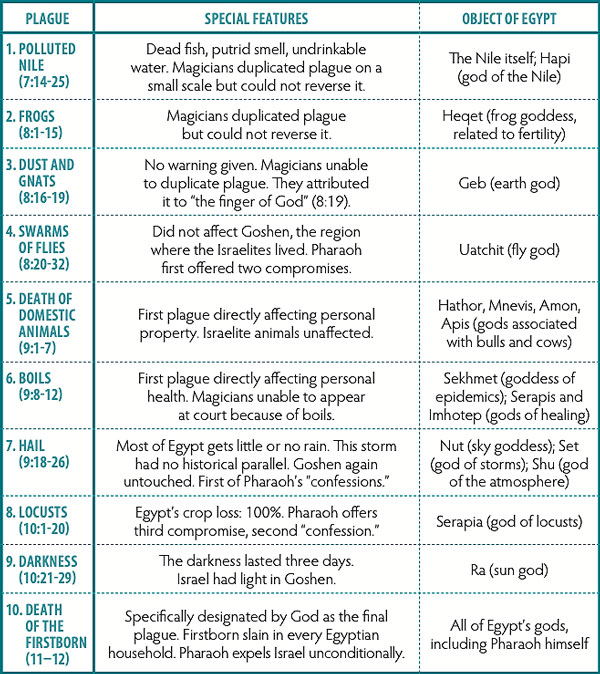
January 22
Exodus 12:1-8, 37-51

Overview
In the end, it’s no contest. Death touches every Egyptian family as the final plague brings destruction to every firstborn child and beast. But the Israelite homes escape death because their households are protected by the blood of a sacrificial animal slain as a substitute for the firstborn. Pharaoh, the stubborn monarch, finally commands the Hebrews to leave, and the long-awaited Exodus begins. Passover thereafter becomes an annual memorial of the salvation of God’s people from their Egyptian homes of bondage.
Your Daily Walk
“One generation will commend your works to another; they will tell of your mighty acts” (Psalm 145:4).
If someone were to write an article titled “What to Do Between God’s Miracles,” it might consist of a single word: Remember. The mighty supernatural acts of God on behalf of His people have been relatively few and far between. One of God’s purposes for such spectacular demonstrations has been to reveal His power quietly at work behind the scenes. Because miracles like the 10 plagues occurred infrequently, God’s people were instructed to recall the past as a basis for faith in the present. And as an aid to feeble memories, God instituted memorials such as the Passover—to be observed regularly by His people throughout the generations.
What was a good idea then is a good idea now. Are there objects in your home that can remind you of God’s faithfulness in the past—a picture on the wall, a cancelled check, a scrapbook? Are there certain dates you could designate “Memorial Anniversaries” to recall special provisions of God? Select your own memorial today and plan now to recall a mighty act of God in your life. Like Passover, make it a yearly habit to recall God’s goodness.
Insight - Israel’s Severance Pay for Forced Labor
In their eagerness to remove the Israelites (and the plagues) from their land, the Egyptians turned over vast quantities of gold, jewelry, and clothing—fair payment for 400 years of slave labor.
____________________
January 23
Exodus 14:19–15:27

Overview
Things get worse for the Israelites before they get better. God leads His band of three million refugees to the intersection of Baalzephon and the Red Sea, a seemingly inescapable dead end. Pharaoh, experiencing yet another change of heart, dispatches a crack chariot division to bring the Israelite Exodus to an end. Instead, the Egyptian army meets its end in the swirling waters of the Red Sea. Moses watches the people’s panic turn to praise as they walk across the seabed dryshod and sing a great song of jubilation to their Savior God.
Your Daily Walk
You are seated in church when you hear the words, “Please bow your head and worship the Lord in the quietness of your own heart.” You set your bulletin aside and close your eyes. Then you think to yourself, What am I supposed to do now?
Worshipping God is a skill seldom taught and infrequently practiced. At its root, worship involves recognizing the “worth-ship” of another. It is a response to God's greatness. People in the Bible worshiped God for who He was (His person) and for what He did (His works), because His actions are always consistent with His character.
If you had been standing with the Israelites on the far banks of the Red Sea as the waters swallowed up the Egyptian army, you would have had no trouble responding in an attitude of worship. Even today, you can join in their chorus of praise. Read through their song in chapter 15 again, making a list of God’s actions (conduct)—which prompted worship from His people—and a second list of what is proclaimed about God’s attributes (character). Now you, too, should be ready to “sing the praises” of your God and Savior today.
Insight - Taking the Scenic Route
Israel’s God and Guide (in the form of a cloudy pillar) steered the travelers away from the most direct route to Canaan, the “way of the sea,” for at least two reasons: (1) to avoid certain warfare; and (2) to take Israel to the mountain of God (3:12). The nation needed to learn to walk with God before learning to fight for God.
____________________
January 24-25
Exodus 16–18
Exodus 16:1–17:7

Overview
Only days after the miracle of the Red Sea, grumbling and discontent began to surface among the people on the march. The nation God delivered by faith must now learn to walk by faith, and they have much to learn. Of prime concern is finding sufficient water and food to sustain a caravan of three million people in the desolate wilderness. A month into the journey, when food and water supplies are exhausted, the people cry out anxiously to Moses. Miraculously, God provides manna, quail, and water in abundance to remind them that He is the source of their supply. Even Moses must learn this lesson. Exhausted from attempting to administer the nation single-handedly, Moses follows his father-in-law's advice and selects assistants to help him with the work.
Your Daily Walk
Have you found that your blessings arealso your biggest problems? The things you thought would bring you the greatest joy are, in fact, the things that cause you the most headaches. For instance: the new car (which spends more time in the shop than on the road), the long-awaited child (who now has the house under siege), the unexpected promotion (which produced those equally unexpected ulcers).
Israel learned the hard way that blessings bring responsibility. Daily manna was a wonderful provision from God, but it had to be collected and eaten in a particular way. God’s presence in the pillar of cloud and fire was comforting, but it meant unquestioned obedience. When the pillar moved, Israel moved.
Make a list of some of God’s recent blessings to you, including the ones that seem to give you grief. Next to each, put an obligation that is yours if you enjoy the blessing as God intended.
Insight - A Subtle Prophecy
The water from the rock at Rephidim beautifully symbolizes Christ, our life-giver (John 7:37-39). The smitten rock illustrates Christ's death, resulting in an outpouring of life through the Holy Spirit because of accomplished redemption.
____________________
January 26
Exodus 19–20
Exodus 20

Overview
Israel could scarcely be called a nation. Up to this point, she’s just a vast group of unorganized people. Self-government was impossible in Egypt, and as yet, there are no laws. But at Mount Sinai, in a setting designed to remove distractions and focus attention on God, the people receive their charter as God’s chosen nation. After declaring their willingness to obey the commands they are about to receive, the Israelites spend two days preparing themselves to hear God. On the third day, beginning with an awe-inspiring display on Mount Sinai, God delivers the spiritual and moral principles by which the nation’s social and religious life will be conducted.
Your Daily Walk
“The Christian life is a bunch of dos and don’ts!” “The Christian life is liberty to do as I please!”
To be sure, in Christ there is freedom from bondage to sin and release from the guilt of past failures. But liberty does not mean license to live as you please. Just because the Israelites were free from Egyptian slavery did not mean they were free to follow their every desire. God still wanted them to live as His chosen people, so He gave them rules for their daily conduct—not a list of dos and don’ts to spoil their fun, but a series of commands for their protection and profit.
Imagine what a football game would be like without rules: no boundaries, no clock, no referees, no time limit. And probably no fun. Rules are essential for the enjoyment of life.
Read your way slowly and thoughtfully down the list of commandments in today’s reading again. Try to think of at least one reason why each command would make your life happier or safer if you kept it unquestioningly. Is there one you need to work on?
Insight - What Was the Hike up Sinai Like?
Mount Sinai is best identified as Jebel Musa, a 7,363-foot peak on the southern end of a mountain ridge two miles long and one mile wide. Before it stretches a plain adequate to hold Israel’s camp.
____________________
January 27
Exodus 21–24
Exodus 24

Overview
The law given by God to Israel at Sinai falls into three categories: moral and spiritual laws (Exodus 20), civil and social laws (Exodus 21–23), and religious laws (Exodus 24–Leviticus). Today’s reading contains the civil and social laws that comprise “the Book of the Covenant” (24:7), given alongside the Ten Commandments. Following a formal ceremony ratifying the covenant, Moses is called again by God to Mount Sinai to receive further revelation.
Your Daily Walk
Some things bear repeating, and even then, they don’t always sink in. God’s word to Israel in the first two commandments could hardly have been clearer: “No other gods … no idols.” Yet He would later repeat those same warnings again and again. He wanted to impress upon His people the seriousness of His lordship, and to make certain they understood the necessity for exclusive devotion to the God of Israel.
God knew that we eventually worship that which we serve (23:24). Therefore, whatever or whoever commands our attention becomes our god. Recognizing that fact can help us guard against idolatry. Here are two good questions that point to the real “Lord” of your life:
1. What do you think about when your mind is in neutral?
2. What do you do during your idle moments?
Review your own loyalties, and then fill in the blank: “An objective observer of my life over the past week would conclude that _______________ is my god.” Is there something that needs to change so that you, like Israel, have “no other gods” besides the Lord?
Insight - A Forbidden Recipe
The prohibition against boiling a young goat in its mother’s milk (23:19) made little sense to modern scholars until archaeological discoveries revealed that the practice was current in Canaan as a pagan magic spell connected with agricultural fertility rites.
____________________
January 28
Exodus 25–27
Exodus 25:1-9

Overview
During Moses’s stay on the mountain, God reveals His detailed plans for the tabernacle in which He will dwell and receive His people’s worship. No item is overlooked in God’s design of this portable tent of worship. Everything is to be done “according to the plan shown you on the mountain” (26:30). God’s dwelling place with His people, Israel, will be the central structure in the camp and the focus of the nation’s attention and activities.
Your Daily Walk
How big is your God? Having studied the tabernacle in detail, keep in mind this was a portable building, capable of being dismantled and carried around as Israel journeyed. Though God’s presence uniquely inhabited the tabernacle, the fact that it could be disassembled for travel reminded the Israelites that their God could not be confined to four walls. He was with them in the fire and cloud; He could divide great seas and drown mighty armies; He could provide water from rocks and manna from the morning dew. Contrast this with the pagan gods of neighboring nations—powerless idols that had to be carried on their worshipers’ shoulders (Isaiah 46:5-7). Israel’s priests carried God’s temporary house on their shoulders, but Israel’s God carried them!
If at times you find yourself wishing God were a little more flexible, yielding more to your own desires and expectations, consider this fact: If God were small enough for you to control, He would not be strong enough to help you in times of need.
If you can, visit your church sometime today, and in the quiet, worshipful atmosphere of the silent sanctuary, spend a few minutes praising the God you serve—a God no building can contain.
Insight - How Would You Like to Hang These Drapes?
The Jewish historian Josephus explained that the veil that separated the Holy Place from the Holy of Holies was four inches thick. It was so sturdy that it could not be torn apart by horses tied to it, pulling in opposite directions.
____________________
January 29
Exodus 28–31
Exodus 29

Overview
No center of worship is complete without people to minister in it and utensils to use in the worship services. Chapters 28–31 describe the priests, Israel’s representatives before God, who are chosen to lead the worship in the tabernacle. Everything about them is special, from the clothing they wear to the elaborate sacrifices needed to prepare them for ministry, as well as the utensils and supplies they use (such as incense, perfumes, oil, the altar, and the basin) in the tabernacle worship. Even the designers and construction workers are handpicked by God.
Your Daily Walk
Preparing a priest for service in the tabernacle was no small chore (chapter 29). The most curious part of the ceremony involved killing a ram and applying the blood to the tip of the priest’s right ear, the thumb of his right hand, and the big toe of his right foot (29:20). The blood was a picture of cleansing. Before the priest could minister before the Lord, he had to be cleansed from the sin that polluted him. Then he needed to be dedicated to the Lord from the top of his head to the bottom of his feet. Every part of him, from his ear (which hears God’s Law) to his hand (which does God’s will) to his foot (which follows in God’s steps) must be surrendered to the will of God.
Does God have that kind of control over your whole life? If not, starting with your head, give each part of your body to Him in a prayer of dedication: “Lord, take my eyes; help me to look at those things that please You. Take my ears; help me to listen to things that build up, not tear down…” Then you, like Israel’s priests, will be ready to do His will—from head to toe.
Insight - Mystery Stones
The Urim and Thummim were probably two flat stones kept in the high priest's breastplate and used to determine the will of God. Each may have had one dark side and one light. Some scholars speculate that they were tossed into the air and allowed to fall to the ground. Two dark sides showed “yes,” two light sides showed “no,” and one of each showed “no reply.”
____________________
January 30
Exodus 32–34
Exodus 33–34

Overview
Six weeks have passed since the people made their solemn vow of fidelity to God. Concluding that Moses has died on the mountain, they insist on creating a replica of an Egyptian god. Coming upon this grotesque scene, Moses dashes the newly inscribed tablets to pieces, dramatically proclaiming the broken covenant. He destroys the golden calf and orders the Levites to slay guilty Israelites. Israel’s repentance, Moses’ selfless intercession, and God’s faithfulness to His promises account for a renewal of the covenant. New tablets are engraved and Moses experiences yet another encounter with God on Mount Sinai.
Your Daily Walk
“I can’t understand teenagers. One minute they want to be treated like adults; the next minute they act like children.”
This oft-voiced exasperation of many a parent illustrates a fact about growth. The process of maturation does not always move in a consistently forward direction. Everyone at one time or another reverts to former patterns of behavior.
The incident of the golden calf is but one of many cases of backsliding in Israel’s history. One lesson is clear: Believers are not immune from the practice of reverting to old habits and patterns of living. It may occur in an unguarded moment, such as an outburst of temper. Or it may be the result of impatience, when God’s timetable seems agonizingly slow. Or it may be because of the world’s culture that still lures your unguarded heart.
Take a personal inventory of your spiritual life. Have you made a commitment to the Lord in recent weeks? If so, have you followed through on it, or did you revert to your previous behavior? If you see a “golden calf” in your life, deal with it now.
Insight - The Golden Calf—A Lingering Legacy
Calf worship was expressly forbidden in the law (Exodus 20:4-6) and shown to be utterly useless by the plagues in Egypt. Yet, at least twice in Israel’s history, golden calves spelled destruction for the people (see Exodus 32; 1 Kings 12:28).
____________________
January 31
Exodus 35–40
Exodus 40

Overview
The Book of Exodus closes with a detailed account of the construction of the tabernacle, the new place of residence for the God of Israel as He accompanies His people to Canaan. Notice the many steps involved in the project: Moses organizes the needed workers and materials; skilled artisans do the actual construction; Moses inspects the finished work; the tabernacle is erected and the furniture set in place; and finally, the glory of the Lord fills the tabernacle, showing God’s pleasure with the structure. From start to finish, the entire project is done “just as the Lord had commanded” Moses.
Your Daily Walk
God has always sought to dwell in the midst of people. Think back to the opening chapters of Genesis. There you find Adam and Eve in the garden. And in the cool of the evening, God walks through the garden, seeking face-to-face fellowship with His creation.
In today’s reading, God’s glory takes up residence in the tabernacle in order to accompany the Israelites on their journey to Canaan. Later in Israel’s history, God’s presence will reside in Solomon’s magnificent temple. And today God’s Holy Spirit indwells every child of God (1 Corinthians 6:19-20). The lesson is clear: God wants to identify Himself with those who are truly His. More specifically, God wants to identify Himself with you, to fellowship with you, to spend time with you, and to help you get to know Him better.
How do you go about building a relationship like that? Jot down the first five things that come to mind. Now use your list to help you organize your day and assign priorities to your activities. Place “time with God” at the top of the list. After all, that’s His greatest desire: to walk and talk with you. If that’s your greatest desire, tell Him so right now.
Insight - A Long Way to Find Freedom
Exodus begins with a mob of miserable slaves held captive in Egypt, yet ends with an emancipated nation in fellowship with God and on its way to Canaan. No wonder Exodus is called the “book of redemption.”
Congratulations! You’ve started your new year the right way by beginning a journey through the Bible with this devotional guide.
But every walk demands a first step. Have you taken the crucial first step in the Christian life … the step of faith to salvation? Unless you take that step, your so-called relationship with God will meander aimlessly, and your path will lead only to frustration and defeat. But take this mandatory step, and your walk with Jesus will be vibrant and fulfilling for all eternity. Consider these stepping stones on the path of salvation:
- All people are sinners. “All have sinned and fall short of the glory of God” (Romans 3:23).
- The penalty for sin is death.“The wages of sin is death” (Romans 6:23).
- Salvation comes by personal trust in God’s Son, Jesus Christ.
“It is by grace you have been saved, through faith—and this not from yourselves, it is the gift of God” (Ephesians 2:8).
Christ paid the price on the cross for every one of your sins so that you might have eternal life. By believing in His death, burial, and resurrection all on your behalf, you enter into an eternal relationship with God.
“God so loved the world that he gave his one and only Son, that whoever believes in him shall not perish but have eternal life” (John 3:16). Free salvation awaits you. Take the first step now, and watch your pathway unfold!
____________________
Genesis
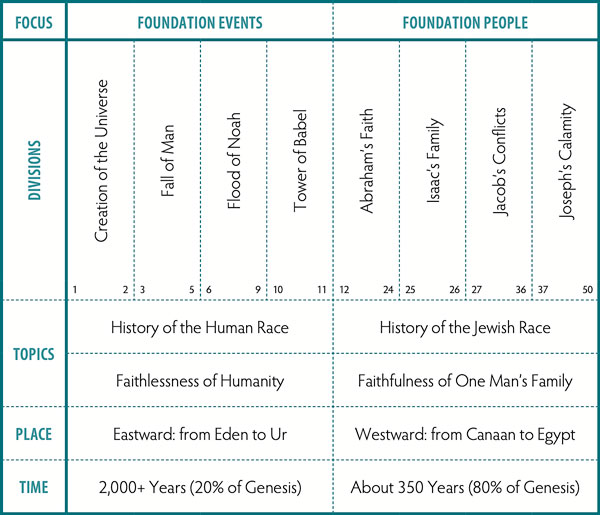
January 1
Genesis 2:4-25

Overview
The first two chapters of the Bible begin at “the beginning.” Chapter 1 gives a concise overview of the progress of creation, climaxing in the creation of humanity. Chapter 2 takes a zoom-lens look at day six. There, the details emerge of how God’s image-bearers were created—man from the dust of the ground and woman from his rib. The stage is set, the characters are in place, and the drama can begin.
Your Daily Walk
“When all else fails, follow the directions.” That tongue-in-cheek advice is based on a law as universal as gravity—the Law of Design, which states: “Things work well when they function according to the way they were designed; they work poorly (or not at all) when that design is violated.” God, the Master Designer, made the water, sky, and land; then He made creatures suited for each environment. So it should not surprise you to discover that birds make terrible submarines, or that fish can’t climb trees.
The same design apparent in both the solar system and the desert flower is built into humans and their relationships. The husband is the head of the home and the spiritual leader of his family; the wife is his helper. When we follow God’s design for marriage, there is harmony, and He is glorified.
See how many ways you can complete this sentence: “By God’s design, I am __________.” If you get stuck, consult Psalm 139:14; 1 Corinthians 11:3; Ephesians 2:10; 5:21–6:9; Titus 2:14. With God’s help, you can become all you were created to be.
Insight - Big Questions, Bigger Answers
The first verse in the English Bible uses only 10 words to answer four of the most basic questions that thinking individuals ever ask: (1) What is there? (2) How did it get there? (3) Did it have a beginning? (4) Who or what is responsible? The answers have been graciously supplied by the only One who was there at the time. (The correct answers are: (1) the heavens and the earth; (2) it was all created; (3) yes; (4) God.)
____________________
January 2
Genesis 3

Overview
The perfect environment into which Adam was placed is now shattered by the entrance of sin. Satan, posing as the subtle serpent, challenges God’s only prohibition on Adam and Eve’s use of the garden. Disobedience follows as the first family eats from the forbidden tree and is expelled from Eden. The results of their sin are devastating, as humanity and the whole creation fall under the penalty of death. Cain becomes the first murderer, and the downward spiral continues from Adam to Noah, paving the way for God’s sweeping judgment upon the wickedness of the world
Your Daily Walk
Have you ever seen an advertisement for a new “miracle product,” then gone out and bought it, only to discover it fails to live up to its billing?
Satan has been overselling his “product”—sin—for thousands of years. He first tried this approach with Eve in the Garden of Eden. Notice the promise: “God knows that when you eat of it your eyes will be opened, and you will be like God, knowing good and evil” (3:5). Eve believed his claim and tried his product. The result? Pain, bitter disappointment, expulsion from the garden, separation from God, death.
Where has Satan tested your resistance to temptation? What are some of the false promises he wants you to believe to sell you on sin? “If it feels good, it must be right. Everyone else is doing it, so it must be OK. It won’t hurt to do it just once.”
When tempted today to fall for one of Satan’s false promises, respond instead with this scriptural promise from James 4:7— “Resist the devil, and he will flee from you.”
Insight - Same Scheme, Different Results
Compare Genesis 3 with Matthew 4:1-11, and you’ll notice an interesting fact. Satan tempted Jesus in the same three ways that he tempted Eve (lust of the flesh, lust of the eyes, and pride of life; see 1 John 2:16). But in Jesus’ case, Satan failed on every count.
____________________
January 3/4
Genesis 6

Overview
In the course of its rebellion, humanity becomes so sinful that God prepares to execute the death sentence on the entire race. In grace, He directs Noah—a righteous man who walks with God—to build a great barge-like ship to escape the coming judgment. Noah obeys God, and while the floodwaters purge the earth, the ark preserves human and animal life for a fresh start. After a safe landing “on the mountains of Ararat” (8:4), God gives new directions and makes new commitments to Noah and his descendants, saying: “I will remember my covenant” (9:15).
Your Daily Walk
Just imagine: “You say you get tired of waiting for God to right the wrongs in your day? Maybe you should quit your job and sign on with Noah & Sons Shipbuilders. They’re short of help, and you will be welcome if you know anything about building triple-decker cargo ships. Nobody’s ever tried this kind of thing before. But Noah is convinced God told him to do it. Says he’s working against a deadline too.
“The contract calls for 120 years—no more, no less. Ol’ Noah figures the Lord wants to give people another chance to turn back to Him. God’s not in any hurry. That’s because He’s long-suffering. But the Lord won’t wait forever. When the time comes, it’s going to get really wet around here. God always keeps His word—and just at the right time too.
“You can start by sawing those gopher logs into planks…”
Make a list of the faith-inspired steps of obedience that Noah took in chapters 6–9. Noah obeyed God by picking up a hammer and a saw. What is God asking you to do today to join Noah’s faithful ranks?
Insight - When Came the Rainbow?
God decreed the rainbow to be a tangible sign of His promise never again to destroy the earth by flood. However, Scripture does not indicate whether the rainbow had previously existed and was then chosen by God as a sign, or whether it was a new phenomenon, suggesting a changed climate after the flood.
Genesis and Exodus
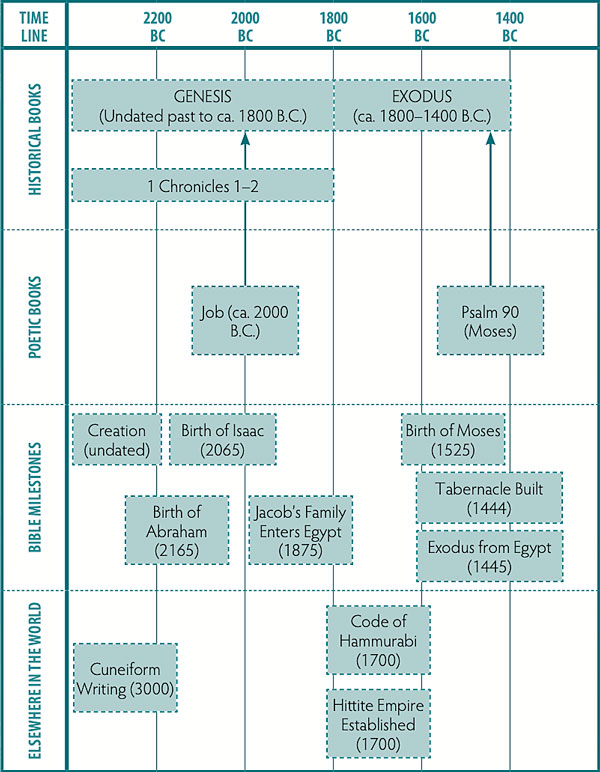
____________________
January 5
Genesis 11:1-9, 27-32

Overview
Chapters 10–11 explain the origin of nations after the flood. Beginning with Noah and his three sons, God repopulates the world. But since the root of sin has not been removed from the hearts of the people, the fruit of sin becomes apparent once again in proud, disobedient actions. So God scrambles the languages, causing humanity to disperse over the face of the earth—as He had initially been commanded. After describing generations of self-serving humans in general, the narrative shifts to one man in particular—Abram—from whom God will build a new nation.
Your Daily Walk
What’s so crucial about obeying God? He’s patient and forgiving. And He will always give you another chance. Right?
Think back over the opening chapters of Genesis. In the Garden of Eden, God gave Adam and Eve a forest of trees to enjoy and only one tree to avoid. What happened? They ate fruit from the forbidden tree and were promptly evicted.
After the flood, God gave Noah’s descendants one command: “Be fruitful…and fill the earth” (9:1). How did they respond? “Let us build ourselves a city, with a tower that reaches to the heavens, so that we may…not be scattered over the face of the whole earth” (11:4). Once again, judgment followed disobedience.
God’s commands are not to be analyzed, debated, or disregarded. They are to be obeyed. If you believe that, complete this sentence: “I will save myself some grief if I obey God today [how?].”
Insight - 4,000 Years After Babel
How many languages are there in the world today? According to Wycliffe Bible Translators, there are almost 7,000, with about 500 of them with a complete Bible translation. Today, nearly 2,000 language groups don’t have a single verse of Scripture available in their languages. These groups are mainly in these three areas: Central Africa/Nigeria; Mainland and Southeast China; and Indonesia/Pacific Islands. (source: www.wycliffe.org)
____________________
January 6
Genesis 12:1-9; 13:14-18

Overview
Chapters 12–14 describe God’s call of Abram to leave his home in Ur and then again in Haran (both in modern-day Iraq) and travel to a distant but unspecified new land. Abram faces many potential distractions along the way: the death of his father in Haran, a severe famine, and the worldly pursuits of his nephew Lot. But God is looking for a man of faith who will trust Him completely to keep His promises. For Abram and his descendants, those promises include receiving a great name, becoming a great nation, and experiencing great blessings in the face of impossible odds.
Your Daily Walk
How much room have you allowed in your life for God to redirect your steps?
Close your eyes and imagine for a moment that you are Abram. God has just told you to pack your belongings and prepare to move. “Move where?” you respond. “To a place I’ll show you at the proper time.” So you obey. You quit your job, load up your furniture, pack up your family, and head out of town. Destination: Unknown! If this sounds far-fetched, reread the opening verses of chapter 12. That is precisely the challenge Abram faced.
Suppose God told you to do something that just didn’t fit into your own master plan for your life. Would you be willing to respond by faith and trust Him one step at a time—for finances, a place to live, a new church, a new circle of friends? During a quiet moment today, take a walk and get alone with God. Be candid with Him. If you’re available, tell Him so. If you’re not but you want to be, tell Him that too. Then relax and let Him lead.
Insight - Walking in Abram’s Sandals
While Abram’s faith was growing, so was his stamina. After walking 600 miles from Ur to Haran, Abram set out at the age of 75 for the land of Canaan, 400 miles away. He later made a 400-mile round trip to Egypt for a total of 1,400 miles.
____________________
January 7
Genesis 15

Overview
Today’s reading describes the Abrahamic covenant as it was given by God, confirmed, and symbolized. God’s promises to Abraham are given in great detail, confirmed with a unilateral treaty, repeated, and established by the sign of circumcision. But as the years pass with no evidence of fulfillment, Abraham acts in foolish impatience. The result is a son, Ishmael, who will cause his father's heartbreak, constantly reminding Abraham of the price of his unbelief.
Your Daily Walk
How would you spend today if you thought you might have no tomorrow? For Abram, this was more than an academic question. With his little army of 318 men, he had just thrashed a band of warring kings, rescued his nephew Lot, and brought back the kidnapped people and goods. Now, in the long, lonely night hours that follow, he is scared. Scared that his enemies might return to continue the battle. Scared that his life might be snuffed out while he is yet childless.
In his moment of deepest need, with fear eating away at his faith in God, he hears a voice: “Do not be afraid, Abram. I am your shield” (15:1). God surrounded Abram with His presence, removed Abram’s fears, and confirmed His promise. And Abram “believed the Lord” (15:6).
What fear paralyzes you most often? Fear of failure? Fear of the unknown? Write it down, along with the words of Genesis 15:1. Thank God that He can—and will—exchange that fear for His strength and comfort.
Insight - Hagar’s Treatment—Abusive or Acceptable?
After 10 years of fruitless waiting for a son, Sarah offered Abram her personal Egyptian maid, Hagar, hoping to produce a son by her. The Hurrian laws from that period describe this as a customary practice. If a son was born, he was regarded as the wife’s. But the painful lesson from Ishmael’s birth is clear: God’s will is done in any way, but God’s way is not God’s will.
____________________
January 8
Genesis 18

Overview
Chapters 18–20 relate to crises in the lives of two of Abraham’s family members: his wife, Sarah, and his nephew, Lot. Lot’s life of compromise and worldly pursuits stands in stark contrast to the life of faith demonstrated by his uncle. In response to Abraham’s fervent prayers, God spares Lot while destroying his hometown for its wickedness and perversion. Yet, even a man of faith like Abraham can stumble when he takes his eyes off God. On a trip to Gerar, Abraham lies about his beautiful wife, Sarah, calling her his sister to save his own skin from King Abimelech.
Your Daily Walk
Try to imagine the most difficult miracle God could ever perform. If you were to select “The Miracle of All Time,” what would it be? Jot down what comes to mind.
How does your miracle compare with the one described in 18:9-15? God promised Abraham and Sarah a son. At first, that may not appear very spectacular, but consider the obstacles. Abraham was 99 years old at the time, and Sarah was 90. For her whole life, Sarah had never been able to bear children and was now beyond childbearing years. Yet even the time of Isaac’s birth was appointed by God. No wonder God asked: “Is anything too hard for the Lord?” (18:14).
If you could ask God for one miracle today, what would it be? Help you overcome a past failure? Conquer a dismal self-image? Rebuild a shattered marriage? Write that miracle in the margin of your Bible next to Genesis 18:14, and daily remember the truth that God specializes in impossible cases.
Insight - Where Is Sodom Today?
After its destruction by burning sulfur (19:24-28), Sodom is never mentioned again in the Bible as an occupied city. Today, locations at the southern end of the Dead Sea stand out in satellite photos because of their white ash content. Round balls of nearly pure sulfur were found embedded in the ash.
___________________
January 9
Genesis 21:1–22:19

Overview
The climax of more than 20 faith-stretching years for Abraham and Sarah comes in the birth of Isaac, their miracle son and heir. But soon Abraham’s faith is tested again as God calls upon him to sacrifice that treasured son upon an altar. Abraham obeys, showing that the experiences of the past two decades have not been in vain. For his faithfulness to the point of death, God rewards Abraham with further assurances of blessing. In the closing years of Abraham’s life, a time saddened by Sarah’s death, one crucial detail remains: finding a suitable bride for Isaac.
Your Daily Walk
Have you ever wished you had a timer that would tell you exactly when God would fulfill His promises in your life? A way to tell with assurance when your prayer would be answered for a helpmate, the salvation of a loved one, or the end of an extended illness? Abraham must have wished for such a timer on many occasions as he waited year after year for the son God had promised to give him. But in the birth of Isaac, God demonstrated that, though His promises may not come speedily, they will come certainly. “At the very time God had promised him” (21:2), He fulfilled His long-standing covenant.
It’s easy to impose your own preconceived timetable upon God’s promises … and difficult to deal with the frustration and anxiety that result when God doesn’t answer “on time” according to your expectations. Try this instead: Memorize Genesis 21:1-2. Let the words remind you throughout the day that the timing of the Creator of time is always perfect.
Insight - The Issue Was Obedience
God’s command to Abraham to offer Isaac did not mean God was condoning human sacrifice (a common pagan practice in Abraham’s day). Rather, God was testing Abraham’s faith in His covenant promises. Check Hebrews 11:17-19 and James 2:21-23 for added insight into this event.
____________________
January 10-11
Genesis 25:19–26:5

Overview
The story of Isaac continues, focusing on his family and work. Though Abraham has died, God’s promises to him live on in his son Isaac and his twin grandsons, Esau and Jacob. Sin, too, lives on—as demonstrated by Jacob’s theft of his brother’s birthright (Genesis 25:33) and by Isaac’s imitation of his father’s deception (Genesis 26:7). Despite human failings, God’s covenant remains sure, as He says to Isaac: “I will…confirm the oath I swore to your father Abraham” (26:3).
Your Daily Walk
“God has no grandchildren.” This means that each generation must be personally related to God by faith. It’s not enough that your parents trust Christ as their Savior; you must commit yourself. It is a personal, individual decision. You become a child of God by faith in Christ. So do your children and your grandchildren. Seen that way, it’s clear that God has no grandchildren.
And so it is with the promises of God. Each succeeding generation must learn to receive and rest in them personally to enjoy their benefits. God has promises for you today that Christians have been claiming for centuries.
Check up on your relationship with Christ. Is it strictly firsthand, based on personal faith in Christ’s finished work on the cross? Or are you relying on secondhand knowledge from your parents, your church, or your friends to get you through? You can become a child of God right now by believing on His Son (John 1:12). Then you can discover the joy of finding God’s timeless promises true in your own life. But the choice is yours. God said, “I will …” What do you say?
Insight - A Family Tradition
The cave of Machpelah, near Mamre, was originally purchased by Abraham from Ephron the Hittite as a tomb for Sarah. It would soon become the burial place for Abraham himself (25:9); Isaac, Rebekah, and Leah (49:30-31); and Jacob (50:13).
____________________
January 12
Genesis 27, 29

Overview
Chapters 27–31 introduce the third major character of the patriarchal era: Jacob (“he grasps the heel”, “supplanter,” or “deceiver”), a man who lives up to his name. The theft of the family blessing intended for his twin brother, Esau, demonstrates his scheming character. But it is through Jacob that God’s promises—made more than a century and a half earlier—begin to be fulfilled to a greater degree. During a 20-year stay in Haran, Jacob works for one wife and gets three more in the bargain, fathers 11 sons and a daughter, and amasses huge quantities of livestock and servants—the nucleus from which God will fashion a new nation.
Your Daily Walk
For every Jacob, you’ll usually find a Laban. For every individual who insists on doing things his own way, giving God a helping hand, there is often a painful head-on collision with someone who is at least his equal as a schemer.
Laban became God’s rod of discipline in Jacob’s life. There’s no doubt God was accomplishing His purpose with Jacob despite his stubbornness and conniving (28:15), but Jacob could have spared himself 20 years of grief if he had learned to wait on God.
Have you noticed “The Laban Principle” at work in your own spiritual life? A family member, a fellow employee, or a creditor may apply God’s stroke of discipline. But the goal is always the same: to help you develop spiritual maturity.
Write out a one-paragraph description of what you are going to do the next time you feel like rushing ahead of God. Chances are, before the week is out, you’ll need it—and use it.
Insight - Marital Bliss…or Marital Blisters?
The wisdom of God’s original one-man/one-woman blueprint for marriage is illustrated in the sad example of Jacob’s household, where jealousy, bickering, and scheming between Leah and Rachel were regular occurrences. Refresh your memory of family life God’s way by rereading Genesis 2:23-24. Then look up 1 Kings 11:1-8 to discover another man for whom multiple wives meant multiplied woes.
____________________
January 13
Genesis 32

Overview
In chapters 32–36, Jacob the schemer becomes Jacob the servant of God. After leaving his Uncle Laban, Jacob fears the inevitable reunion with his estranged brother, Esau. But before he can be reconciled to Esau, he must first be reconciled to God. At the ford of Jabbok, he wrestles with the angel of the Lord, insisting on a blessing before he will release him. The angel assures him of God’s continued presence, and leaves him with a new name—Israel (in Hebrew, the name Israel sounds like “he struggled with God”; see Genesis 32:28)—and a permanent limp. After an emotional reunion with Esau, Jacob returns to Canaan, where God confirms the promises He made to Abraham and Isaac—promises of a large posterity and a new homeland.
Your Daily Walk
Is it possible to be a rich Christian in the will of God? That question would have brought a chuckle from Abraham or Jacob. Both men were fabulously wealthy in their day. Jacob, in particular, shows how a person blessed by God can gain great wealth in the world. His own personal testimony is found in 32:10: “I am unworthy of all the kindness and faithfulness you have shown your servant. I had only my staff when I crossed this Jordan, but now I have become two groups.” When he first crossed the Jordan, all Jacob owned was the staff in his hand and the clothes on his back. Now, some 20 years later, it takes two companies of men to carry all of God’s blessings back across.
Reflect on the material possessions God has given you. Could it be that God has prospered you so that you, in turn, might be a blessing to others? If so, who are the “others” God has brought into your life for that purpose? If God brings someone to mind, write that individual’s name in the margin. Then let Jesus’ own words in Acts 20:35 spur you to action.
Insight - When God Prospers Someone, Look Out!
Beginning with nothing, Jacob amassed such wealth over 20 years that when he left for Canaan, he could afford to give his brother Esau 550 animals as a gift without straining the family budget.
____________________
January 14
Genesis 37, 39

Overview
Beginning with chapter 37, the narrative focuses on the next generation: Joseph, dreamer of dreams. Though the favorite son of his father, Jacob, Joseph alienates himself from his brothers by his forthrightness. Envy grows into hatred, until finally the brothers sell him into slavery. Taken to Egypt, Joseph continues to suffer injustices, first at the hands of Potiphar’s wife, and later from the forgetful chief butler. While Joseph is resisting the temptation of immorality, his brother Judah falls prey to the same sin. Clearly something is needed to insulate the chosen family from moral corruption for the next four centuries while it multiplies into a mighty nation.
Your Daily Walk
“I know some of the things I do to be accepted by my friends are wrong. But if I don’t go along, they’ll laugh at me.”
Joseph could relate to that statement. He learned firsthand the consequences of doing what was right. He could have avoided much discomfort by deciding to disobey his father or to give in to Mrs. Potiphar. Loyalty to his convictions carried a price tag.
But faithfulness had its compensations too. Note the repeated expression in chapter 39: “The Lord was with Joseph.” Which would you rather be: a guilt-ridden brother trying to explain Joseph’s disappearance, Judah trying to untangle the mess created by his lack of restraint, Potiphar’s frustrated wife, or Joseph? Only one of those individuals was truly free.
Where is compromise threatening to dull your faith? Ask God to give you the courage to stand true to Him with love and tact. Then take the next opportunity to set the record straight and make your convictions known to all parties involved.
Insight - Clothes Mark the Man
Joseph’s famous “coat of many colors” was probably an ornamented, ankle-length coat with long sleeves. It identified the wearer as a favorite son and perhaps indicated Jacob’s intent to make Joseph chief heir of the family fortune.
____________________
January 15
Genesis 41–44
Genesis 43–44

Overview
A difficult dream sent by God to Pharaoh jars the memory of the chief butler, and Joseph is soon promoted from prisoner to prime minister because of his God-given insight. The dream is a reliable forecast of the prosperity and famine in the years ahead. The worldwide famine prompts Jacob to send 10 sons to Egypt for grain, where Joseph, recognizing them immediately, proceeds to teach them a painful lesson. A series of confrontations culminates in chapter 44, where the brothers unknowingly fulfill Joseph's boyhood dreams.
Your Daily Walk
For years, Joseph’s brothers had lived with their cunning deception of Jacob. The secret was so complete that Jacob probably blamed himself for the loss of his favorite son. And the other sons, though seeing their father's agony, maintained their conspiracy of silence at his expense.
But they overlooked one witness to their crime—God. As Judah discovered: “God has uncovered your servants’ guilt” (44:16). God gave them time to set things right, then He applied pressure. The result was a band of frightened men haunted by the memory of their lost brother. Guilt, anxiety, and uncertainty were their constant companions until their wrong was set right through confession and restoration.
As a sinner in the presence of God, you have two choices. You can carry the anxiety of your “secret” sins until God chooses to expose them. Or you can confess those sins to God and to those you’ve wronged, and as a result find forgiveness and peace. Because of Jesus’ death, you can take steps today to make things right with a brother or sister, pastor or neighbor, spouse or roommate. Will you do it?
Insight - Whatever Happened to the Tribe of Joseph?
Joseph’s sons, Manasseh and Ephraim, were later “adopted” by Jacob (48:5). Consequently, the descendants of Joseph would later comprise two tribes of Israel, named respectively for his two sons.
____________________